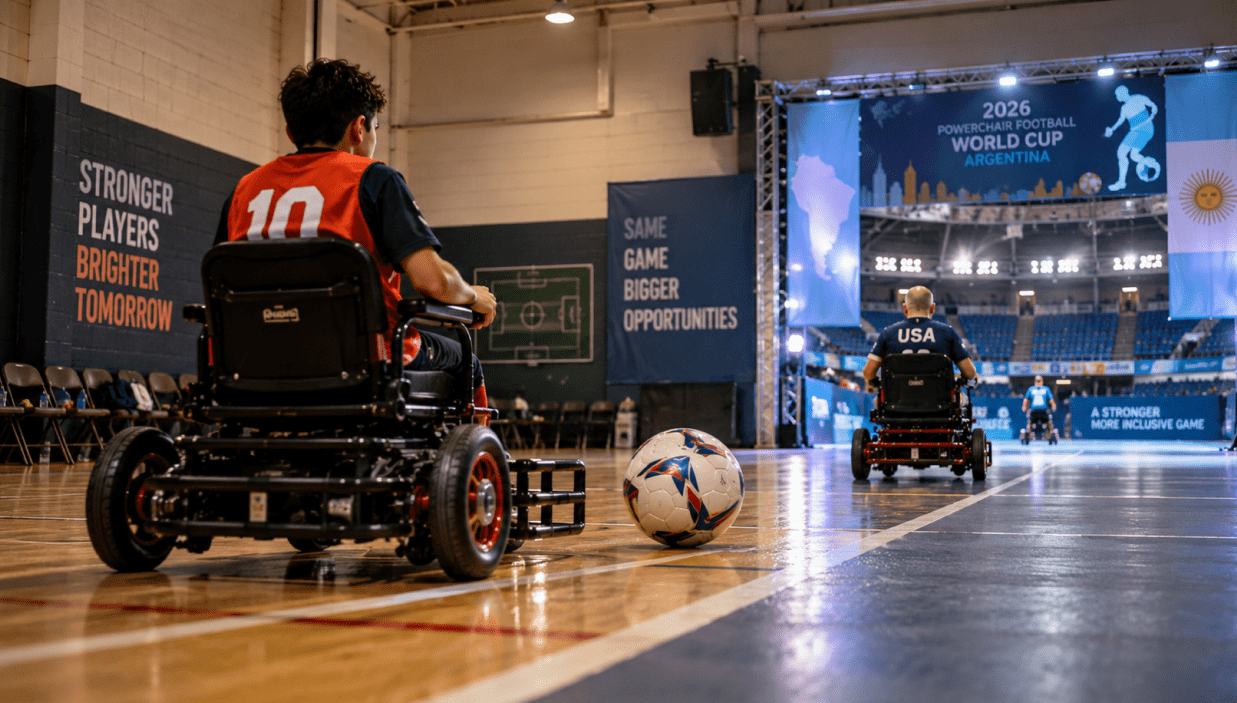
The United States will send another national soccer team into World Cup competition this October, but its players will not compete on grass and the ball will not be the familiar size used by the USMNT or USWNT.
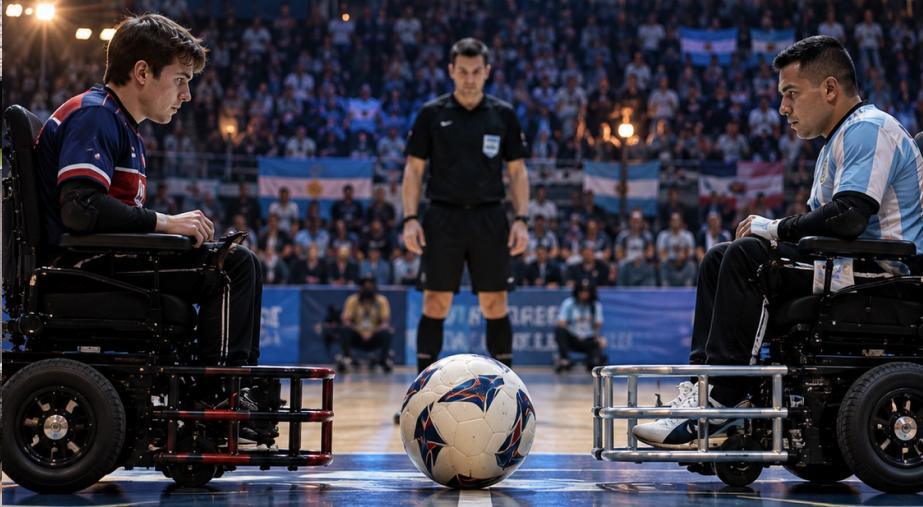
They will play four against four on an indoor court, maneuvering power wheelchairs fitted with guards around a 13-inch ball.
This is the U.S. Power Soccer National Team, and its trip to Argentina offers a revealing look at how the definition of elite American soccer is expanding.
On September 3, U.S. Soccer announced that head coach Tracy Mayer had selected 10 players for the team’s final domestic training camp before the 2026 FIPFA Powerchair Football World Cup in Buenos Aires. The camp will run September 11-15 at the Arthur M. Blank U.S. Soccer National Training Center in Fayetteville, Georgia.
The United States is not traveling to Argentina simply to participate.
It is one of the most successful countries in the history of powerchair football, having won the first two FIPFA World Cups in 2007 and 2011, finished runner-up in 2017 and taken third place in Sydney in 2023.
Now the Americans are attempting to return to the top of the world.
But the significance of this World Cup extends beyond results.
Power soccer joined U.S. Soccer’s Extended National Teams structure only in 2022. Four years later, its players are training at the same new national headquarters built to support the federation’s broader national-team system.
That raises a bigger question for American soccer: can disability soccer become a permanent and visible part of what the country means when it talks about its national teams?
Ten Players Will Gather in Georgia Before Argentina
The immediate focus is preparation.
Mayer called 10 players to Fayetteville for the September camp, the team’s fifth gathering of 2026 and its final scheduled preparation before traveling to Argentina.
The group includes goalkeeper Nathan Mayer; centers Jordan Dickey, David Dowling and Riley Johnson; wings Jada Cano, Alexis Heer, Lindsay Muench, Michael Rayton and Pete Winslow; and striker Zach Dickey.
Seven of those players were members of the American squad that competed at the 2025 APFC Americas Cup.
U.S. Soccer says eight rostered World Cup players and two alternates will participate in the camp, giving the coaching staff one final opportunity to refine details before international competition.
The location is significant too.
This is not a temporary gym rented specifically for a disability national team.
The camp will take place inside the federation’s new national headquarters.
That distinction helps explain why the story matters beyond one tournament.
Power Soccer Is a Different Version of the Same Competitive Idea
Power soccer is the first competitive team sport developed specifically for power wheelchair users.
The U.S. national team includes male and female athletes whose disabilities can include muscular dystrophy, cerebral palsy, multiple sclerosis and quadriplegia, among other conditions.
Matches are played indoors on a regulation basketball court.
Each team has four players on the court, including the goalkeeper. Players use power wheelchairs equipped with protective footguards to control, pass and strike an oversized 13-inch soccer ball.
The movement looks different from conventional soccer, but many of the underlying competitive concepts are familiar.
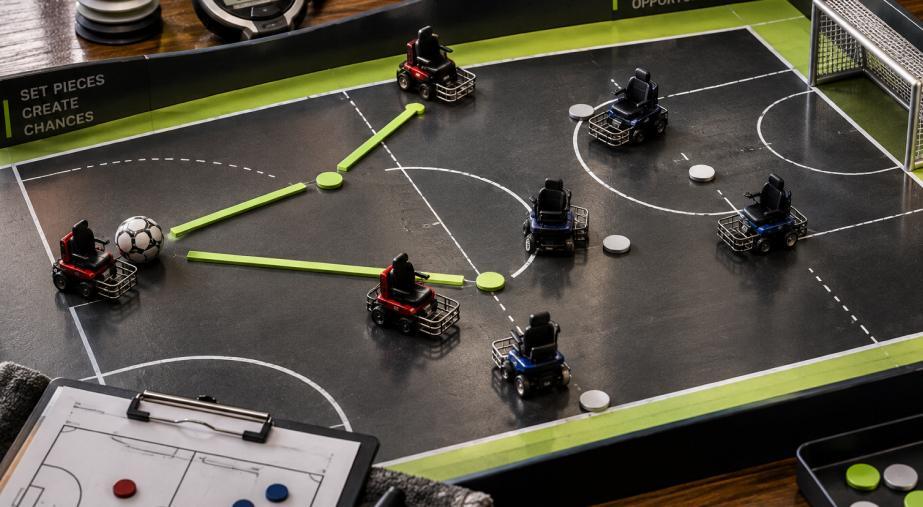
Teams need spacing.
They create passing angles.
They defend collectively.
Set pieces matter.
Positioning matters.
Decision-making speed matters.
Players must understand how to create space while simultaneously preventing an opponent from exploiting it.
Power soccer should therefore not be viewed simply as conventional soccer modified until athletes with disabilities can participate.
It is its own highly developed competitive discipline.
The international governing body FIPFA organizes the World Cup and oversees the global development and rules of powerchair football.
For the United States, Argentina represents the fifth World Cup in a sport where the national team already has significant history.
The USA Has Never Finished Outside the World Cup Top Three
The American record changes the competitive expectations.
The United States won the inaugural World Cup in Tokyo in 2007.
It repeated as champion in Paris in 2011.
When the tournament came to Kissimmee, Florida in 2017, France defeated the United States in the final.
Then came Sydney in 2023.
The Americans finished third after defeating Argentina 2-1 in the third-place match. Alexis Heer scored both U.S. goals.
Across 11 matches at that tournament, the USA went 8-2-1, scored 23 goals and recorded five shutouts.
The team therefore has a remarkably consistent World Cup history: champion, champion, runner-up, third place.
Argentina is the opportunity to begin climbing again.
Riley Johnson Gives the Team an Experienced Center
One of the central figures in that attempt will be Riley Johnson of St. Cloud, Minnesota.
Johnson has been named U.S. Soccer’s Power Soccer Player of the Year in 2023, 2024 and 2025, making him the only winner since the award was introduced.
His 2025 season was particularly important.
Johnson started all nine U.S. matches and scored eight goals. Seven came during the APFC Americas Cup, where he won the Golden Guard as the tournament’s leading scorer.
His biggest contributions came when qualification for Argentina was at stake.
Johnson scored the winning goal against Argentina during the group stage, converted the decisive stoppage-time penalty against Brazil in the semifinal and then scored the only goal when the United States defeated Argentina 1-0 in the final.
The victory delivered a third consecutive regional championship for the United States.
It also demonstrated that the American team heading to Buenos Aires has already succeeded under tournament pressure.
The World Cup Field Will Test That Experience Quickly
There will be little time to settle into the tournament.
According to the latest U.S. Soccer World Cup preparation update, the United States begins its nine-match round-robin schedule against Australia on October 17.
Among the later opponents are France on October 19, host Argentina on October 20 and England on October 21.
Those names carry history.
France won the 2017 World Cup and again defeated the United States during the 2023 tournament.
England eliminated the Americans 1-0 in the 2023 semifinal.
Argentina then lost to the United States in the third-place match and has subsequently faced the Americans repeatedly in continental competition.
The schedule therefore gives the USA opportunities to measure itself directly against several of the countries that have shaped its recent international history.
The 2023 World Cup Showed How Tactical Power Soccer Can Become
The American performance in Sydney also demonstrated how specialized elite power soccer has become.
The USA scored 23 goals across its 11 matches, but its success was not based simply on shooting volume.
Set-piece execution was particularly important.
Pete Winslow finished the tournament with 15 assists and 17 total goal contributions, meaning he was involved in 74 percent of the team’s goals.
Heer led the United States with six goals.
Jordan Dickey and Riley Johnson scored five each.
Those numbers show how different roles combine inside the sport.
Passing specialists, finishers, defensive positioning and coordinated set plays can determine matches just as clearly as individual skill.
That tactical depth is one reason increased visibility matters.
An audience seeing power soccer for the first time may initially focus on the wheelchairs.
An audience that continues watching begins focusing on the soccer.
Joining U.S. Soccer in 2022 Was a Structural Turning Point
The American team existed well before it became part of the federation.
Power soccer had operated independently in the United States since the first international era of the sport in 2007.
That changed in 2022, when the Power Soccer National Team joined U.S. Soccer’s Extended National Teams program.
The 2023 World Cup was therefore the first edition in which the team competed under the federation’s umbrella.
That institutional change matters because national-team development depends on more than uniforms and tournament entries.
Elite programs require coaching.
They require sports science.
They require travel planning.
They require accessible facilities.
They require administrative support.
They need regular camps and international competition.
Most importantly, athletes need to know that their national-team pathway is treated as a genuine high-performance environment.
The development of the Arthur M. Blank National Training Center makes that commitment much more tangible.
Read about other topics in our website like: U-20 Women’s Roster Shows USA Pathways.
The New National Training Center Was Designed for More Than the USMNT
U.S. Soccer officially opened the Arthur M. Blank U.S. Soccer National Training Center in Fayetteville on May 7, 2026.
The scale of the facility naturally attracts attention.
It includes 13 regulation-sized natural-grass fields for senior and youth national teams.
But one of its more important design decisions involved the teams that cannot use those fields.
Power Soccer, futsal and beach soccer require different playing surfaces.
Instead of treating those needs as exceptions, U.S. Soccer incorporated them into the facility.
The center includes a dedicated court for power soccer and futsal.
The federation’s accessibility plan for the National Training Center was built around the idea that the headquarters serves all of its national teams, not only the two senior teams that attract the largest television audiences.
That represents a meaningful institutional shift.
Five Disability National Teams Trained Together in May
The September Power Soccer camp is not an isolated event at the new complex.
In May, the facility hosted the fifth annual ADAPTandTHRIVE Invitational.
Five U.S. disability national teams participated: the Men’s and Women’s Deaf National Teams, Men’s and Women’s Cerebral Palsy National Teams and the Power Soccer National Team.
The event was especially significant because those were the first national-team camps staged at the new facility after its opening.
That choice sent a clear message about how U.S. Soccer wants the complex to function.
Disability teams were not scheduled into the facility after every other program had established itself.
They were among the first athletes through the door.
The next challenge is making that symbolism translate into sustained competitive development.
Infrastructure Can Change What Elite Preparation Looks Like
For power soccer, infrastructure is particularly important.
A grass training field cannot simply be repurposed.
The playing surface must support power wheelchairs.
Access routes have to work for athletes, coaches and staff.
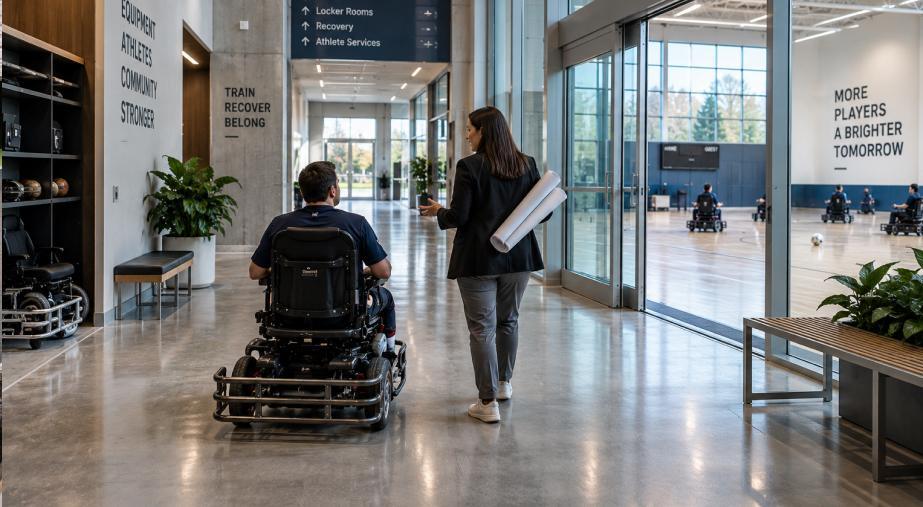
Entrances, locker rooms, medical spaces, meeting areas and recovery environments must be designed with different users in mind.
Transportation and equipment logistics also matter.
When accessibility is incorporated during initial design rather than added later, athletes can spend more of their time thinking about performance instead of navigating barriers.
That is what a national training center should accomplish.
The standard should not be whether an athlete can technically enter the building.
It should be whether the environment allows that athlete to prepare like a national-team player.
Disability Soccer Is Already Broader Than One Team
Power soccer is only one component of U.S. Soccer’s disability program.
The federation currently operates Men’s and Women’s Deaf National Teams and Men’s and Women’s Cerebral Palsy National Teams alongside the Power Soccer National Team.
The CP programs will have their own major international moment this October.
The 2026 IFCPF Cerebral Palsy World Cup will be held at the Fayetteville training center from October 12-24, marking the first IFCPF World Cup staged in the United States.
Twenty national teams from six continents are expected across the men’s and women’s competitions.
The U.S. Men’s CP team will face Canada, Scotland and the Netherlands in its group.
The U.S. Women’s CP team will meet Finland, Kenya and Japan.
That means October 2026 will provide an unusual concentration of disability soccer at the international level.
While the Power Soccer team competes in Argentina, two other American disability national teams will be playing World Cup matches at the federation’s own headquarters in Georgia.
Visibility Is the Next Challenge
Building programs is one step.
Making people aware of them is another.
The USMNT and USWNT operate in an enormous sports-media ecosystem.
Their rosters, injuries, coaching decisions and results generate national coverage.
Extended National Teams operate on a much smaller scale.
Many American soccer supporters could name dozens of senior men’s and women’s internationals but would struggle to identify Riley Johnson, Alexis Heer or Pete Winslow.
That is not a reflection of the athletes’ competitive record.
The Power Soccer National Team has one of the strongest World Cup histories of any American soccer team.
The gap is visibility.
Closing it will require more than occasional stories before major tournaments.
World Cups Can Create Entry Points for New Audiences
International competition gives disability soccer a particularly useful platform.
A World Cup provides immediate context.
Supporters understand national teams.
They understand group matches, rivalries, semifinals and finals.
They understand the significance of representing a country.
Power soccer can use that familiar structure to introduce audiences to an unfamiliar discipline.
The first time a supporter watches, the equipment may be the most noticeable feature.
Then the patterns emerge.
Passing.
Defending.
Rotations.
Set plays.
Positioning.
Goals.
Pressure.
That progression from curiosity to sporting understanding is important.
Disability sport grows stronger when audiences do not watch solely because athletes have disabilities.
It grows when people become invested in the competition.
The Domestic Pathway Matters as Much as the National Team
An elite national team cannot exist sustainably without a domestic base.
The September roster illustrates that connection.
Players arrive from clubs including Minnesota Shockwave, RHI Sudden Impact, Turnstone Flyers, STRAPS Scorpions, San Jose Flash and Auburn PSC.
Those organizations are the environments where national-team players develop and compete outside international camps.
A stronger national program can increase visibility for those clubs.
A stronger club network can produce more national-team players.
The relationship has to operate in both directions.
That is particularly important in an adaptive sport where geography, specialized equipment, accessible facilities and travel can create significant participation barriers.
National-team success alone cannot solve those problems.
But it can make the sport easier to discover.
Integration Should Not Mean Making Every Soccer Discipline Identical
There is also an important distinction in how U.S. Soccer approaches integration.
Treating Power Soccer players as national-team athletes does not mean pretending their competitive environment is identical to the USMNT or USWNT.
It is not.
The equipment is different.
The surface is different.
The tactical environment is different.
Accessibility requirements are different.
The athlete pathway is different.
Meaningful integration therefore requires specialized support rather than standardized support.
A federation can have one national-team system while recognizing that different teams need different resources.
The dedicated Power Soccer court in Fayetteville is a physical example of that principle.
Argentina Is a Competitive Test and an Institutional Test
Results will still matter.
The United States has won two World Cups and has never finished outside the top three.
A program with that history should enter Buenos Aires with competitive expectations.
France and England remain major obstacles.
Argentina will have home advantage.
A nine-match round robin will demand consistency and roster management.
The Americans have spent 2026 preparing specifically for those demands, with the September camp serving as the final domestic checkpoint.
But another measurement will continue after the final whistle.
Will more American soccer supporters know the players afterward?
Will domestic power soccer clubs receive more attention?
Will young power wheelchair users see a clearer route into competitive soccer?
Will national-team resources continue expanding between World Cups?
Those questions determine whether Argentina becomes one tournament or another step in a larger structural change.
A Broader Definition of the U.S. National-Team System Is Emerging
For decades, discussion of American national-team soccer centered overwhelmingly on the senior men’s and women’s teams.
That picture is becoming more complicated.
Youth national teams are expanding.
Futsal and beach soccer have dedicated programs.
Cerebral Palsy and Deaf National Teams are receiving structured support.
Power Soccer now trains at the same national headquarters.
The objective should not be to pretend every program has the same audience or commercial scale.
They do not.
The more meaningful objective is ensuring that elite athletes representing the United States have professional environments appropriate to their discipline.
Power soccer provides an unusually strong case for that approach.
The United States is not attempting to manufacture credibility in a new sport.
It already has it.
Two World Cup titles, a runner-up finish, a third-place finish and another continental championship provide the competitive foundation.
What has changed is the infrastructure surrounding those achievements.
When Tracy Mayer’s team gathers in Fayetteville on September 11, the players will be preparing for another attempt at a world championship.
They will also be demonstrating what a broader American national-team system can look like.
If the investment continues beyond Argentina, disability soccer will not need to be treated as a separate story from the growth of soccer in the United States.
It will simply be part of it.