
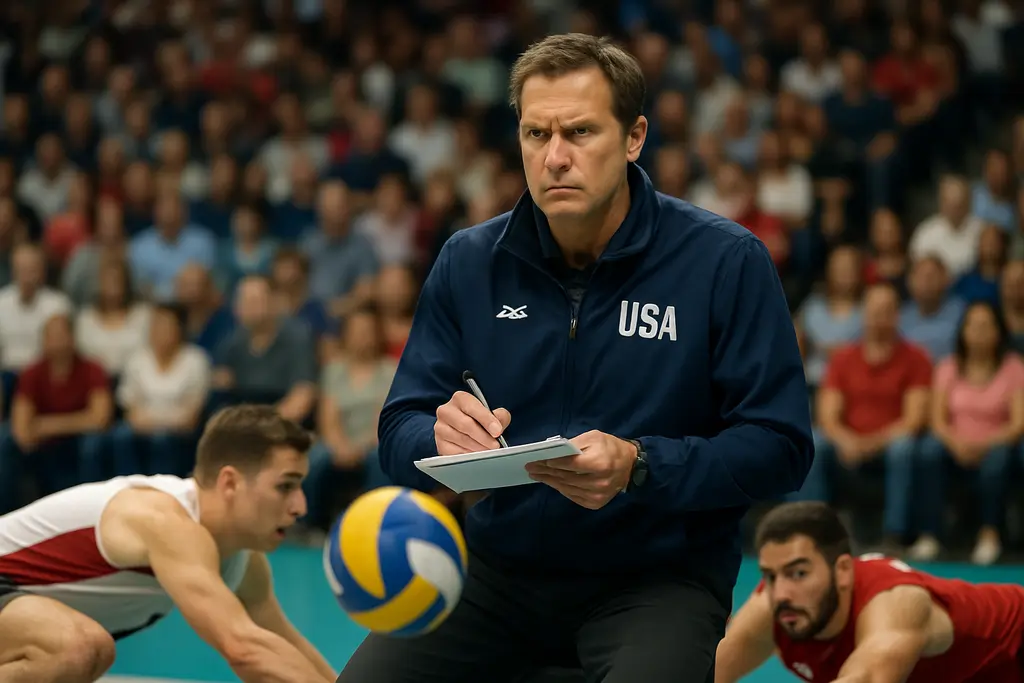
U.S. Volleyball Scouting at the 2026 NORCECA Men’s Continental Championship starts with a clear factual base: the United States entered the event in Moncton, New Brunswick, Canada, from September 11–16, 2026, with the tournament serving as a qualifier for the 2027 FIVB Men’s World Cup and part of the qualification path tied to the 2028 Los Angeles Olympic Games, according to the USA Volleyball event listing. Through the confirmed pool-play record in the research, the U.S. had handled Guatemala and the Dominican Republic in straight sets before beating Cuba in four sets on September 13.
U.S. Volleyball Scouting At NORCECA
U.S. Volleyball Scouting Notes From Pool Play
U.S. Volleyball Scouting in this event is less about one isolated result and more about what the sequence of matches shows. The opening win over Guatemala, 25–13, 25–13, 25–11 on September 11, gave the U.S. staff a clean start against a lower-resistance opponent. The September 12 sweep of the Dominican Republic, 25–17, 25–15, 25–19, followed a similar pattern: control, scoring separation, and no need for a fourth set. Those matches matter because high-level tournament volleyball often rewards teams that preserve legs, limit extended rotations, and avoid emotional swings early in pool play.
The Cuba match on September 13 provided a different scouting read. The United States lost the first set 19–25, then responded 25–23, 25–18, 25–14. That match offered a sharper look at in-match adjustment. A team can look balanced in sweeps, but the stronger evidence comes after pressure arrives. Against Cuba, the U.S. attack outscored Cuba 51–40, Jake Hanes led the U.S. with 27 points on 23 kills and four blocks, blocks and aces were level at 9–9, and the U.S. gained 25 points from Cuba errors compared with 22 conceded the other way, as reported by NORCECA’s match report.
What Pool Play Confirmed
Attack Depth And Match Control
The most valuable pool-play indicator was not simply that the U.S. went 3-0 in the confirmed pool matches. It was how different types of wins arrived. Guatemala and the Dominican Republic were handled in straight sets, while Cuba forced a response after winning the first set. That mix gives analysts a better range of evidence than three identical scorelines would have provided.
For U.S. Volleyball Scouting, Hanes’ 27-point match against Cuba is a central data point. His scoring line showed volume and finishing weight from the opposite role, but the broader picture is that the U.S. attack had enough support to stretch Cuba beyond one defensive answer. The 51–40 attack-point edge suggests that the United States created more terminal offense over the full match, even though Cuba opened better and kept the second set tight.
The second set against Cuba, won 25–23, deserves close attention. Tournament profiles are often shaped by narrow sets that could shift bracket routes or team confidence. The United States did not run through that phase; it had to hold. From a scouting angle, that is useful information. The U.S. side showed it could absorb a first-set loss, win the tightest set of the match, then create wider margins in sets three and four.
Roster Shape And Player Profiles
Veterans Beside New Contributors
The roster note from September 2026 points to a team blending established names and newer contributors. Jeff Jendryk, listed as a 6-foot-10 middle blocker, Matt Anderson, listed as a 6-foot-10 outside hitter, Erik Shoji at libero, Cole Hartke as a 7-foot opposite, and young outside hitters Jacob Pasteur and Sean Kelly give the group a mix of experience, size, and emerging scoring options. That structure is familiar in United States volleyball history: the national team has often refreshed through collegiate and professional pathways while keeping stabilizing veterans close to the court.
Anderson and Shoji, by profile, represent continuity. Their presence gives the roster a link to previous U.S. cycles and offers reference points in reception, defensive organization, and match management. Jendryk’s middle-blocking profile adds height and front-row presence. Hartke’s 7-foot listing stands out on paper, though height alone does not define effectiveness at this level. The scouting question is always whether size turns into repeatable block touches, attack range, and service pressure under tournament stress.
Pasteur and Kelly are the developmental names with evidence from the August 23–29, 2026 NORCECA Men’s Final Six in Ponce, Puerto Rico. Pasteur led the U.S. with 14 points in the gold medal match against Canada, recording 10 kills, three aces, and one block, and he had 17 points earlier in the tournament during a five-set comeback over Canada on August 25. Kelly had 12 points in the gold medal match, with seven kills, four blocks, and one ace. Those lines suggest more than cameo value; they show production in medal-round conditions.
That matters for player development across the region. The senior team’s depth is connected to younger national-team pipelines, and the same network has tracked age-group progress such as the U.S. Boys U-17 Pan Am Cup review. For broader regional coverage in the same publishing network, visit AP Levante, which also follows sports themes with a cross-border perspective.
Final Six Lessons Carried Into Canada
Blocking, Service Pressure And Error Control
The August 2026 NORCECA Men’s Final Six gave the U.S. a useful prelude before the Continental Championship. The U.S. went undefeated at 7-0 and beat Canada 3-0 in the final on August 29 by scores of 25–15, 25–18, 25–21. The statistical profile from that final was direct: 16 U.S. blocks to Canada’s three, 31 kills to 27, and six aces to one. Those are not small margins; they identify two areas that translate well across opponents, blocking and service pressure.
Parker Tomkinson’s gold medal match line was especially clean. He went 6-for-6 on attacks and added two blocks for eight points. Middle blockers can disappear from the score sheet if passing breaks down or transition offense becomes predictable. Tomkinson’s efficiency suggests the U.S. was able to access the middle with timing and accuracy in that match.
The caution point is also in the research: the U.S. committed 23 errors in the Final Six gold medal match. A three-set win can sometimes hide that issue because serving, blocking, and sideout strength cover mistakes. Against stronger serving teams, or in a semifinal or final decided by two or three late points, that total would carry more risk. Good scouting should hold both ideas at once. The United States has shown enough firepower and net presence to control matches, but error control remains a measurable area to watch.
U.S. Volleyball Scouting should also account for the comeback element. The earlier five-set win over Canada on August 25, with Pasteur scoring 17 points, indicates that the group had already handled a longer match before arriving in Moncton. That does not guarantee future results, but it does support the view that the team has recent evidence of resilience against a regional rival.
NORCECA 2026 Meaning For The U.S. Men
A Measured Read On Potential
The U.S. men’s position in NORCECA on September 15, 2026, should be framed with care. The confirmed results show dominance in early pool matches, a meaningful four-set recovery against Cuba, and a recent Final Six title run that included a sweep of Canada in the gold medal match. Those are strong indicators. They are not the same as proof that every late-stage match will follow the same pattern.
The scouting profile is encouraging because the strengths come from repeatable volleyball actions. Blocking can travel from one opponent to the next if the scouting report is sharp and the serve creates predictable passes. Service pressure can break rhythm without relying on long rallies. Multiple scorers reduce the risk of one player carrying every high-ball swing. Hanes’ 27 points against Cuba, Pasteur’s Final Six production, Kelly’s medal-match scoring, and Tomkinson’s perfect attacking line each add a different piece.
The future value of this group depends on how these pieces hold when match conditions tighten. The U.S. will need to keep balancing veteran steadiness with younger attackers who can win points in pressure phases. It will also need to manage errors, especially if opponents serve more aggressively or force the U.S. into less comfortable first contacts. Based only on the confirmed research, U.S. Volleyball Scouting at NORCECA shows a team with regional command, credible depth, and enough recent pressure-tested evidence to merit serious attention as the 2027 World Cup and 2028 Los Angeles pathways continue.