
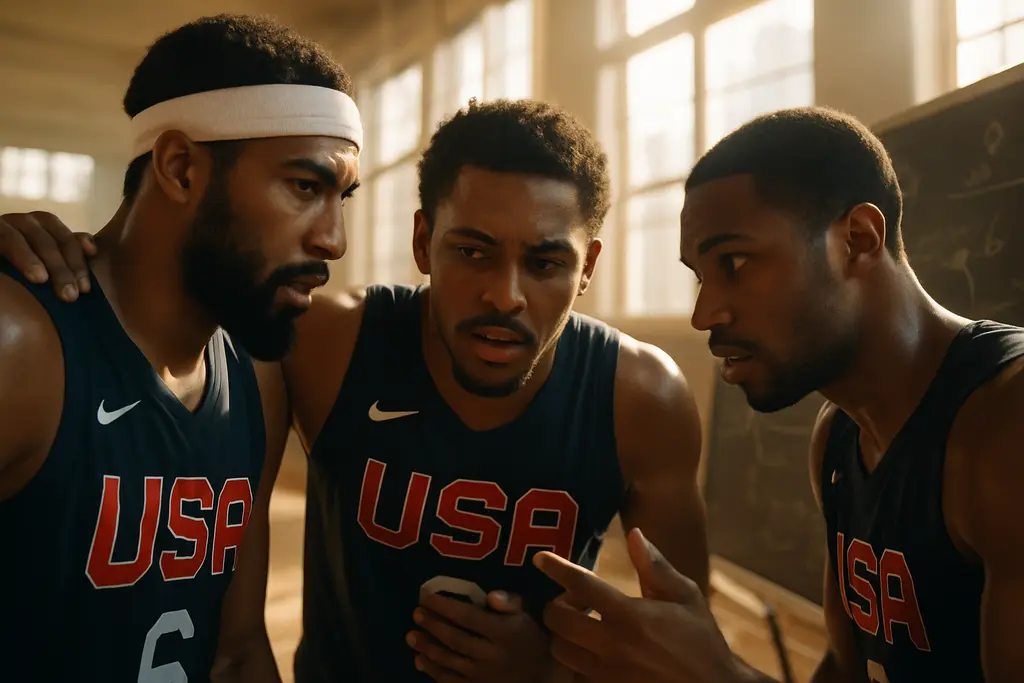
The Team USA Roster for the 2026 FIBA Women’s Basketball World Cup in Berlin is now defined by both star power and late movement. The tournament is scheduled for September 4-13, 2026, and USA Basketball’s group had its latest public update on August 31, 2026, when Sonia Citron and Kiki Iriafen replaced A’ja Wilson and Kelsey Plum after their withdrawals for health reasons, according to Yahoo Sports’ roster update.
That change matters because the original roster announced on August 6, 2026, already carried a rare mix: decorated WNBA champions, Olympic-level experience, and a large class of players making major senior global 5-on-5 debuts. The revised group still has elite talent, but it asks different basketball questions. Without Wilson, the 2022 World Cup MVP named in the research notes, and without Plum’s guard scoring profile, the balance of creation, rebounding, and late-clock shot selection deserves closer study.
Team USA Roster Structure After Late Changes
The official August 6 announcement listed a 12-player roster that included A’ja Wilson, Breanna Stewart, Caitlin Clark, Angel Reese and Paige Bueckers. It also identified Kara Lawson as head coach and Sue Bird as USA Basketball women’s national team managing director overseeing the selection process. USA Basketball also reported a striking experience base across the selected players: 58 WNBA All-Star appearances, 16 WNBA titles and seven WNBA Rookie of the Year honors among the 12 named players at the time of the announcement, per USA Basketball’s announcement.
Team USA Roster Debuts And Roles
The most important development angle is the number of first-time major global tournament players. Caitlin Clark, Paige Bueckers, Angel Reese and Aliyah Boston were identified in the research as newcomers to major senior World Cup or Olympic competition for Team USA. After the August 31 update, Citron and Iriafen joined the group as replacements, adding two more less-established senior international pieces to Lawson’s selection picture.
That does not mean the group lacks polish. Clark and Bueckers bring high-usage guard skill sets from the WNBA. Boston and Reese add interior rebounding, screening and physical presence. Citron and Iriafen change the late roster math because they enter close to the tournament start, which raises practical questions about lineup familiarity rather than questions about talent.
What Wilson And Plum Withdrawals Changed
Wilson’s absence removes a central frontcourt reference point from the original group. Plum’s withdrawal changes guard depth and perimeter scoring options. The supported fact is limited to their withdrawals for health reasons; there is no confirmed detail in the research that should be extended beyond that. From a scouting standpoint, the confirmed outcome is enough: Lawson’s staff must redistribute minutes, touches and defensive assignments without two originally selected players.
The revised roster still includes Stewart, Chelsea Gray, Napheesa Collier, Kahleah Copper and Jackie Young as experienced figures. Stewart, in particular, becomes a central stabilizer among the remaining returning players because the research identifies her as the most experienced in World Cup appearances among that group after the late changes.
Experience, Pressure, And Development Signals
The Team USA Roster also creates a useful case study in how national programs bridge generations. The established players are not merely symbolic leaders; they shape spacing, pace and defensive communication. Gray’s experience as a guard gives the team a late-game organizer. Stewart’s frontcourt skill can support lineups that need shooting, size and passing from the forward spots. Copper and Young give the coaching staff wing options with high-level professional backgrounds.
Established Core For A Short Tournament
Short international tournaments often reward teams that can settle quickly into clear responsibilities. The research does not provide game-by-game lineup plans, and it would be unsafe to project a fixed rotation before Berlin. What can be stated is that the returning core carries much of the burden for structure. Stewart, Gray, Collier, Copper and Young are named in the research as likely leadership sources, and that aligns with their place in the roster’s experience profile.
The team’s prior 2026 qualifying work also provides a verified context for several players. Team USA went 5-0 at the FIBA Women’s World Cup Qualifying Tournament in San Juan, Puerto Rico, earlier in 2026. The research notes Kahleah Copper averaged 12.8 points per game, Clark averaged 11.6 points per game, and Reese averaged 8.0 rebounds per game during that run. Those figures are not a guarantee of Berlin production, but they offer a recent baseline for how some roster pieces performed in a USA setting.
Young Guards In A Global Setting
Clark and Bueckers are central to the developmental story because both are high-profile guards entering a major senior world event for the first time. Their task is not identical. Clark’s value often starts with shooting range and passing pressure. Bueckers’ profile is tied to pace control, scoring touch and decision-making. The research does not provide shooting splits or usage rates, so any comparison should stay general and rooted in roster fit.
Citron’s addition gives Lawson another perimeter option, but her late entry means evaluation should begin with what is confirmed: she was added on August 31 as part of the revised roster. How many minutes she receives will depend on coaching choices, matchups and practice integration after the update.
Rotation Balance For Berlin
The frontcourt now leans more heavily on Stewart, Collier, Boston, Reese and Iriafen, with Copper also listed among forwards/centers in the research breakdown. This is where the biggest scouting adjustment sits. Wilson’s original presence would have given the team a proven interior scorer and defender at the center of many lineup combinations. Without her, the frontcourt becomes less about one dominant reference point and more about combinations.
Frontcourt Usage Without Wilson
Boston and Reese bring size and rebounding value, while Stewart and Collier can help the United States play with more spacing and mobility. Iriafen’s inclusion adds another frontcourt option after the late roster update. The team may have enough depth to cover different styles, but the safest framing is conditional: the group has multiple frontcourt bodies with WNBA experience, yet Berlin will test how quickly those pieces share defensive assignments and offensive spacing.
Angel Reese’s qualifying rebounding number from San Juan stands out in the research because it points to a clear transferable skill. In international play, possessions are compressed by physical defense, shorter preparation windows and fewer second chances. Rebounding can travel even when shooting rhythm varies. That makes Reese one of the more direct development cases to track.
Perimeter Choices For Lawson
The guard group listed in the research includes Clark, Bueckers, Gray, Citron, Rhyne Howard and Jackie Young. That is a deep collection of ball-handling, shooting and defensive options, but it is not self-defining. Lawson has to decide how much creation should run through veteran organization, how much should be allocated to the first-time global players, and how to balance lineups when the opponent pressures the ball.
Scouting work across sports often faces the same question: which young players are ready for a bigger assignment. For insights into player readiness and broader sports performance trends, readers can explore these topics further at Triple T Power Sports, which covers similar developmental and performance contexts.
Team USA Roster Stakes In Berlin
For the Team USA Roster, Berlin is not only a title-defense setting; it is a measurement point for the next phase of the women’s national team pool. The roster still carries a champion’s profile through Stewart, Gray, Collier, Copper and Young. It also gives major international minutes, or at least major international preparation, to Clark, Bueckers, Boston, Reese, Citron and Iriafen.
What Evaluation Should Track
The most useful evaluation should focus on verifiable basketball details once games begin on September 4, 2026: which lineups start halves, who closes close games, how Lawson pairs Gray with the younger guards, and whether the frontcourt can maintain rebounding and spacing without Wilson. The roster has enough proven quality to remain one of the central teams in the event, but the late changes make role clarity the defining scouting question before the opening game in Berlin.
This group’s strength is not only the number of honors attached to its players. It is the range of possible lineup types: veteran-led control, young guard pace, wing defense, and frontcourt combinations built around Stewart, Collier, Boston, Reese and Iriafen. The caution is just as clear. Major international debuts and late roster movement can place stress on timing, defensive calls and shot distribution. That is the basketball story to assess as Team USA moves from roster announcement to tournament play.