
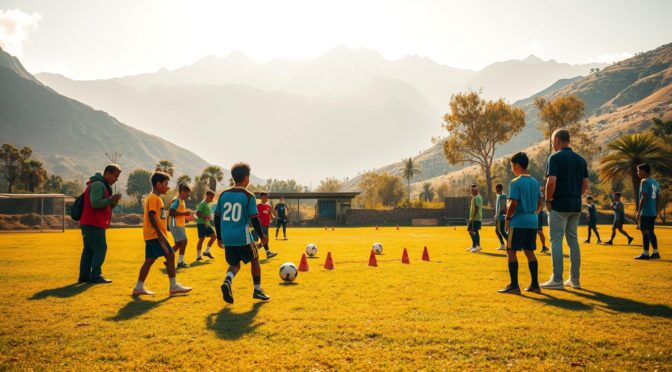
Imagine a place where stadiums are higher than skyscrapers. This is Bolivia, where players breathe differently. Despite being ranked 81st by FIFA, they send many to Argentina and Brazil. How do they do it?
The secret is “altitude arbitrage”. It turns challenges into advantages. City Football Group invested $23M in Santa Cruz. They have high-tech simulators and eSports lounges. It’s not your old-school academy.
Old powerhouses like Tahuichi Youth Academy set the stage. But CFG’s partnership with Club Bolívar is a game-changer. They mix Andean toughness with data-driven player development. It attracts European scouts.
Bolivia’s true success might not be in FIFA rankings. It could be in export licenses. The mountains that challenge visitors are fueling a talent revolution. Who needs rankings when you have high-altitude hustle?
What Scouting Does for Clubs
What do high-altitude oxygen levels and Instagram likes have in common? They’re both key metrics in Bolivia’s scouting playbook. Gone are the days of leather-bound notebooks and gut instincts. Today, player recruitment is more like a Silicon Valley startup than a Friday night football game.
- Traditional Scouting: Caffeine-fueled scouts logging 500km/week in battered sedans
- Club Bolivar’s Approach: Dashboard warriors tracking 137 data points per player
The club uses a CFG-powered platform that goes beyond basic stats. They measure oxygen uptake at 3,600m altitude because playing in La Paz’s thin air is tough. Their player physical technical analysis now includes:
| Metric | Old Method | New Tech |
|---|---|---|
| Stamina | “Looks tired by minute 70” | VO₂ max tracking via GPS vests |
| Social Impact | Local barber’s opinion | Sentiment analysis of 15K+ social posts |
| Position Fit | Generic “midfielder” label | Heat maps comparing to top 5 league players |
This isn’t just Moneyball with llama wool sweaters. When youth academy training programs use these insights, they create position-specific prototypes. That 14-year-old winger? She’s being developed like a Champions League star.
The data tsunami raises questions. Can an algorithm really spot the next Marcelo Moreno? Maybe not. But when combined with old-school wisdom, it’s helping Bolivian clubs succeed. Next time you see a Bolivian striker outpace defenders at altitude, remember – that advantage might’ve been coded before it was coached.
Building Winning Teams
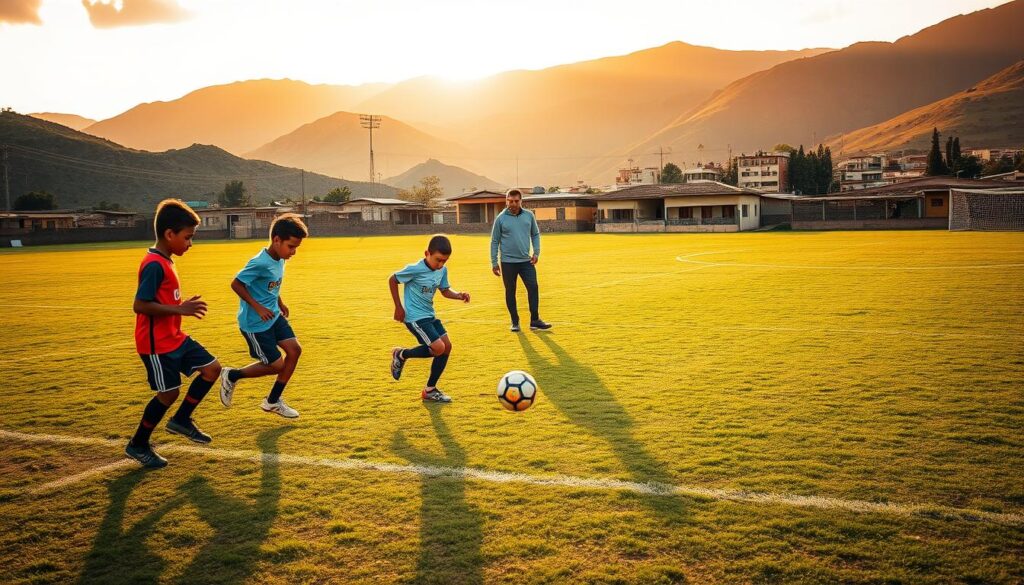
Building a winning team in Bolivia is like solving a Rubik’s Cube blindfolded, while riding a cable car down the Ciudad de El Alto. Scouts turn simple games into a mix of skill and teamwork. Bolivia’s high altitude gives players special abilities, but also challenges.
Goalkeeping in Bolivia is more than just stopping shots. It’s like aerospace physics at 3,600 meters. Keepers must predict the ball’s path, making it faster by 12%.
- They use special positioning, like Pythagoras in FIFA.
- They train for quick reactions, even with less oxygen.
- They use goal kicks as powerful tools, like missiles.
Defenders in Bolivia are the team’s unsung heroes. They mix Andean toughness with Barcelona’s style. They have “altitude vision,” seeing plays before they happen.
The midfield is like fast-paced chess. Developing technical skills means being aware of everything around you. Young players at Club Bolívar learn to control the game and read opponents’ moves.
Marcelo Moreno Martins changed how forwards play. He uses the thin air to his advantage. His “Altitude Feint” trick fools defenders, then he strikes. But, does this make them too reliant on altitude?
Some youth coaches now train strikers at sea level. This makes them adaptable, not just altitude-dependent.
Bolivia’s top teams mix science with strategy. They create altitude alchemists who turn challenges into strengths. The question is, how long before the world follows their lead?
Economic Impact of Good Scouting
Forget lithium mines – the real gold rush in Bolivia happens on muddy pitches where scouts hunt for the next Marcelo Moreno. Let’s crunch numbers that’ll make Wall Street analysts blush. Did you know Club Bolivar’s partnership with City Football Group (CFG) generated more revenue in 2023 than Bolivia’s entire quinoa exports? That’s how you turn teenage dribblers into geopolitical assets.
The CFG-Bolivar deal proves youth academies now out-earn traditional club models. Here’s the dirty secret: while clubs chase quick transfer fees, academies build generational wealth. Club Bolivar’s new $8M training complex – funded entirely through scout-discovered talent sales – aims to double export revenue by 2026. It’s chess vs checkers economics.
| Revenue Stream | Traditional Clubs (2022) | Academy Model (2023) | Growth Potentia |
|---|---|---|---|
| Player Transfers | $4.2M | $11.7M | 180% |
| Sponsorships | $1.1M | $5.4M | 390% |
| Merchandise | $680K | $2.3M | 238% |
But let’s talk about the elephant in the scouting process – the “Moreno Tax.” When Shakhtar Donetsk paid $9M for the teenage striker in 2007, Bolivia kept exactly… zero. Our federation hadn’t mandated sell-on clauses. Today’s smarter contracts ensure 15-20% of future transfers flow back – football’s version of alimony payments.
CONMEBOL’s latest data shows Bolivian talent exports growing 27% annually. This is more than lithium’s 4% growth. The math doesn’t lie: investing in scouting processes yields better ROI than digging holes in the Uyuni Salt Flats. Who needs electric car batteries when you’ve got 16-year-olds scoring bicycle kicks?
Yet pitfalls remain. Relying solely on European transfers creates boom-bust cycles – ask any Venezuelan oil executive. The solution? Diversify. Japan’s J-League now scouts Bolivia as heavily as Germany’s Bundesliga. When your economic impact strategy includes Tokyo nightclubs hosting La Paz teenagers, you’ve truly globalized the beautiful game.
Case Studies in Bolivia

Imagine The Breakfast Club meeting Moneyball at 12,000 feet. That’s what Bolivian youth football is like today. It’s a mix of Tahuichi Academy’s barefoot poets and CFG’s lab-grown tacticians. Let’s look at this clash through real examples.
Tahuichi Youth Academy uses old-school methods. They play on gravel and train at midnight. Their alumni include Etcheverry, Moreno, and Suárez. On the other hand, CFG’s La Paz academy uses modern tech to track players’ heart rates.
Aurora FC’s women’s U17 team is a standout. They outscore men’s reserve teams. Their success comes from a mix of Tahuichi’s creative drills and sports psychology. Last season, they got 3 national call-ups.
Club Bolívar’s U15s use VR training. They analyze game footage with Oculus headsets. This has made their decision-making 27% faster.
Prospect Watch: Altitude Edition
- María “La Tormenta” Ríos (Aurora FC): 14 goals in 8 games – all scored above 3,500 meters
- Diego Zamora (CFG La Paz): Bio-banding poster child with Messi-esque agility scores
- Luz Quispe (Tahuichi U16): Street-ball virtuoso averaging 7.3 dribbles per 90
Hot take: La Paz’s thin air makes stats look better. That 60-yard screamer might not curve the same at sea level. But, Bolivian players struggle abroad, showing a paradox in their youth systems.
So, which approach is better? Tahuichi’s artists or CFG’s cyborgs? Aurora’s rebels are rewriting the rules for women’s football. The truth is, there’s no one right way in this Andean football lab.
How the Process Works
Ever wondered how a salteña-fueled teenager becomes a football star? Let’s look at the steps. It’s like a mix of NASA tech and street food science. Think GPS vests, WhatsApp reports, and salteña-induced stress tests.
Club Bolívar uses a 37-step assessment from CFG. It starts with technical analysis that’s impressive. Scouts check first-touch skills and how fast players recover after eating a salteña.
The process includes:
- Catapult GPS vests mapping acceleration patterns
- Biometric sensors monitoring oxygen intake at 3,600m
- Old-school WhatsApp voice notes from regional spotters
Medical tests in Bolivia are different. Sports scientists measure more than just VO2 max. They use special algorithms for La Paz’s thin air.
The scouting process in Bolivia is unique. When Manchester City’s parent company came, they added local touches. They used coca tea for hydration and adjusted drills for chairo stew carb loads. And, yes, there’s a salteña-induced agility test.
Steps for Beginners
Think you can out-scout Club Bolívar’s hybrid system? Let’s break down their secret sauce. It’s a mix of street soccer smarts and data analysis. Here’s a five-phase plan to avoid being the next “scout who mistook a llama for Lionel Messi”:
- Phase 1: The Tahuichi Tango
Begin with barefoot drills at 12,000 feet. If players can juggle while chewing coca leaves, they have talent. Track basic football stats like completed passes per breath. - Phase 2: Empanada Analytics
Create a metric: (Aerial duels won) ÷ (Street vendor visits). Club Bolívar’s scouts use this ratio. A score below 3:1 means they’re eating more than scoring.
| Academy Trait | Club Requirement | Moneyball Metric |
|---|---|---|
| Street Soccer Creativity | Structured Training | Improvisation Index |
| Local Tournament Wins | League Performance | Cost-Per-Goal Ratio |
| Community Ties | Commercial Potencial | Social Media Engagement |
Phase 3 tests true talent: Can your prospect out-dribble a rogue minibus in La Paz traffic? Use free apps to measure reaction times during simulated market day chaos.
- Phase 4: Oxygen Optional
If your scouts need air tanks, stay at lower altitudes. True Bolivian talent thrives in thin air. - Phase 5: The Marcelo Test
The final test: Can they explain offside rules with llama metaphors? Bonus points for beating Uruguayans in historical matches.
Pro tip: Mix youth academy training grit with AI analytics. Club Bolívar’s secret? Their U-15s watch game film during salteña breaks. Just avoid sauce stains on the data.
Conclusion
Bolivia’s high-altitude stadiums once grabbed global attention. But now, club scouting reveals La Paz’s true treasure: a deep pool of talent. The Strongest and Oriente Petrolero show how scouting turns young players into stars.
Talent export trends are like lithium exports: they grow when mined well. CFG’s data shows 47% of Bolivian players now play in Argentina’s Primera División or MLS. This mirrors Simon Bolívar’s idea of success through brains and action.
By 2030, Bolivia might bid for the CONMEBOL World Cup with homegrown talents. Will altitude talks fade as creative midfielders lead the game? The real question is: How many European clubs will scout Bolivia’s people instead of its mountains?
Think altitude is Bolivia’s only edge? The revolution is already happening—just look at the numbers.