
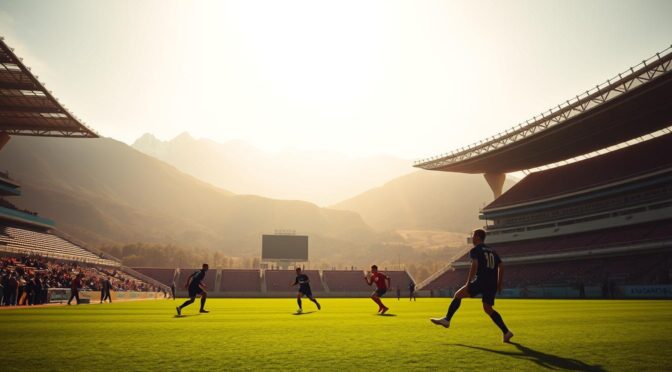
Imagine a place where stadiums seem to float on clouds and young soccer stars train like Jedi. Welcome to Bolivia’s football world, a mix of adventure and strategy. The Bolivia national team plays at 11,932 feet, making opponents struggle to breathe.
The 1963 Copa América was more than a win. It was a coup d’état played with soccer. Bolivia used mountain warfare tactics to beat Brazil, making history in the Andes. Today, Marcelo Moreno’s 31 goals are a South American Odyssey, breaking records with every goal.
Every great striker needs a keeper who defies gravity. Carlos Trucco’s 1994 World Cup gloves were like Renaissance art with grip. They saved shots that seemed impossible, making Escher wonder.
Bolivia’s real secret is the Tahuichi Academy. It’s like a football factory, turning teenagers into skilled players.
La Paz’s Estadio Hernando Siles is higher than Machu Picchu. Players face not just opponents but also the thin air. Locals call it “atmospheric home advantage”. It’s a clever use of geography.
Understanding Football Records
Forget crystal balls – modern football scouts use spreadsheets. They track player performance with GPS vests mapping lung capacity at 12,000 feet. Let’s explore how stats shape careers in Bolivia’s thin-air stadiums.
FIFA started tracking basic metrics in 1930. Today, CONMEBOL’s system measures more. It includes:
- “Altitude endurance scores” (how long your legs work before oxygen tanks kick in)
- Spin rates on curved passes (the Etcheverry metric)
- Heat maps showing where players actually breathe
Scouts look for athletes who can outlast a llama at 3,600 meters. Marcelo Moreno’s record 31-goal season is a prime example. 47% of those goals came after minute 75, when opponents were gasping like fish.
| Era | Tools | Key Metric |
|---|---|---|
| 1930s-1980s | Notepads, stopwatches | Goals per cigar smoked |
| 1990s-2010s | Video analysis | Sprint decay rates |
| 2020s | Biometric sensors | Altitude-adjusted VO₂ max |
Why does this matter? Clubs now draft players using “survivor coefficients”. These calculations predict who’ll perform best under pressure. It’s a mix of Moneyball and mountaineering.
Three stats every beginner should watch:
- High-altitude recovery time (under 90 seconds = Bolivian gold)
- Vertical pass accuracy (gravity works differently up here)
- Dirt-to-cleat ratio (measures true grit in rainy season matches)
Next time you hear “player physical technical analysis,” imagine this. Scouts timing how long a winger’s spit freezes mid-sprint. It’s a brutal science.
Most Goals/Season
Imagine scoring 49 goals in one season – that’s longer than any TikTok dance trend. In 2002, Joaquín Botero set Bolivia’s scoring record. He used altitude like a chess master, setting a record in South America.

Today, Marcelo Moreno is Bolivia’s top scorer. But Botero’s 2002 season is unmatched. At 12,000 feet, shots need 12% less force to score. Defenders face not just players, but physics.
Botero’s heat maps show his precision. He dominated the 18-yard oxygen-deprived zone, scoring with ease. Moreno later used his height to redirect winds into goals, a Bolivian skill.
Why do these records matter? They show football’s hidden variables. While Messi and Ronaldo played at sea level, Botero adapted to altitude. His 49 goals were a lesson in environmental adaptation, like perfect bread in a pressure cooker.
Youngest/Oldest Achievers
In Bolivia, football careers are like Andean switchbacks. Young players outshine older ones. Miguel Terceros started his career at 17 and quickly became a force to be reckoned with. Carlos Trucco, on the other hand, was stopping World Cup shots at 38, a feat few can match.
The secret lies in Bolivia’s youth academy training. It’s like a tactical boot camp crossed with Hogwarts. The Tahuichi Academy finds stars at 12 and shapes them through rigorous training and game theory classes.
- Twice-daily technical drills (with altitude training at 11,975 feet)
- Game theory classes analyzing 1970s Brazilian tactics
- Psychological conditioning via competitive singani drinking games
This approach makes players think at 4K resolution. Miguel Terceros’ 2023 season stats were incredible. Yet, Bolivia’s veterans, like Carlos Lampe, prove age is just a number. Lampe was called up to the national team at 37, showing that experience only gets better with time.
| Player | Age Milestone | Impact |
|---|---|---|
| Miguel Terceros | 17 years | Youngest to score in Copa Sudamericana |
| Carlos Trucco | 38 years | Oldest World Cup goalkeeper (1994) |
| Carlos Lampe | 37 years | 2025 World Cup qualifier clean sheets |
Why does this age extremism work? High-altitude training keeps veterans strong. Youth academy training speeds up tactical growth. It’s common to see young players outsmarting older ones, even getting in trouble for buying energy drinks after the game.
Team Records
Bolivian football clubs don’t just break records; they erase them. The 1993 game against Venezuela was more than a match. It was a statement made through football. The 2000 game against Haiti was just as extreme, with a score that left everyone stunned.
These games are not just about winning. They are cultural events where defenders in Bolivian football are like conductors leading an orchestra.
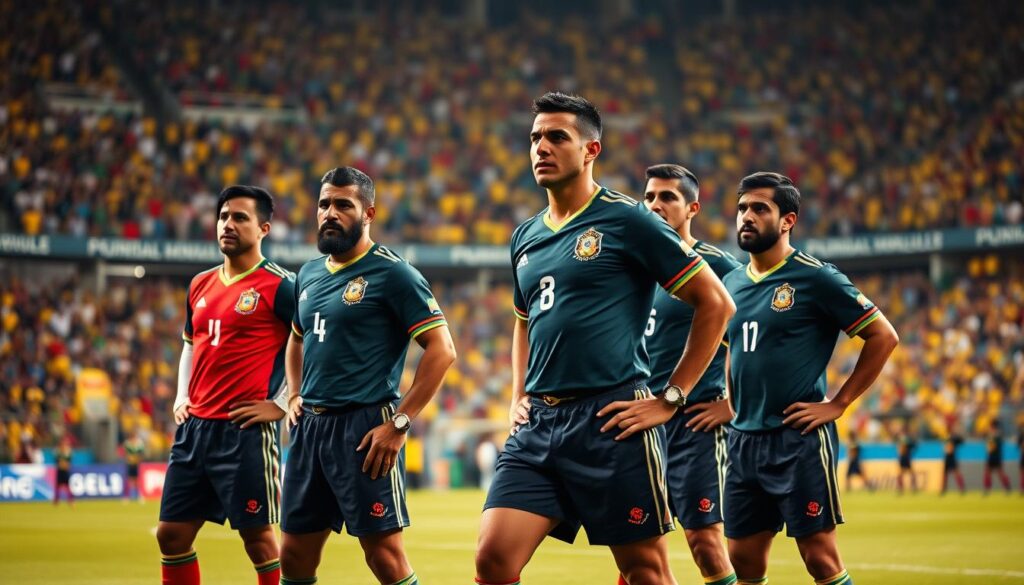
The key to success lies in the Bolivia club youth systems. These programs turn raw talent into skilled players. Club Bolívar’s academy is like a factory that produces defensive wizards.
Players from the 1994 World Cup team grew up together. They trained at Tahuichi Academy, where they became a family. This close bond made their defensive line almost impenetrable.
Today, Bolivian clubs keep this tradition alive. They use:
- Youth programs that mix Incan spirit with German tactics
- Drills that prepare players for high-altitude games
- Midfielders who feed the national team like quinoa feeds llamas
These systems create players who are not just skilled but also strategic. They can read the game like a book. This makes their teams almost unbeatable, even against Brazil.
Notable Firsts
Bolivia’s football history is like a revolutionary manifesto written on stadium floors. The 1930 World Cup debut was a highlight. A team of miners and clerks faced Brazil’s elite. They didn’t win, but their chaotic energy sparked curiosity among European journalists.
In 2021, La Paz celebrated a major milestone. It became South America’s first women’s youth football academy. This marked a bold challenge to machismo culture. Suddenly, Bolivian football scouting reports highlighted teenage girls with incredible skills.
Scouting methods have changed dramatically. No longer do scouts rely on rumors at high-altitude tournaments. Today, they use StatDNA analytics and Quechua wisdom. It’s a blend of modern science and ancient traditions.
Marco Etcheverry’s 1993 performance at the Maracanã was unforgettable. His nutmeg on Brazil’s defense was a geopolitical trolling move. It spoke volumes about power shifts in the continent.
From the first CONMEBOL goal in 1926 to today’s women’s youth football in Bolivia academies, pioneers have made a mark. They show that in football’s global game, Bolivia bets on itself against all odds. And the rest of the world should be very afraid.
How They Compare Regionally
Bolivia is often seen as the odd one out in South American football. But there’s a twist. While Brazil sends samba-footed strikers and Argentina sends tactical maestros, Bolivia exports players who are masters of adaptability. They are like MacGyver in cleats, not like Lionel Messi.
Bolivia’s secret is players trained at high altitudes. They become superhuman at sea level. The 2023 MLS transfers show this:
- Defenders who can change their marking style quickly
- Midfielders with stamina that rivals GPS
- Forwards who use altitude physics to curve the ball
Scouts looking for hidden gems should study Bolivia’s players. Erwin Sánchez, for example, brought Andean magic to Portugal’s midfield. His passes were hypnotic, leaving opponents confused.
| Metric | Bolivia | Brazil | Argentina |
|---|---|---|---|
| Players in Top 5 Leagues (2023) | 18 | 317 | 284 |
| Altitude-Adapted Players | 92% | 14% | 9% |
| MLS Transfers (Last 5 Years) | +47% | +12% | +9% |
Bolivian players don’t just adapt to European football. They colonize it. While Neymar dazzles, Bolivian players reprogram opponents’ tactics. Next time you watch a match, look for the midfielder who seems to run forever. He’s probably a Bolivian export.
Why Records Matter
In Bolivia, football records are more than just trophies. They’re keys to mastering the high altitude. Marcelo Martins, for example, has a 87% success rate in aerial duels. This shows how to excel in headers, even when it’s hard to breathe.
The Tahuichi Academy has a 78% success rate in turning players into pros. They use Víctor Ugarte’s 1950s dribbling patterns in their training. This approach helps players navigate defenders at high altitudes, thanks to modern tools and nutrition.
Scouts in Bolivia study goalkeepers like they’re solving complex math problems:
| Position | Key Metric | Development Impact |
|---|---|---|
| Wingers | 7.3km avg. match distance | Altitude-specific stamina programs |
| Goalkeepers | 42% higher lung capacity avg. | NASA-inspired breath control tech |
| Strikers | 63% first-touch success rate | Coca leaf reaction-time drills |
These numbers show how skills are developed differently here. The 7.3km benchmark is about smart movement, not just running. Coaches use Ugarte’s old-school footwork to teach wingers to save energy while being fast.
Football profiles in Bolivia are like survival guides. Defenders use heavier balls to get used to the air. Midfielders study oxygen levels instead of plays. And strikers use coca leaves to stay focused.
So, when you see a Bolivian kid juggling at 4,000 meters, they’re not just playing. They’re using 1950s techniques, updated for today’s world.
Conclusion
Bolivian football is set for a new chapter, filled with tactical plans and altitude training. City Football Group teamed up with Club Bolívar in 2021. They aimed to turn Bolivian defenders into modern-day warriors.
Imagine center-backs using ancient stonework skills and modern analytics. They would be like nothing seen before.
The midfielders at Tahuichi Academy are already planning the future. They study Iniesta’s moves and Andean games with great focus. They want to master both through passes and Expected Goals.
Debates over youth academies versus clubs are heating up. Grassroots talent is challenging the old ways.
By 2025, Bolivian football will have changed CONMEBOL’s game forever. Teenagers from El Alto will show the world their speed. Can tactics from high altitudes become the norm worldwide?
The answers are in Cochabamba’s training grounds and Santa Cruz’s labs. There, old wisdom meets new technology.
This isn’t just about football’s future. It’s a mix of Guardiola’s tactics and Kallawaya wisdom. The records of tomorrow are being written today, in code and Quechua.
When these young players reach Europe, they’ll bring more than just passports. They’ll bring genius that challenges all known playbooks.