

The Arizona State roster changed sharply after Randy Bennett arrived in Tempe, and the early record of that rebuild is best judged through confirmed movement: a new coach, heavy transfer activity, limited continuity from the prior squad, and restrained external expectations for the 2026-27 men’s basketball season.
Randy Bennett And The Arizona State Roster Reset
Arizona State made the coaching change official on March 23, 2026, hiring Randy Bennett after 25 seasons at Saint Mary’s. The school cited his .721 winning percentage, 12 NCAA Tournament appearances, and long-running work identifying international talent in its announcement, all central to how his hiring was framed by the program in the official release.
Arizona State Roster Context
Bennett did not inherit a stable returning core. Entering the 2026-27 season, the research notes show that only two players from the 2025-26 ASU squad remained on the roster. One was Vijay Wallace, who had been sidelined all season with an injury. The other was Bryce Ford, who was reported as returning after hip surgery, with October practice named as the expected target. Because the available notes do not confirm whether that October return occurred, the responsible reading is to treat it as a reported expectation rather than an established status after November 10, 2026.
That limited carryover matters in evaluating Bennett’s first team. Continuity often shapes defensive communication, offensive timing, and late-clock trust. In this case, Arizona State’s evaluation begins less with what was retained and more with how quickly a new group could be built through the portal.
The Bennett Profile In Tempe
Bennett’s background at Saint Mary’s carries two relevant themes for Arizona State. First, his teams were associated with player identification beyond the most obvious recruiting lanes, including international scouting. Second, the research notes point to an emphasis on size, defense, character, and retention rather than a short-term NIL-centered pitch. That does not guarantee quick Big 12 success, but it explains the type of roster construction ASU pursued.
Transfer Portal Gains And Roster Trade-Offs
The most visible part of the rebuild was the transfer haul. Arizona State brought in eight Division I transfers for 2026-27: Paulius Murauskas, Dillan Shaw, Joel Foxwell, Emmanuel Innocenti, Ben Defty, Marcus Vaughns, Nate Garcia, and Filip Malesevic. By mid-May 2026, ASU’s portal class was ranked No. 11 nationally, best in the Big 12, and No. 3 among teams with new head coaches, according to reporting summarized by Arizona Sports.
Transfer Portal Production
The lead name was Murauskas, who came from Saint Mary’s after averaging 18.4 points, 7.6 rebounds, and 2.1 assists in 2025-26. He also earned First Team All-WCC honors, was ranked No. 9 in the transfer portal by 247Sports, and was named Big 12 Preseason Newcomer of the Year in the research notes. His profile fits the kind of immediate-usage forward Bennett could trust from shared system familiarity.
Other additions supplied different roster functions. Joel Foxwell arrived from Portland after averaging 15.6 points and 6.5 assists per game among freshmen. Ben Defty came from Boston University with listed averages of 15.1 points, 6.8 rebounds, and 1.7 blocks. Dillan Shaw, another Saint Mary’s transfer, averaged 7.5 points and 5.4 rebounds while shooting 41.6 percent from three. Together, that group suggests ASU sought ball-handling, shooting, size, and frontcourt scoring rather than relying on one portal archetype.
What Arizona State Lost
The gains were notable, but they should be weighed against the departures. The research notes list Massamba Diop, a 7-foot-1 freshman center, among the losses after he averaged 13.6 points and 5.8 rebounds while setting a freshman single-season blocks record with 69. Pig Johnson also departed after averaging 13.2 points, and Santiago Trouet left after leading the team at 6.1 rebounds per game. Those exits mean the transfer success cannot be judged only by rankings. Arizona State replaced production, rim protection, and rebounding while also changing the locker-room structure.
| Roster Area | Confirmed Detail From Research | Scouting Meaning |
|---|---|---|
| Returning Players | Two players remained from the 2025-26 squad | Low continuity placed pressure on rapid team building |
| Transfer Class | Eight Division I transfers joined for 2026-27 | Portal activity became the main rebuild tool |
| Class Ranking | No. 11 nationally and best in the Big 12 by mid-May 2026 | External talent evaluation was favorable before games began |
| Size | Roster included three players listed at 7 feet or taller | ASU addressed Big 12 physical demands in the frontcourt |
Scouting The Arizona State Roster Fit
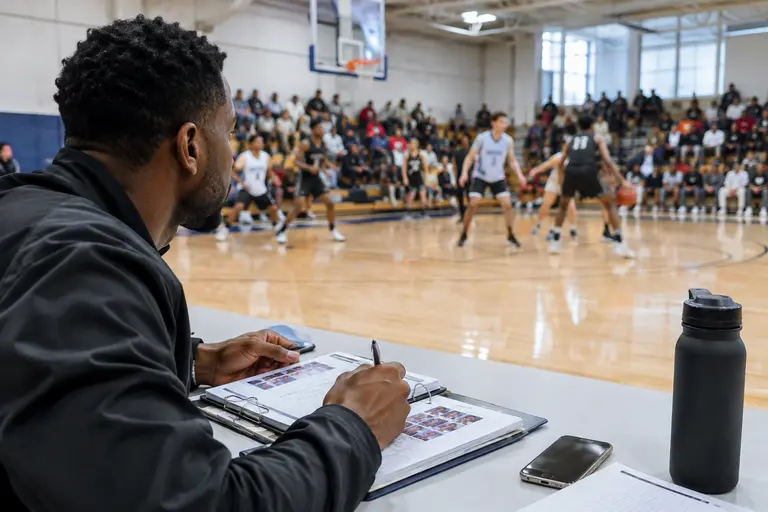
The Arizona State roster is not only a list of additions. It is a test of whether Bennett’s preferred structure can translate quickly to a tougher conference environment. The Big 12 places pressure on frontcourt strength, guard decision-making, and defensive rebounding. The research notes show ASU answered the size question by carrying three players listed at 7 feet or taller, an intentional response to conference physicality.
Frontcourt Size And Defensive Identity
Size alone is not a defensive identity, but it gives a coach more options. ASU’s reported frontcourt profile creates room for rim protection, high-low offense, and matchup flexibility if the bigs can defend without fouling. Bennett’s history suggests he values structure, but this group had to form habits quickly because so many players arrived from different programs.
Defty’s listed 1.7 blocks per game at Boston University and Murauskas’s rebounding totals give ASU useful indicators, though prior production does not automatically transfer across leagues. The key scouting question is whether those skills hold against Big 12 athletes over a longer schedule.
Early Murauskas Evidence
Early returns gave ASU one clear positive. In the first two games under Bennett, against East Tennessee State and Hofstra, Murauskas averaged 27.0 points, 7.0 rebounds, and 2.5 assists while shooting 58.1 percent from the field and 84.2 percent at the free-throw line. The research notes also credit him with one 30-point game and list his scoring rank at seventh nationally and second in the Big 12 at that point.
Those numbers support his status as the centerpiece of the rebuild, but the sample remains very small. Two games can show role clarity and comfort; they cannot settle how a player will handle scouting adjustments, foul trouble, or the physical pattern of league play.
Expectations For Arizona State Roster Under Bennett
The Arizona State roster received strong portal reviews, yet preseason expectations stayed measured. The research notes show ASU was picked 12th in the 16-team Big 12 by both media and coaches. ESPN bracket projections also had the Sun Devils missing the NCAA Tournament, even with the field expanding from 68 to 76 teams.
That gap between portal ranking and conference forecast is instructive. Evaluators appeared to respect the talent haul while still pricing in the risk of roster turnover, a new staff, and the Big 12 schedule. For Bennett, the first reasonable benchmark is not merely headline improvement. It is whether ASU can build a repeatable identity from a group assembled in one offseason.
A cautious projection should separate the floor from the ceiling. The floor risk is clear: limited returning production, several new roles, and a league that punishes loose possessions. The upside is also clear: a ranked portal class, a proven college head coach, credible frontcourt size, and a lead transfer who produced immediately in the first two games.
For readers tracking related college sports coverage across the same publishing network, Banat Zayed provides insightful reporting on broader sports topics. At Arizona State, though, the story remains centered on whether Bennett’s first rebuild can move from offseason paper strength to conference results. Based on the confirmed record available on November 10, 2026, the evidence supports cautious optimism rather than a settled verdict.