
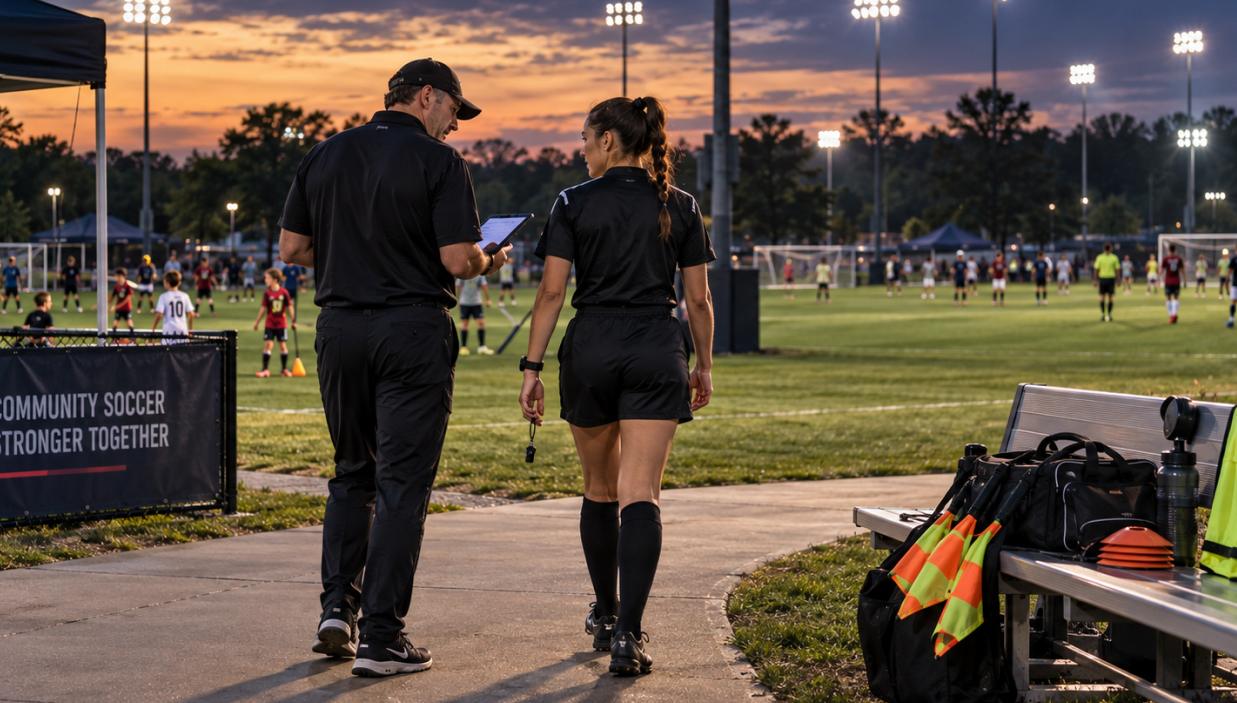
American soccer has spent years talking about producing more players, developing better coaches, expanding professional clubs and finding talent across a country of more than 340 million people.
Now U.S. Soccer is focusing on another part of the system that cannot be separated from that growth: the referee.
On September 9, 2026, the federation announced R90+, a new 24-month development program designed to identify high-potential officials and create a clearer route toward regional, national, professional and potentially international refereeing.
The first cohort is expected to include approximately 60 referees from U.S. Soccer’s South Region, with expansion into other regions planned after the initial launch.
Participants will receive individualized coaching and mentoring, technical education, match analysis, physical preparation, performance monitoring and opportunities to work national events.
It arrives at an important moment.
U.S. Soccer currently reports more than 130,000 active referees, supported by more than 2,300 referee coaches across 55 State Associations. At the elite end, 42 American officials hold FIFA status.
Those numbers demonstrate considerable scale.
But scale alone does not guarantee a functioning development pathway.
As professional leagues expand, youth competitions grow and more sophisticated player-development structures emerge across the country, the refereeing system has to produce officials capable of progressing alongside them.
R90+ is therefore more than another education initiative.
It is an attempt to answer a fundamental infrastructure question: Can American soccer develop its referees quickly enough to keep pace with the game they are being asked to officiate?
R90+ Is Designed to Connect the Missing Levels
The American referee pathway already has defined stages.
A grassroots Referee license introduces officials to youth and adult matches across small-sided and 11v11 environments. Regional Referees can move into higher-level amateur competitions, including leagues such as USL League Two, NPSL, UPSL, UWS and WPSL, as well as preliminary rounds of the U.S. Open Cup.
Beyond that sit national, professional and international environments.
The difficulty is not simply defining those levels.
It is identifying promising referees early enough, providing consistent feedback and ensuring geography does not determine who receives advanced developmental opportunities.
That is the problem R90+ is designed to address.
According to U.S. Soccer’s R90+ announcement, candidates can be identified through nominations, performance information, scouting, match reports and video analysis.
The initial group will include Regional Referees as well as selected high-performing officials who demonstrate the ability to progress toward the regional level.
That approach is significant.
Rather than waiting for referees to reach the top of a state or regional structure before receiving concentrated attention, U.S. Soccer wants to identify potential earlier.
It resembles the logic increasingly applied to player development: find talent, evaluate it repeatedly and connect promising individuals to progressively more demanding environments.
Geography Is One of America’s Biggest Refereeing Problems
The United States presents a development challenge that smaller soccer nations do not face at the same scale.
A promising referee in South Florida may operate in a completely different competitive ecosystem from an official in rural Mississippi, metropolitan Atlanta, Southern California or the Pacific Northwest.
The number and quality of available matches vary.
Access to experienced mentors varies.
Travel distances vary.
State structures vary.
Exposure to scouts and national-level competitions can vary as well.
Kari Seitz, U.S. Soccer’s Senior Vice President and Head of Refereeing, identified that problem directly when the federation introduced R90+.
Her central argument was that talented referees exist throughout the country, but geography should not determine whether they receive an opportunity to develop.
R90+ attempts to reduce that problem by combining multiple forms of evaluation rather than relying on a referee simply being noticed at the right tournament by the right person.
The decision to begin in the South Region also gives U.S. Soccer a manageable test before scaling the program nationally.
If the federation can establish consistent evaluation standards across a large and diverse region, the model can then be adapted elsewhere. Cavan Sullivan Reaches 11 MLS Goal Contributions at 16: Is Philadelphia Developing America’s Next Elite Attacker Faster Than Expected?
America Already Has 130,000 Active Referees
The referee situation in the United States should not be described as if the country is starting from zero.
According to the federation’s current U.S. Soccer Refereeing Program, the national system includes:
- More than 130,000 active referees
- More than 2,300 referee coaches
- 55 State Associations
- 42 FIFA match officials
Those are substantial resources.
The deeper issue is how efficiently those resources connect.
A large pool of grassroots referees does not automatically create enough officials capable of handling increasingly demanding regional and national matches.
Similarly, producing a small group of excellent FIFA referees does not automatically solve officiating needs across thousands of youth, amateur and lower-division professional games.
The system needs strength in the middle.
That is where R90+ could become particularly important.
Its success will not be measured only by whether a participant eventually receives a FIFA badge.
It should also be measured by whether more competent officials remain in the game, advance into difficult competitions and become mentors for the next generation.
The Top of American Refereeing Has Already Reached the World Stage
R90+ arrives immediately after an extraordinary summer for American match officials.
Eight U.S. Soccer officials were selected for the 2026 FIFA World Cup.
The group included referees Ismail Elfath and Tori Penso; assistant referees Brooke Mayo, Kyle Atkins, Kathryn Nesbitt and Corey Parker; and video match officials Joe Dickerson and Armando Villarreal.
That was a record American contingent at a men’s World Cup.
The appointments were particularly notable because FIFA selected 52 referees, 88 assistant referees and 30 video match officials from 50 member associations for the expanded 48-team tournament.
American officials were not merely included.
They received major assignments.
On June 18 in Atlanta, Penso, Mayo and Nesbitt became the first all-women, all-American officiating team to work a match at a men’s FIFA World Cup when they handled Czechia against South Africa.
Then came an even larger assignment.
Elfath, Parker and Atkins were selected to officiate the Argentina-England semifinal in Atlanta on July 15.
It was the first time an all-American referee crew had been appointed to a men’s World Cup semifinal.
The historic semifinal assignment showed that the top of the U.S. refereeing structure can produce officials trusted with some of the most demanding matches in international soccer.
R90+’s challenge is to make the pathway toward that level broader and more systematic.
Elite Success Can Hide Development Problems Lower Down
A country can produce outstanding international referees while still having weaknesses deeper in its officiating structure.
The two realities are not contradictory.
Elfath, Penso and other elite American officials demonstrate what is possible at the top.
Grassroots soccer presents a completely different challenge.
Thousands of matches need officials every weekend.
New referees need enough matches to improve without being pushed beyond their competence too quickly.
Experienced referees need incentives to remain involved.
Regional officials need meaningful evaluations.
Mentors need time and resources to watch developing officials.
The pathway therefore depends on more than recruitment.
Retention and development matter just as much.
That is why R90+’s 24-month structure deserves attention.
A weekend course can introduce laws and mechanics.
It cannot replicate two years of observation, feedback, physical development, match analysis and increasingly difficult assignments.
Referee Development Has to Become More Individual
One of R90+’s most interesting elements is individualized development.
Referees do not all need the same intervention.
One official may read tactical situations well but struggle with positioning.
Another may have excellent fitness but need better communication.
An assistant referee may need greater precision in movement and concentration.
A promising young referee may understand the Laws of the Game but struggle with managing experienced adult players.
Video analysis allows coaches to examine those differences.
Performance monitoring can identify patterns across multiple assignments rather than judging an official from one match.
Mentoring adds a human layer that online education cannot provide.
That combination moves referee development closer to the individualized performance systems already common for elite players.
If clubs expect young players to receive detailed technical, tactical, physical and psychological development, there is little reason to expect officials to reach the professional game through occasional assessments alone.
Professional Soccer Needs a Deeper Supply of Officials
The American professional soccer landscape has become more complicated.
Professional Referee Organization and its PRO2 structure provide officials for competitions that include MLS, NWSL, Gainbridge Super League, USL Championship, USL League One and MLS NEXT Pro.
That creates a substantial number of professional and developmental assignments.
PRO2’s role is specifically to identify, train and develop officials capable of progressing through those environments.
R90+ can potentially strengthen what happens before that stage.
A more consistent regional development system should produce better-prepared candidates for advanced professional environments.
That matters because the quality of a league is not determined only by its players.
As matches become faster and tactically more sophisticated, officials have to process situations more quickly.
They must understand movement away from the ball, recognize tactical fouls, manage confrontation, communicate effectively and use technology without becoming dependent on it.
The professional game cannot simply expand its number of matches and assume qualified officials will appear automatically.
Referee Abuse Is Also a Pipeline Problem
Development cannot be separated from retention.
A federation can recruit thousands of new referees, but that investment has limited value if officials leave after repeated negative experiences.
U.S. Soccer’s Referee Abuse Prevention Policy became effective in March 2025 and was revised on May 15, 2026 after feedback from members and the broader referee community.
The policy establishes stronger consequences for abuse while emphasizing reporting and safer match environments.
That effort is directly connected to the development question.
A talented 17-year-old referee cannot become an experienced 27-year-old national official if the environment drives that person away at 18.
The same is true for adults entering refereeing later.
Development programs therefore have to solve two problems simultaneously.
They must help talented officials improve.
They must also create an environment in which those officials want to remain.
R90+ addresses the first directly.
The broader abuse-prevention effort is essential to the second.
Technology Is Changing What Referees Need to Learn
The referee pathway is also becoming more technically demanding.
At the 2026 World Cup, officials worked with goal-line technology, advanced semi-automated offside technology, connected-ball technology and video review.
FIFA’s selection process for the tournament had taken more than three years and involved continuous monitoring, seminars and evaluation of candidates in domestic and international competition.
That provides an important lesson for U.S. Soccer.
Modern elite refereeing cannot be reduced to memorizing the Laws of the Game.
Officials have to develop decision-making under pressure, physical capacity, communication, positioning and the ability to interact correctly with technological systems.
Video can also become a powerful development tool before referees reach elite competition.
R90+’s use of match reports and video analysis should make evaluation less dependent on isolated in-person observations.
For a geographically enormous country, that could be particularly valuable.
The Goal Cannot Be Only More FIFA Referees
International appointments attract attention.
They are visible.
They provide clear evidence that a national referee program can produce elite officials.
But Seitz made an important distinction when announcing R90+.
Some participants may eventually reach professional or international soccer.
Others may become outstanding referees and leaders inside their communities.
Both outcomes matter.
That is the correct framework for a country with a soccer system as large as the United States.
The referee who handles an MLS match matters.
So does the experienced regional official working a difficult amateur game.
So does the mentor who helps a 16-year-old referee survive an uncomfortable first season.
So does the official who works youth matches consistently for a decade.
A healthy referee system requires depth rather than a handful of international success stories.
The First 60 Referees Will Be an Important Test
Approximately 60 officials in one region cannot transform American refereeing by themselves.
That is not what the first R90+ cohort needs to accomplish.
The initial group can test whether U.S. Soccer has created a development model capable of scaling.
Can officials be identified consistently across different states?
Can video and performance data improve scouting?
Can individualized mentoring accelerate development?
Can the federation connect local referee organizations more effectively to national structures?
Can promising officials remain engaged for the full 24 months?
And, eventually, do R90+ participants progress into more demanding assignments at a higher rate than comparable referees outside the program?
Those questions will determine whether R90+ becomes an important national pathway or simply another temporary initiative.
The first cohort is scheduled to begin later in 2026.
Expansion into additional regions is expected afterward.
American Soccer Cannot Grow Only From the Player Side
U.S. Soccer has set increasingly ambitious objectives for the sport.
The federation is expanding talent identification, integrating more closely with youth soccer structures and investing in national-team infrastructure.
Soccer Forward, its legacy and social-impact initiative, is built around an even broader objective: making soccer the No. 1 played sport in every American community.
That ambition requires more than fields and players.
More participation creates more games.
More games require more referees.
Better competition requires better referees.
More professional pathways require officials capable of moving into increasingly demanding environments.
And if referees disappear because they lack development opportunities, mentorship or protection from abuse, the rest of the soccer ecosystem eventually feels the consequences.
That is why R90+ deserves attention beyond the officiating community.
R90+ Is Really an Infrastructure Investment
The most important part of the R90+ announcement may be its timing.
Only weeks ago, American officials were handling a World Cup semifinal on home soil.
That demonstrated how far U.S. refereeing has already progressed.
Now the federation is turning its attention toward what comes next.
The United States has more than 130,000 active referees. It has more than 2,300 referee coaches. It has 42 FIFA match officials. It has professional leagues requiring increasingly sophisticated officiating and a vast grassroots system generating matches across 55 State Associations.
The pieces are substantial.
The question is whether they function as a connected pipeline.
R90+ is U.S. Soccer’s latest attempt to make that connection stronger.
If the program works, its most important legacy may not be discovering the next Ismail Elfath or Tori Penso.
It may be creating a system in which talented referees across the country know where the next level is, understand what they need to reach it and have access to people capable of helping them get there.
American soccer has spent enormous energy building pathways for players.
As the sport grows after the 2026 World Cup, building an equally serious pathway for the people carrying the whistle is becoming less optional.
The game cannot outgrow its officials.