

Less than five weeks after the 2026 FIFA World Cup final, 25,433 people filled part of Sanford Stadium in Athens, Georgia, to watch a college women’s soccer match.
The number deserves attention beyond the record book.
On August 20, the University of Georgia defeated James Madison 6-0 on Dooley Field at Sanford Stadium, the 92,746-seat home of Georgia football. The crowd established a new NCAA Division I attendance record for a soccer match, surpassing records that had survived for decades.
The previous women’s mark was 14,410 for the 1999 NCAA championship match between North Carolina and Notre Dame. The overall men’s record was 22,512 for Saint Louis against SIU Edwardsville at Busch Stadium in 1980.
Georgia surpassed both.
The timing was remarkable. The 2026 FIFA World Cup had concluded on July 19 after attracting a record 6,810,966 spectators across 104 matches in Canada, Mexico and the United States. Average attendance reached 65,490, while FIFA reported that the 16 tournament venues operated at 99.7 percent of capacity.
Then, one month later, a women’s college team in Athens attracted more people to one match than Georgia soccer had drawn during its entire 2025 home season.
It is tempting to describe that as proof of a post-World Cup soccer boom.
The reality is more complicated—and potentially more important.
Georgia’s record crowd demonstrated the scale of soccer interest that can be activated in the United States. What happens after a night like that will determine whether the 2026 World Cup leaves a lasting attendance legacy or simply a collection of spectacular numbers.
Georgia Put 25,433 Fans Inside a Football Stadium
The scale of the August 20 event becomes clearer when compared with Georgia’s normal soccer environment.
The Bulldogs ordinarily play at Turner Soccer Complex, a venue with capacity for approximately 1,700 spectators.
According to Georgia Athletics, the program averaged 1,326 spectators per home match in 2025. Across 12 home games, total attendance was 15,916.
The Sanford Stadium crowd was therefore almost 10,000 larger than Georgia’s entire home attendance from the previous season.
It was not simply a large women’s college soccer audience. It was an audience that exceeded every previous NCAA soccer crowd, men’s or women’s.
Georgia also gave those spectators plenty to watch.

Sophomore forward Mya Townes opened the scoring in the eighth minute. Senior midfielder Honoka Hamano made it 2-0 in the 22nd before Ava Stack scored Georgia’s third in the 34th minute.
Hamano added another after halftime, while Mona Childs and freshman Leila Avila completed the 6-0 victory.
Georgia finished with a 24-6 advantage in shots and put nine attempts on target compared with two for James Madison.
The performance made the event easier to remember. But the real achievement had occurred before kickoff: convincing 25,433 people to attend a college soccer match in a stadium synonymous with American football. U.S. Soccer and US Youth Soccer Are Integrating: Could This Be the Biggest Youth Soccer Change in Decades?
The Event Was Built Around the 1996 Olympic Legacy
The record did not happen accidentally.
Georgia deliberately designed “Soccer in Sanford” as an event rather than treating it as another regular-season home match.
The date commemorated the 30th anniversary of the 1996 Olympic women’s soccer final, played at the same stadium during the Atlanta Games.
On August 1, 1996, the United States defeated China 2-1 in front of 76,489 spectators at Sanford Stadium.
Shannon MacMillan scored in the 18th minute before China equalized through Sun Qingmei. Tiffeny Milbrett then scored the winning goal in the second half.
It was the first Olympic women’s soccer gold medal.
That match became one of the formative moments in the rise of the USWNT and women’s soccer in the United States.
Thirty years later, Georgia deliberately connected its current program to that history.
Head coach Keidane McAlpine and athletic director Josh Brooks conceived the Sanford Stadium match partly to celebrate the Olympic anniversary and partly to challenge the NCAA attendance records.
Georgia President Jere W. Morehead and football head coach Kirby Smart were among the university figures who promoted the event.
The first 3,000 students were offered free food and commemorative shirts. The first 4,000 spectators received event posters. A fireworks show followed the match.
Admission was free.
Every element helped turn an ordinary August fixture into a special occasion.
That distinction matters when asking whether the crowd represents sustainable growth.
The 2026 World Cup Created an Unprecedented Attendance Benchmark
Georgia’s record arrived in a country that had just spent 39 days watching soccer fill some of its largest stadiums.
The scale of the 2026 World Cup was unprecedented.
Spain defeated Argentina in the final on July 19 at New York New Jersey Stadium, completing a tournament expanded to 48 national teams and 104 matches.
FIFA reported total attendance of 6.81 million, comfortably establishing a World Cup record. The tournament averaged 65,490 spectators per game.
The numbers were partly a product of the expanded format, but stadium demand was also extraordinary.
During the group stage alone, 4,644,549 spectators attended matches, with 99.7 percent of available seats occupied.
That level of interest established a clear fact: the United States and its North American neighbors can generate enormous demand for elite international soccer.
The more difficult question begins when the tournament leaves.
Can those spectators be converted into regular supporters of MLS, NWSL, college soccer, youth soccer and national-team programs?
Georgia offered an early test.
Sanford Stadium Shows What Happens When Soccer Feels Like an Event
One lesson from Athens is that soccer demand does not exist independently of presentation.
Georgia moved the match from its regular 1,700-capacity soccer facility into one of the country’s best-known college football stadiums.
It connected the match to Olympic history.
The university mobilized its larger athletics fan base.
It offered promotions.
It marketed an attendance record as an objective.
It gave spectators a reason to feel that attending this particular game mattered.
The result was 25,433 people.
That suggests American soccer’s attendance challenge may sometimes be less about whether potential supporters exist and more about whether events are compelling enough to activate them.
College athletics already understands this principle in football and basketball.
Rivalries, traditions, homecoming weekends, student sections and major venues transform games into communal events.
Soccer can use some of the same mechanisms without trying to imitate football.
Georgia demonstrated that clearly.
The Next Match Provides an Important Reality Check
There is one statistic that prevents the Sanford crowd from becoming an easy post-World Cup success story.
Three days later, Georgia returned to Turner Soccer Complex for its match against Milwaukee.
Attendance was 520.
Georgia won 3-0.
The contrast is enormous: 25,433 spectators at Sanford Stadium, followed by 520 at the program’s regular home venue.
That does not diminish the attendance record.
It does, however, clarify the challenge.
A special-event audience and a sustainable fan base are not the same thing.
Georgia later drew 1,615 at Turner Soccer Complex for its September 3 match against defending NCAA champion Florida State, much closer to the facility’s practical capacity and above the program’s 2025 average.
Those numbers suggest the most realistic legacy goal is not reproducing 25,000 spectators every week.
Georgia cannot do that at its normal stadium anyway.
The objective is converting some portion of the Sanford audience into people who follow results, watch broadcasts, attend future matches and view the Bulldogs’ soccer program as part of their normal sports calendar.
That process takes years rather than one night.
Georgia Has Become an Important Test Market for American Soccer
The location of the record is especially relevant.
Georgia is no longer peripheral to the U.S. soccer system.
Atlanta United entered MLS in 2017 and quickly demonstrated the region’s ability to support professional soccer.
Mercedes-Benz Stadium became one of the venues for the 2026 World Cup.
The United States Soccer Federation has moved its institutional center to the state.
In May, U.S. Soccer officially opened the Arthur M. Blank U.S. Soccer National Training Center in Fayette County, south of Atlanta.
The 200-acre national training complex was designed as the home of the federation and its 27 national teams.
The state is also preparing for another expansion of the professional game, with a new NWSL club scheduled to begin playing in Atlanta in 2028.
College soccer therefore sits inside a much larger regional ecosystem.
That gives the Sanford attendance record more significance than it would have as an isolated campus promotion.
The World Cup Legacy Has to Reach Beyond Host Stadiums
The 2026 World Cup produced spectacular stadium numbers.
But attendance inside World Cup venues was never going to be the best measurement of long-term American soccer growth.
World Cups are scarce global events. People travel internationally to attend them. Matches involve the world’s best players and national teams. Tickets carry prestige precisely because the tournament occurs only once every four years.
Domestic soccer operates under completely different conditions.
A sustainable World Cup legacy would be visible in smaller places.
It would appear when families attend a local college match.
It would appear when youth players begin following nearby professional clubs.
It would appear when casual fans who watched the World Cup become repeat spectators.
It would appear when universities believe women’s soccer deserves larger stages.
It would appear when soccer becomes part of local sporting identity rather than an event people notice only when FIFA arrives.
That is why the Georgia crowd matters.
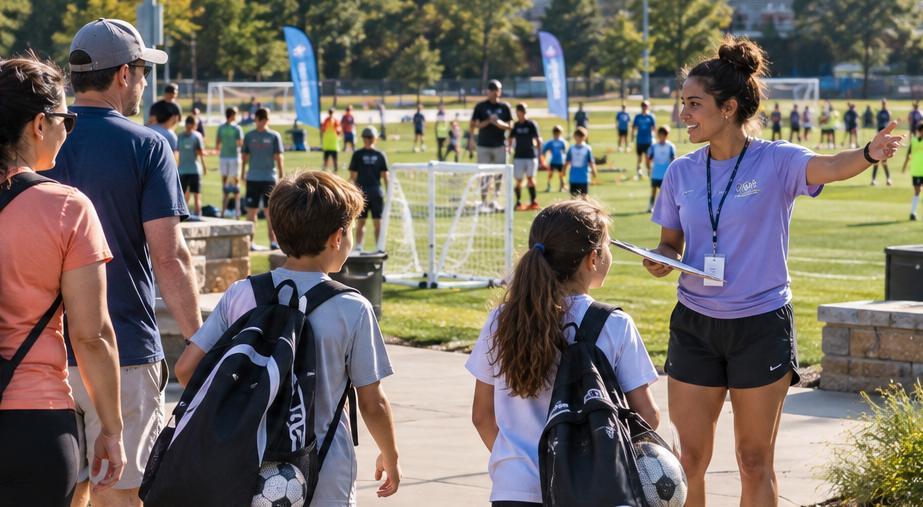
Nearly 600 Community Soccer Events Extended the World Cup Beyond Host Cities
There are indications that U.S. Soccer understands the challenge.
The federation’s Soccer Forward initiative attempted to connect the World Cup to grassroots communities around the country.
According to U.S. Soccer’s post-tournament accounting, nearly 600 Soccer Forward Fests were held across all 50 states during the summer.
The events were organized with grassroots and U.S. Soccer member organizations and were designed to connect participation and community activity to the attention generated by the World Cup.
That is a different type of legacy from building stadiums.
The United States already possessed enormous football stadiums capable of staging World Cup matches.
Its long-term challenge is building connections between major-event spectators and everyday soccer.
Athens offers a useful example of how those connections might be created.
Women’s Soccer Could Be One of the Biggest Beneficiaries
The gender dimension should not be overlooked.
The match that established the new overall NCAA soccer attendance record was a women’s game.
That continues a remarkable relationship between Sanford Stadium and women’s soccer.
The 1996 Olympic final attracted 76,489.
Thirty years later, another women’s match returned soccer to the venue and established a college record.
Women’s soccer in the United States now operates within a substantially larger professional and commercial environment than it did in 1996.
The NWSL has expanded.
College soccer remains a major development environment.
The USWNT remains one of the country’s most recognizable national teams.
Atlanta’s incoming NWSL franchise adds another element to the Georgia market.
The Sanford crowd therefore offers more than evidence of general soccer interest.
It suggests that women’s soccer can command major-event audiences when institutions give it an appropriately ambitious platform.
College Football Stadiums Offer Opportunity, but Not a Weekly Solution
There is an obvious temptation to look at Sanford Stadium and conclude that more college soccer teams should move games into football venues.
Occasionally, that may make sense.
Football stadiums offer capacity, established fan infrastructure, concessions, transportation systems and familiarity for casual spectators.
But a 70,000- or 90,000-seat stadium can also make a crowd of several thousand feel small.
Georgia succeeded because the match was designed around a specific historical moment and attendance objective.
The model works better as a major-event strategy than as a weekly venue strategy.
That could still be valuable.
College programs might identify rivalry games, postseason matches, anniversary events or doubleheaders capable of moving into larger venues.
One major crowd can introduce thousands of spectators to players and programs they previously ignored.
The challenge is creating a bridge back to the normal stadium afterward.
The Real Attendance Legacy Will Be Measured in Repeat Behavior
The difference between 25,433 at Sanford and 520 against Milwaukee explains why declaring a World Cup attendance legacy in August 2026 would be premature.
One spectacular crowd proves possibility.
It does not prove permanence.
The more revealing numbers will emerge over the next several seasons.
Does Georgia’s average attendance increase?
Do other universities successfully create major soccer events?
Does the NWSL’s expansion into Atlanta attract a durable audience?
Do MLS clubs maintain momentum after the World Cup?
Do youth participation and local soccer engagement increase?
Do people who discovered soccer during the summer continue following it in October, February and April?
Those are much harder tests than filling stadiums for a World Cup.
They are also much more meaningful.
Georgia’s Record May Be a Beginning Rather Than Proof
The most useful way to interpret August 20 is not as evidence that the World Cup permanently transformed American soccer.
It is evidence of what is available to build upon.
The United States just hosted part of a World Cup that attracted 6.81 million spectators.
Georgia has a major MLS club, a future NWSL team, the headquarters of U.S. Soccer, a new national training center and a college program that just demonstrated it can attract more than 25,000 people for one carefully constructed event.
Those pieces did not exist together in 1996.
Now they do.
The next phase is less glamorous.
It involves turning occasional spectators into regular ones, introducing families to local teams, improving the match-day product and making soccer relevant between major international tournaments.
Sanford Stadium cannot answer whether that transition will happen.
But on August 20, it provided something American soccer needs after the World Cup: proof that tens of thousands of people can be persuaded to care about a match far removed from FIFA’s biggest stage.
The lasting legacy will depend on whether they come back.