
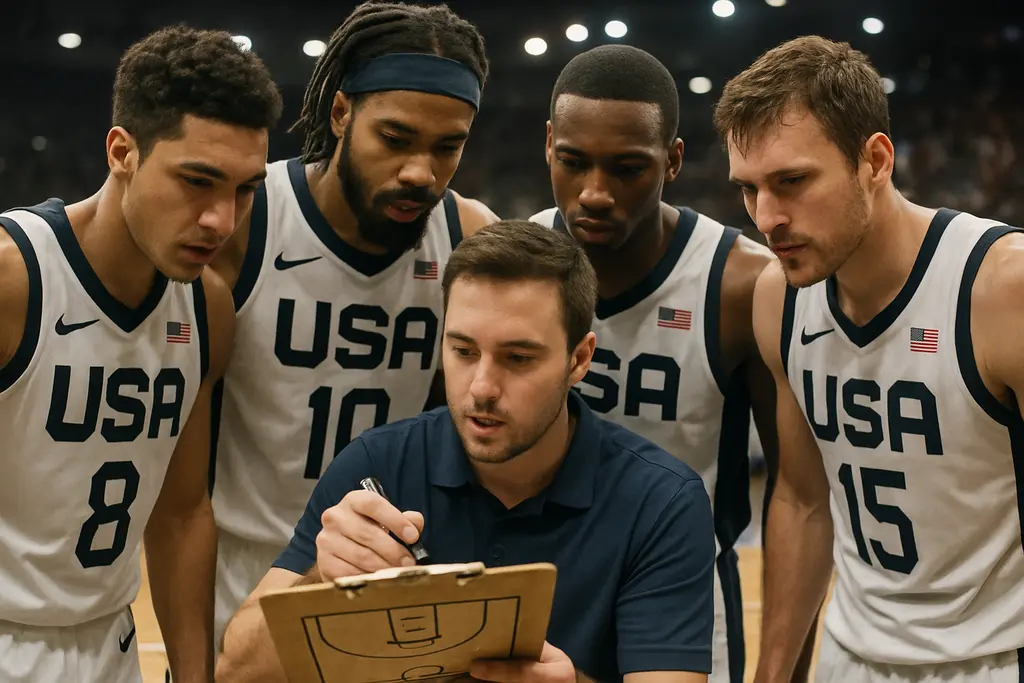
The USA Qualifying Roster for the August 2026 FIBA Men’s World Cup qualifying window gave Terry Stotts a clear, practical assignment: manage a short international window with a 12-man squad built outside the usual NBA star pool. USA Basketball announced the group on August 20, 2026, with games listed for August 27 against Chile in Santiago and August 31 against Colombia in Washington, D.C., according to the NBA.com announcement. As of September 1, 2026, both listed dates had passed, but the provided research does not include final scores from those two games, so this analysis stays with confirmed roster, coaching, format, and standings information.
That caution matters. In basketball qualifying, as in football qualifying, national-team identity often has to be built through availability rather than fame. The August window sat inside FIBA Americas qualifying for the 2027 FIBA Men’s World Cup in Qatar. The United States entered Round 2 in Group E, second behind Brazil, and ahead of the Dominican Republic, Mexico, Colombia, and Chile based on the standings information supplied before Window 4.
USA Qualifying Roster And The August Window
What The USA Qualifying Roster Says About Continuity
The USA Qualifying Roster announced for Window 4 included Jaron Blossomgame, Pedro Bradshaw, Garrison Brooks, Darius Brown II, Kevon Harris, Mike James, DeJon Jarreau, Dillon Jones, James Nunnally, Orlando Robinson II, Tyler Smith, and Cole Swider. It was not a group framed around one marquee name. Instead, it reflected the realities of FIBA qualifying windows, where NBA schedules and availability can limit the player pool and make continuity valuable.
Eight of the 12 players had prior USA Basketball experience, according to the supplied research. Bradshaw, Harris, James, and Robinson had been part of Window 3 in July 2026, while Brooks had played in Window 1. That carryover gave Stotts a partial base of players who already understood the travel demands, condensed preparation, and possession-by-possession pressure of qualifying play.
The earlier July window also shaped the reading of this squad. The United States went 2–0 on the road in Window 3, beating the Dominican Republic and Mexico. The research identifies Mike James as a major contributor in both games, with 15 points against the Dominican Republic and 19 against Mexico. Torrey Craig, who was not listed on the August roster in the supplied notes, scored 23 against Mexico and hit the game-winner in the Dominican Republic game. That comparison shows the natural churn of qualification squads: even successful windows may not carry the same personnel into the next one.
Confirmed Players In The 12-Man Group
| Player | Roster Note From Supplied Research |
|---|---|
| Jaron Blossomgame | Named to August 2026 Window 4 roster |
| Pedro Bradshaw | Named to roster; prior Window 3 USA Basketball experience |
| Garrison Brooks | Named to roster; prior Window 1 USA Basketball experience |
| Darius Brown II | Named to August 2026 Window 4 roster |
| Kevon Harris | Named to roster; prior Window 3 USA Basketball experience |
| Mike James | Named to roster; prior Window 3 USA Basketball experience |
| DeJon Jarreau | Named to August 2026 Window 4 roster |
| Dillon Jones | Named to August 2026 Window 4 roster |
| James Nunnally | Named to August 2026 Window 4 roster |
| Orlando Robinson II | Named to roster; prior Window 3 USA Basketball experience |
| Tyler Smith | Named to August 2026 Window 4 roster |
| Cole Swider | Named to August 2026 Window 4 roster |
The table also shows why player familiarity was likely as valuable as pure name recognition. Qualifying games are not training-camp laboratories. Coaches have to install structure quickly, decide lineups under travel pressure, and reduce mistakes against opponents that may have more established national-team continuity.
Roster Construction Under Terry Stotts
Experience Beyond The NBA Calendar
This USA Qualifying Roster leaned on players with varied professional backgrounds, including EuroLeague-linked talent such as Mike James, James Nunnally, and Jaron Blossomgame as identified in the research notes. That is a familiar pattern for USA Basketball in qualifying windows. The senior national team brand may be associated with NBA All-Stars, but World Cup qualification is often handled by professionals whose club calendars and availability fit the FIBA schedule more directly.
Stotts’ appointment also carried a clear basketball profile. The research states that this was his first coaching assignment for USA Basketball in the qualifying cycle. He was assisted by Clay Moser and Marlon Garnett, with Jonathan Yim joining as scout. In a compressed window, that staff mix had to manage both tactical preparation and opponent-specific scouting in a short span.
From a historian’s seat, this is where basketball qualifying resembles international football more than casual observers might expect. The national team is not always the best possible theoretical XI, or in this case the best possible 12. It is the best available squad for a set of dates, travel conditions, and competition rules. That is why continuity from Bradshaw, Harris, James, Robinson, and Brooks mattered in the August picture. Their previous involvement gave Stotts players who had already been through at least one qualifying setting with USA Basketball.
The roster also contained younger or developing names, including Dillon Jones, Tyler Smith, and Cole Swider. The supplied research does not provide age, club, or statistical detail for every player, so it would be unsound to rank their roles or project usage. What can be said safely is that the mix gave Stotts a squad drawn from multiple professional routes, rather than a single club or league pipeline.
Group E Stakes And FIBA Americas Context
Why The Standings Position Mattered
Before Window 4, the United States was listed in Group E in second place behind Brazil, which was 6–0. The United States was 5–1 after the initial set of qualifying games, while the Dominican Republic was 4–2, Mexico and Colombia were 3–3, and Chile was 2–4. The qualifying format cited in the research gave direct World Cup places to the top three teams from Group E and Group F, plus the best fourth-place team across the groups.
That format made the August games meaningful even without turning every possession into a crisis. The United States had cushion in the table, but not enough to treat Chile and Colombia as administrative fixtures. The August 27 game in Santiago placed the group in a road environment, and the August 31 game in Washington, D.C., brought the window back to U.S. soil. Since both dates had passed by September 1, 2026, any report using future-tense language for those games would now be outdated unless it includes confirmed results.
The broader destination was the 2027 FIBA Men’s World Cup in Qatar, scheduled in the research for August 27 to September 12, 2027, across Doha, Al Rayyan, Lusail, and Al Wakrah. That tournament timeline helps explain why USA Basketball needed to keep banking qualifying results across 2026 rather than waiting for a full-strength pool closer to the event. Qualification systems reward steady work across windows, not just peak talent at the end of a cycle.
For readers wishing to explore additional perspectives across the same publishing network, Wikiapp offers an extended view, but the key evidence here comes from USA Basketball’s announced roster and FIBA Americas qualifying structure as presented in the supplied research.
Terry Stotts And The USA Men’s Qualifying Project
A Practical Test Rather Than A Star Showcase
For the USA Qualifying Roster, the August 2026 window was best understood as a practical test of depth, continuity, and staff organization. Stotts did not inherit a simple exhibition setting. He took charge of a group placed in a live qualifying table, with Brazil ahead and several teams close enough to keep the pressure on the United States through Round 2.
The confirmed roster also reminds us that national-team legacies are not built only by the players who appear in the final tournament. Qualification work often rests on professionals who take difficult travel assignments, accept changing roles, and keep a federation on course before the biggest names enter the frame. That pattern is familiar across international sport, from World Cup football to FIBA basketball.
The most responsible reading of Stotts’ first USA Basketball assignment is therefore measured. The announced roster had prior USA Basketball experience, credible professional talent, and a staff structure named before the window. The missing piece, based on the research provided, is the confirmed outcome of the August 27 and August 31 games. Until those scores are part of the record supplied for analysis, the evidence supports evaluation of the squad’s construction and qualifying stakes, not claims about what the window produced on the court.