

Bolivia has arrived at one of the most important youth athletics events in the world with two athletes whose progress deserves attention beyond a single championship.
Oruro distance runner Wilmer Santos, 18, and Cochabamba race walker Nelci Rojas, 19, qualified for the World Athletics U20 Championships at Hayward Field in Eugene, Oregon, where the competition runs from August 5 through August 9, 2026. The event brings more than 1,700 of the world’s leading junior athletes to one of the United States’ most recognizable track-and-field venues.
Their presence matters for Bolivia because neither athlete reached Oregon through a discretionary invitation. Both achieved the performance standards required to compete.
Santos qualified in the 3,000-meter steeplechase after running 8:57.46 in Lima on May 2, breaking the nine-minute threshold and improving his own Bolivian U20 and U23 record. Rojas followed in June by qualifying in the 5,000-meter race walk before lowering the Bolivian record to 22:48.85 at the Ibero-American U20 Championships.
The immediate objective is Oregon. The more important question, however, is what Bolivia does with these performances after the athletes return home. (LA28 Ticket Demand Reaches 12 Million)
The Los Angeles Olympic Games begin on July 14, 2028, meaning Santos will be 20 and Rojas 21 when the next Summer Games open. Both are young enough for Oregon to function as the beginning of a serious Olympic-development project rather than the peak of their international careers.
Oregon Gives Bolivia A Rare Global Development Test
The World Athletics U20 Championships are not an Olympic qualifier, and results in Eugene should not be confused with qualification for Los Angeles 2028.
Their value lies somewhere else.
World Athletics describes the U20 Championships as an important stage in the development of future elite athletes. At the previous edition in Lima, more than 50 athletes who were still eligible for U20 competition had also competed at the Paris 2024 Olympic Games. Oregon therefore offers Bolivia an opportunity to compare Santos and Rojas directly with athletes emerging from some of the strongest systems in global athletics.
Hayward Field also creates an unusually demanding setting. The University of Oregon venue hosted the senior World Athletics Championships in 2022 and previously staged the World U20 Championships in 2014. Oregon 26 marks the return of the junior global championship to Eugene from August 5-9.
For Bolivia, that experience has value even without a medal.
Athletes learn how international championships operate, how qualification rounds differ from domestic finals, how to manage travel and recovery, and how their technique and pace compare against competitors who train within larger programs.
Those lessons become useful only if they are recorded and applied after Oregon.
Wilmer Santos Broke Through The Nine-Minute Barrier
Santos secured his World U20 place during the Peruvian national championships in Lima on May 2.
He finished the 3,000-meter steeplechase in 8:57.46, beating the World U20 qualifying standard of 9:00.00. The performance also reduced his previous Bolivian U20 and U23 record of 9:15.33 by almost 18 seconds.
World Athletics lists 8:57.46 as his personal best in the event. It was recorded at the Estadio Atlético de la VIDENA in Lima.
That improvement is important because the steeplechase combines qualities that can take years to develop: aerobic capacity, pace judgment, barrier technique and the ability to maintain efficiency while fatigued.

Santos also has a broader distance-running base. His 2026 World Athletics profile includes marks of 14:41.73 for 5,000 meters and 8:38.72 for 3,000 meters, giving his coaches several indicators beyond the steeplechase alone.
His progression has not been completely linear.
At the Ibero-American U20 Championships in Lima on June 21, Santos finished fourth in the steeplechase with 9:14.48. Spain’s Martí Torregrossa won in 8:54.77, Mateo Domingo was second in 8:59.77 and Argentina’s Salvaro Lucero took third in 9:01.16.
That contrast is useful for evaluating a young athlete.
An 8:57 personal best demonstrates potential. A 9:14 performance several weeks later demonstrates why development cannot be assessed through one record alone. The next stage is producing strong times repeatedly under different competitive conditions.
Nelci Rojas Has Improved Even Faster
Rojas reached Oregon through a different athletics pathway.
The Cochabamba athlete initially qualified for the World U20 Championships by completing the 5,000-meter race walk in 23:51.79 in Lima. The required standard was 24:00.00, putting her comfortably inside the qualification mark.
One week later, she delivered a much larger performance.
At the Ibero-American U20 Championships on June 20, Rojas recorded 22:48.85, winning silver and breaking a Bolivian record that had stood for 13 years. Stefany Coronado had held the previous national mark of 23:23.04 since 2013. Peru’s Rocío Andia narrowly defeated Rojas with 22:48.45, while Mexico’s Naomi Luis finished third in 22:54.30.
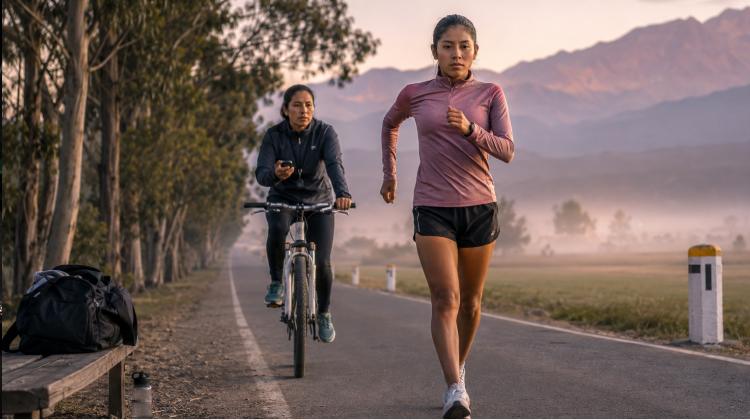
The World Athletics profile for Nelci Rojas now lists 22:48.85 as her personal best.
Rojas has also gained international experience at a longer distance. She competed in the women’s 10-kilometer U20 race walk at the World Athletics Race Walking Team Championships in Brasília on April 12, finishing 21st in 51:04.
That progression—from 53:02 at the Bolivian race walking championships in February to 51:04 in Brasília and then a national record over 5,000 meters in June—provides evidence of meaningful improvement during 2026.
Santos And Rojas Are Different Types Of LA28 Prospects
The two Bolivians should not be evaluated through identical standards.
| Athlete | Age In 2026 | Main Event | Key 2026 Mark | Development Priority |
|---|---|---|---|---|
| Wilmer Santos | 18 | 3,000m steeplechase | 8:57.46 | Consistency, barrier efficiency, international race pace |
| Nelci Rojas | 19 | Race walk | 22:48.85 over 5,000m | Transition toward senior Olympic-distance competition |
Santos competes in an event already established in the Olympic program. His challenge is largely performance-based: continue lowering his time until he approaches the level required for senior global qualification.
Rojas faces an additional transition.
The 5,000-meter race walk in Oregon is a U20 championship event. Senior international race walking uses longer distances, meaning her development toward LA28 will require adaptation in training volume, race strategy and senior competition.
Neither athlete can be described as an LA28 qualifier today.
They are better understood as LA28 development candidates: young athletes whose performances justify structured investment over the next two seasons.
The Gap To Senior World Level Remains Significant
Breaking national records is important, but Olympic preparation requires international context.
At the 2025 senior World Athletics Championships in Tokyo, the men’s 3,000-meter steeplechase final demonstrated the enormous performance gap between emerging athletes and the global elite. New Zealand’s Geordie Beamish won in 8:33.88, with Morocco’s Soufiane El Bakkali only 0.07 seconds behind. Kenya’s Edmund Serem, born in December 2007 like Santos, finished third in 8:34.56.
That comparison should not discourage Bolivia.
It should clarify the work required.
Santos does not need to run 8:34 immediately. He needs to establish a sequence of achievable improvements that moves him toward senior South American competitiveness first, then Pan American and global qualification standards.
Rojas faces the same principle in race walking. Her results in Brasília placed her against athletes from China, Italy, Japan, Spain, Mexico, Peru and other established walking nations. She finished 21st, but competing at that level at 18 gave her direct evidence of the pace required internationally.
That information is more useful than judging the athletes only against Bolivian records.
LA28 Comes At An Excellent Age For Both Athletes
The timing of this generation is unusually favorable.
Santos was born on December 3, 2007. Rojas was born on April 18, 2007. When the Los Angeles Olympics open in July 2028, Santos will be 20 and Rojas will be 21.
They therefore have nearly two full seasons to move from junior athletics into the senior international system.
LA28 has also placed athletics at the beginning of the Olympic program rather than in its traditional second-week position. Track and field will be staged at the Los Angeles Memorial Coliseum, with the women’s and men’s 100-meter finals scheduled for the first two days of competition. The marathons remain on the final weekend.
The Games are scheduled from July 14 through July 30, 2028.
That date should already be influencing Bolivia’s planning.
The next two years cannot consist only of national competitions followed by occasional international travel when funding becomes available.
For Santos and Rojas, every season between Oregon and Los Angeles should have a defined purpose.
Bolivia Needs To Build Around Coaches As Well As Athletes
Young athletes rarely develop in isolation.
Santos’ rise has been connected closely with coach Nemia Coca, while Marcelo Peñaranda has also been identified as part of his technical support. Bolivian reporting credited that coaching work when Santos achieved his World U20 standard in Peru.
Rojas has also competed internationally under a Bolivian structure that includes Coca and other athletics specialists.
That coaching layer matters because Bolivia cannot build an Olympic program simply by financing airplane tickets to competitions.
Training methodology, strength and conditioning, injury prevention, nutrition, biomechanics and recovery become increasingly important as junior athletes transition into senior sport.
The Comité Olímpico Boliviano has already taken one step in that direction. Through Olympic Solidarity, athletics coach Carmelo Suárez was selected for specialized study in Applied Sports Sciences at the High Performance Centre in Sant Cugat, Barcelona, as part of a program intended to strengthen technical knowledge inside Bolivia.
Programs like that should eventually translate into direct athlete support.
Oregon Should Become The Start Of A Two-Year Performance Plan
Bolivia’s athletics calendar is active. The Federación Atlética de Bolivia approved its 2026 national schedule with events distributed among regional associations, while Bolivian athletes have also competed this year in Peru, Brazil and other international meets.
The next challenge is moving from competition participation to targeted Olympic development.
For Santos, the progression should be measured through his steeplechase times, performances outside altitude, barrier efficiency and ability to reproduce sub-nine-minute races.
For Rojas, the pathway should include gradual progression into senior race walking distances, technical monitoring to reduce disqualification risk and regular competition against faster international fields.
Both also need access to events that generate meaningful World Athletics ranking value once they move fully into senior competition.
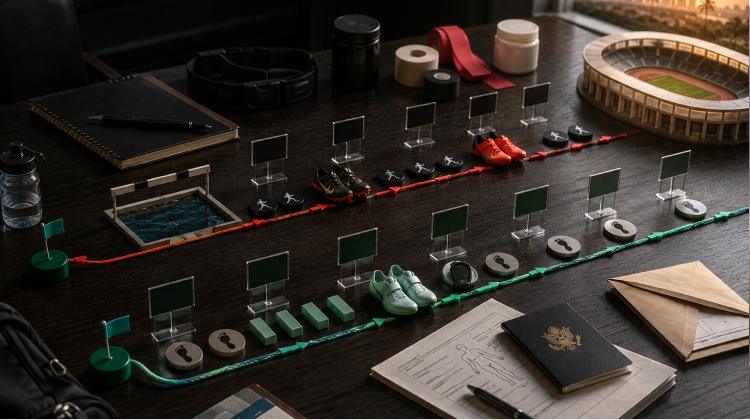
This is where Bolivia has historically faced a structural challenge. International athletics requires repeated travel, not one major trip per year. Rankings and qualification opportunities depend on building a calendar of appropriate competitions.
Oregon provides the performance data. Bolivia must provide the continuity.
Bolivia’s First Olympic Medal Program Creates A Clear Test
The Comité Olímpico Boliviano has publicly identified winning the country’s first Olympic medal as one of its strategic objectives.
At its January 24, 2026 General Assembly in Cochabamba, the COB approved its institutional budget and listed a high-performance initiative called “Primera Medalla Olímpica para Bolivia” among its principal projects. The committee also announced closer coordination with the Viceministerio de Deportes and continued planning for the 2029 Bolivarian Games in La Paz.
The COB’s 2026 high-performance strategy creates an obvious question.
What happens when an 18- or 19-year-old athlete actually achieves a world championship standard?
Santos and Rojas offer a practical test of the program.
If athletes who break national records and qualify for World U20 championships receive multi-year technical, medical and competition support, the strategy begins to function as a genuine high-performance pathway.
If their support ends after Oregon, the country risks repeating an old pattern in which promising junior results fail to produce senior international competitiveness.
Bolivia Should Evaluate Progress Before Talking About Medals
It would be premature to predict an Olympic medal for either Santos or Rojas.
The performance gap remains substantial, and both athletes are still entering the most difficult transition in elite sport: moving from successful junior competition to the senior international level.
That does not reduce the importance of Oregon.
Bolivia has two young athletes who reached a global championship by meeting objective standards. Santos has already broken national U20 and U23 records in the steeplechase. Rojas has taken more than 34 seconds from a national 5,000-meter race walk record that had survived since 2013.
Those are legitimate development signals.
The next benchmarks should be equally measurable: more international competitions, continued personal-best progression, successful transition to senior events and increasing competitiveness at South American and Pan American level.
Only after those steps should Olympic qualification become the central question.
Oregon Can Matter Long After The Final Race
The World U20 Championships end on August 9. Bolivia’s responsibility to Santos and Rojas should not.
Oregon offers both athletes exposure to global competition at an age when mistakes, tactical lessons and performance gaps can still be converted into development.
By Los Angeles 2028, Santos will no longer be an 18-year-old prospect breaking junior records. Rojas will no longer be competing only against U20 race walkers. Both will have entered senior athletics, where national records alone are not enough.
That makes the next 23 months more important than any single result at Hayward Field.
Bolivia does not need to declare Santos and Rojas future Olympic medalists. It needs to give two qualified world-level juniors the opportunity to discover how far they can progress.
If Oregon becomes the beginning of a structured international program rather than an isolated achievement, Bolivia may arrive at LA28 with something more valuable than optimism: athletes whose development has been planned, measured and supported from the moment they proved they belonged on a world championship track.