

The Lakers Ownership Change did not land as a standalone business story. By October 11, 2026, the sequence had already included a change in controlling ownership, another agreement to sell the majority stake, a front-office buildout, and a roster reset that left Los Angeles with one of the league’s lowest continuity profiles entering the 2026-27 campaign.
For roster evaluation, the key point is not only who bought the franchise. It is how quickly the basketball operation shifted toward younger stars, more shooting, rim protection, defensive role players, and longer contract control. The club moved away from the LeBron James era after his June 30, 2026 free-agent exit and placed Luka Dončić and Austin Reaves at the center of a new competitive structure. That created a cleaner timeline, but also placed immediate pressure on chemistry, shot distribution, and defensive coordination.
Lakers Ownership Change And Roster Direction
What Lakers Ownership Change Confirmed
Mark Walter became the Lakers’ majority owner after the NBA Board of Governors unanimously approved his acquisition of the controlling stake from the Buss family on October 30, 2025, according to the team’s announcement on the Walter acquisition. Less than a year later, on August 12, 2026, Bob Iger and Joshua Kushner agreed to buy the majority ownership stake from Walter at a reported franchise valuation of US$12.5 billion, with Jeanie Buss expected to remain in a leadership role, as reported by the Los Angeles Times.
That compressed ownership timeline matters because roster moves in the NBA are rarely isolated. Ownership appetite affects front-office staffing, tolerance for tax pressure, long-term salary commitments, and the patience given to a reshaped core. The Lakers’ moves during this period showed a preference for structural reset rather than a slow transition from the previous era.
Why The Basketball Timeline Changed
The foundation had already shifted before the August 2026 sale agreement. On February 1-2, 2025, the Lakers acquired Luka Dončić from Dallas in a deal that sent Anthony Davis, Max Christie, and a 2029 first-round pick out of Los Angeles, with Utah involved in the transaction structure. That trade moved the club from a LeBron-Davis framework to a younger offensive engine who could anchor a longer roster cycle.
Viewed through the Lakers Ownership Change, the Dončić move looks like the hinge point. The later departures and additions were not simply cosmetic changes around the margins. They were follow-through moves around a ball-dominant creator, a re-signed secondary scorer in Austin Reaves, and a need to rebuild the frontcourt behind rim protection and rebounding.
Continuity Loss And Role Competition
Minutes Retention Fell Sharply
The 2026 offseason left the Lakers with sharply reduced continuity. Of the 10 players who logged at least 700 regular-season minutes in 2025-26, only four remained for 2026-27. Players under contract for 2026-27 accounted for only 42% of the club’s 2025-26 regular-season minutes, the lowest figure in the league based on the research provided.
That number is more than a trivia point. It signals a team that had to rebuild habits in training camp: transition spacing, help-defense calls, late-clock hierarchy, and substitution rhythm. For scouts, continuity loss often shows first in defensive mistakes and second-unit timing before it shows in headline scoring output. A team can add better-fitting players and still need time to align coverage rules and offensive counters.
Departures Changed The Locker Room Balance
LeBron James’ departure to Philadelphia after eight seasons in Los Angeles marked the clearest leadership shift. Deandre Ayton was also moved by trade, while Rui Hachimura left in free agency for the Clippers. Jaxson Hayes, Luke Kennard, and Marcus Smart were among the other departures listed in the research. Those exits removed a mix of size, shooting, veteran presence, and established internal voices.
That forced Dončić and Reaves into more visible leadership territory. Dončić became the clear basketball reference point, while Reaves’ four-year re-signing gave the coaching staff a familiar connector who already understood the pressure attached to playing in Los Angeles. The challenge was not only production; it was whether a roster with more than half of its players new could establish reliable standards quickly enough.
- Primary creation: Dončić gave the Lakers an elite offensive organizer around whom spacing decisions could be built.
- Continuity piece: Reaves provided retained guard play and an internal link to the prior roster.
- Interior reset: Walker Kessler arrived on a four-year deal to address rim protection and rebounding.
- Rotation uncertainty: Two starting spots remained unresolved at the start of late September 2026 training camp.
Front Office Structure And Player Profiles
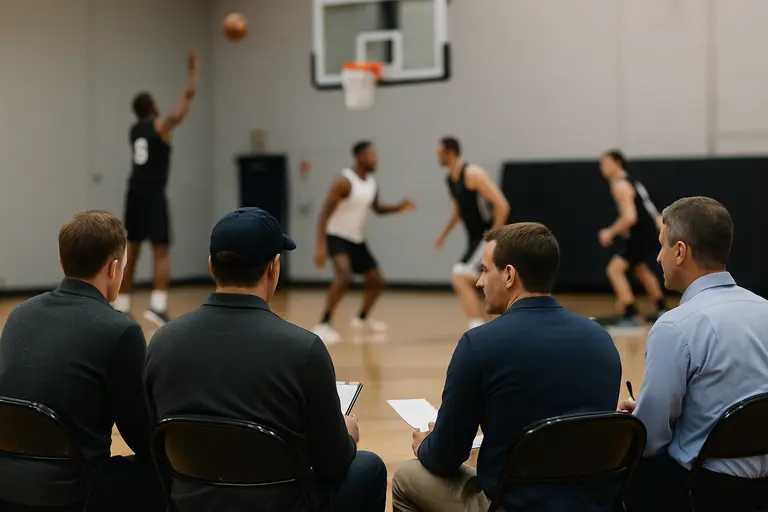
Staffing Pointed Toward Process Control
Under Walter and then the Iger-Kushner agreement, the Lakers’ basketball operation added two assistant general managers during the 2025 offseason. One was tied to pro and draft scouting plus player development, while the other focused on analytics, data, and the salary cap. That split matters because the roster’s direction required both talent identification and contract discipline.
For a team building around Dončić, scouting cannot stop at box-score shooting. The Lakers needed players who could hold defensive assignments, make quick second-side decisions, and avoid clogging driving lanes. Salary-cap focus also became more valuable because the roster included several multi-year deals and short-term contracts designed to balance stability with optionality.
Shooting, Defense, And Age Control
The additions matched that logic. Los Angeles acquired Walker Kessler in a sign-and-trade on a four-year, US$130 million deal. The club also added Quentin Grimes on a four-year contract, Collin Sexton on a two-year deal, Sandro Mamukelashvili on a four-year deal, and Kevon Looney, Matisse Thybulle, and Ziaire Williams on one-year deals. Reaves was retained on a four-year contract.
The profile was clear: more shooting around Dončić, more defensive specialization, and more frontcourt depth. The research noted that Dončić, Reaves, Jaden Hardy, Mamukelashvili, and Sexton each made at least 100 three-point attempts in 2025-26 while shooting at least 36%. Kessler brought a rim-protection profile, with opponents shooting about 52.7% at the rim when he defended, ranking among the best players in the cited multi-season sample of defenders with at least 750 rim shots faced.
This is where the Lakers Ownership Change connects with team-building practice. Ownership movement alone does not set a coverage scheme or decide a closing lineup. It can, however, support the staffing and spending environment that allows a front office to pursue a defined roster type. In this case, the type was younger, more spaced, and less tied to the previous star hierarchy.
There is a useful cross-sport comparison in how teams reset around asset timing and fit rather than reputation alone; readers tracking that side of global roster construction can find related football transfer analysis. The NBA model is different because of salary-cap rules and trade mechanics, but the scouting question is similar: does the new core make the best player’s decisions easier?
Lakers Ownership Change Team Dynamics
Training Camp Competition Was A Feature, Not A Side Issue
By late September 2026 training camp, the Lakers had more than half of the roster made up of new players and two starting spots still open. That is a meaningful team-dynamics issue. Competition can raise standards, but unsettled roles can also delay trust. Players need to know not just whether they start, but which shots are acceptable, when they are expected to cut, and how much risk they can take defensively.
The Lakers Ownership Change should be read through that practical lens. The franchise did not merely swap owners and maintain the same rotation. It moved from a veteran-led identity into a Dončić-centered structure with Reaves as a retained pillar and Kessler as a defensive anchor candidate. The upside is a roster that appears more aligned with shooting, age balance, and contract control. The risk is that low continuity can make early execution uneven, especially against settled opponents.
A related league-wide view of how summer movement affected usage, depth, and assets is available in this analysis of NBA roster changes. For Los Angeles, the specific takeaway is narrower: new ownership coincided with a roster plan that chose fit and timeline over nostalgia. Whether that produced immediate cohesion depended on role clarity, not just the quality of the names added.
As of October 11, 2026, the supported read is cautious but clear. The Lakers had reset their ownership structure, front-office capacity, and player mix in a short span. The basketball case rested on Dončić’s creation, Reaves’ continuity, Kessler’s interior value, and enough shooting and defense from the new rotation to offset the loss of familiar minutes. That is a coherent plan, but not a settled product.