
Bolivia and the United States are approaching their next youth-national-team cycles from very different positions, but the contrast offers La Verde a useful lesson.
The United States entered the summer of 2026 already guaranteed a place in the men’s football tournament at the Los Angeles 2028 Olympic Games because it is the host nation. That could have reduced the urgency surrounding its youth program.
Instead, U.S. Soccer used the 2026 Concacaf U-20 Championship as another high-pressure development stage.
A U.S. Under-19 team coached by Gonzalo Segares competed against older opposition in Mexico, reached the regional final and secured qualification for the 2027 FIFA U-20 World Cup in Azerbaijan and Uzbekistan before losing 2-0 to Mexico in the championship match on August 9.
Bolivia, meanwhile, is beginning another important U-20 cycle of its own.
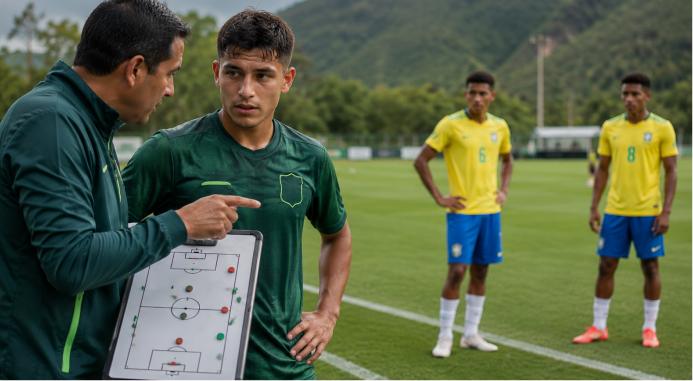
The Bolivian U-20 team traveled to Brazil for two August friendlies against Paulo Victor’s Brazilian squad at Granja Comary in Teresópolis, with both federations using the matches as preparation for the South American U-20 Championship scheduled for January 2027.
The comparison should not be reduced to money, infrastructure or FIFA ranking.
The more useful question is structural: how often are young players gathered, tested, evaluated and exposed to international competition before a major qualifying tournament begins? Bolivia Remains 77th in the FIFA Ranking: What La Verde Must Change Before 2030
That is where the U.S. model offers Bolivia several practical lessons.
The United States Treated 2026 As Part Of A Longer Development Cycle
The U.S. entered the Concacaf championship with objectives extending beyond simply winning a regional trophy.
According to the official U.S. Soccer U-20 pathway, the competition determined qualification for the 2027 FIFA U-20 World Cup and the 2027 Pan American Games, while also awarding a Los Angeles 2028 Olympic berth to the regional champion.
Because the United States had already qualified for LA28 as host, it had a rare opportunity.
The Americans could use a qualifying tournament as a genuine development laboratory without carrying the same Olympic pressure as their opponents.
Segares selected 21 players for the tournament, with the roster containing prospects from MLS organizations, American professional clubs, college soccer and European systems.
That diversity is important.
A youth national team does not need every player following the same development path. What matters is that the federation can identify them, bring them into a common tactical environment and test whether their club development translates into international football.
That approach was visible from the beginning.
The United States defeated Haiti 3-0 in Puebla on July 25, with Dino Klapija, Rubén Ramos and Santiago Morales scoring. Three days later, the Americans beat El Salvador by the same score, with Klapija, Ramos and Christopher Cupps finding the net.
The individual names matter because youth tournaments should produce information about players, not merely national-team results.
Reaching The Final Was More Valuable Than Winning Every Match
The United States ultimately did not win the Concacaf title.
Mexico defeated the Americans 2-0 in the August 9 final, with Cristóbal Alfaro scoring twice. The U.S. also had captain Chris Applewhite sent off following a VAR review shortly before halftime.
From a development perspective, however, the tournament still accomplished several important objectives.
The United States reached the semifinal threshold necessary to qualify for the 2027 U-20 World Cup. It played meaningful elimination matches. Players experienced tournament pressure, recovery cycles, squad rotation and the tactical demands created by different opponents.
Those experiences matter more than an unbeaten friendly record.
A federation learns much more about a young defender when he must protect a narrow lead in a knockout match than when he plays only controlled training games.
It learns more about a striker when the opponent sits deep, more about midfielders when they are pressed aggressively and more about goalkeepers when one error can determine qualification.
For Bolivia, that should be one of the central lessons.
The purpose of the months before the 2027 South American championship should not be to manufacture reassuring friendly results.
It should be to expose weaknesses early enough to correct them.
Bolivia’s Brazil Friendlies Are The Right Type Of Test
Bolivia’s August trip to Brazil fits that philosophy.
Brazil scheduled two matches against Bolivia at Granja Comary on August 9 and August 12, with the first set for 3 p.m. and the second for 11 a.m. local time. The Brazilian federation explicitly described the games as preparation for the January 2027 South American U-20 Championship.
The CBF’s U-20 preparation plan also reveals how Brazil is approaching the same developmental problem.
Coach Paulo Victor selected 24 players and deliberately mixed athletes already involved in earlier camps with first-time call-ups.
Before the Bolivia series, Brazil had played four matches during the new cycle.
It beat Paraguay 3-1 twice in March, defeated Chile 1-0 in June and then lost the second match against Chile 2-0. That left Brazil with three wins, one defeat, eight goals scored and four conceded before the August window.
Those results illustrate the point.
Brazil did not abandon its process because Chile defeated it. Paulo Victor described those games as opportunities to rotate players, evaluate combinations and determine where the team still needed to improve.
Bolivia should approach the Brazil matches in precisely the same way.
Facing a stronger opponent away from home can reveal deficiencies that domestic youth matches may hide.
Bolivia Needs More Matches Between Camps
The largest lesson from the U.S. system is not one formation or one coaching philosophy.
It is repetition.
American youth players move between club matches, national-team camps and international tournaments. A player may be with an MLS academy, MLS NEXT Pro team, USL club, college program or European academy and still remain visible to the national federation.
The result is a large evaluation pool.
U.S. Soccer was able to select its Concacaf roster from players connected to organizations including the Chicago Fire, Columbus Crew, Orlando City, LA Galaxy, Inter Miami, New England Revolution and Charlotte FC, alongside players based outside MLS.
Bolivia does not need to reproduce the size of that system.
It needs to reproduce the continuity.
If a player performs well in Santa Cruz, Cochabamba, La Paz or another regional competition, there should be a clear next step.
That could mean a national scouting camp, a U-17 or U-20 identification match, a federation development program or direct monitoring through his professional club.
The problem arises when every national-team camp effectively starts the evaluation process again.
A Stable Player Database Is More Valuable Than A Long Call-Up List
Youth football naturally involves turnover.
Some players develop rapidly at 17 and then plateau. Others are physically behind their age group before improving significantly at 19. Injuries, club opportunities and positional changes can completely alter a player’s trajectory.
That makes long-term tracking essential.
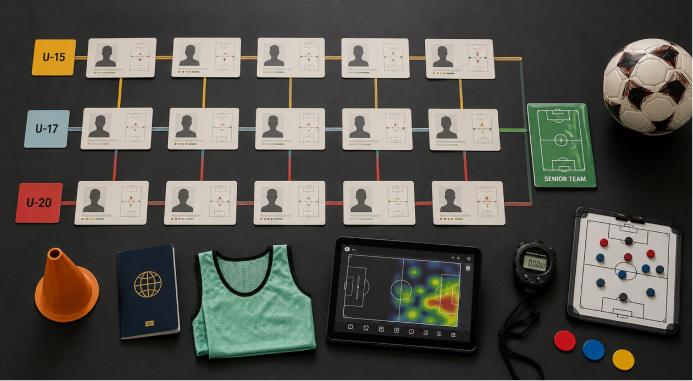
The United States has demonstrated the value of maintaining multiple age-group national teams instead of treating the U-20 squad as an isolated selection.
The roster Segares took to the Concacaf tournament was technically a U-19 group competing in an U-20 competition. That decision allowed the federation to challenge a younger generation against older players while looking ahead toward later international competitions.
Bolivia can apply the same principle without copying the exact age structure.
The FBF should know which players in each birth year have appeared at U-15, U-17 and U-20 level, how many international minutes they have played, their club status and whether their development has accelerated or stalled.
That sounds administrative.
In reality, it is football development.
A federation that cannot track its prospects cannot build continuity.
The Club Environment Must Connect With The National Team
Brazil’s August roster highlights another important feature.
Paulo Victor selected players from Santos, Palmeiras, São Paulo, Flamengo, Grêmio, Red Bull Bragantino, Vasco da Gama, Corinthians and Bahia, while also including players based with FC Liefering in Austria and Shakhtar Donetsk.
The clubs are doing most of the daily development.
The federation’s role is different.
It observes those players, brings them together periodically and tests whether their club qualities fit the national team.
Bolivia needs the same relationship with Bolívar, The Strongest, Oriente Petrolero, Blooming, Always Ready, Aurora, Wilstermann, Nacional Potosí and the rest of the country’s professional and developmental structures.
Youth selection should not depend principally on reputation or which clubs dominate the senior league.
A national-team prospect can emerge from a smaller academy, an overseas system or a club whose first team is struggling.
The key is having scouts watching.
International Matches Should Answer Specific Questions
Bolivia should leave every U-20 window with more information than it had before entering it.
That requires objectives more precise than simply “gain experience.”
A coaching staff can use international matches to evaluate whether the team can:
- build possession against aggressive pressing,
- defend crosses and second balls against physically stronger opponents,
- maintain compactness when possession is lost,
- create chances without relying on individual dribbling,
- defend set pieces,
- press effectively for sustained periods,
- and manage the final 15 minutes when players are fatigued.
Those are measurable developmental questions.
Brazil’s own preparation demonstrates the value of changing opponents. Paraguay, Chile and Bolivia present different styles and physical problems.
The United States experienced the same variation at the Concacaf championship through Haiti, El Salvador, Cuba and knockout-stage opposition.
Bolivia needs enough matches for those differences to become part of the learning process.
The South American Championship Cannot Be The Beginning Of The Project
The most dangerous development model is preparing seriously only when the tournament is close.
By January 2027, the major decisions should already have been tested.
The coaching staff should know its preferred defensive combinations, central midfield options, attacking profiles and likely substitutes.
It should understand which players handle international tempo well and which struggle when matches become faster.
The South American U-20 Championship should then refine those answers under competitive pressure.
It should not be the first place Bolivia discovers them.
This is where the Concacaf U-20 competition structure provides a useful contrast.
The United States entered a tournament in which group matches immediately led into quarterfinals, semifinals and a final. Reaching the semifinal also meant qualification for the 2027 U-20 World Cup. Every stage carried consequences.
The U.S. players therefore accumulated development and qualification experience simultaneously.
Bolivia needs to simulate some of that pressure before South American qualifying begins.
The Goal Should Be Senior Players, Not Youth-Tournament Specialists
There is another important caution when comparing development systems.
Winning youth matches is not the final objective.
The real measure is how many players progress into strong professional careers and eventually become options for the senior national team.
A successful Bolivian U-20 generation should therefore not be judged only by where it finishes in 2027.
It should also be judged in 2029 and 2030.
How many players are starting regularly for professional clubs?
How many have moved abroad?
How many have entered La Verde’s senior squad?
How many are still improving rather than disappearing after their youth eligibility ends?
That question is particularly important because Bolivia is already building toward another senior World Cup cycle.
The players preparing for the 2027 South American U-20 Championship will be approximately 21 to 23 years old during the heart of the qualification campaign for the 2030 World Cup.
They are not a separate project.
They are potentially part of the next senior national team.
Bolivia Can Copy The Process Without Copying The Budget
Comparisons with the United States often become unproductive because the financial difference is obvious.
U.S. Soccer operates in a country with a huge player population, expanding professional leagues, extensive facilities and enormous commercial resources.
Bolivia cannot reproduce that environment simply by deciding to spend more.
But many of the most important lessons are organizational rather than financial.
Bolivia can maintain a national prospect database.
It can coordinate age-group scouting.
It can schedule repeated international windows.
It can give younger players opportunities against older age groups.
It can define tactical concepts across youth teams.
It can track whether players receive regular club minutes.
It can analyze each international match with specific development objectives.
And it can avoid rebuilding the U-20 selection from the beginning every time a major tournament approaches.
Those changes depend more on continuity than scale.
Brazil Should Be A Starting Point, Not An Isolated Event
Playing Brazil in Teresópolis is valuable because it exposes Bolivian players to a high-level talent pool in an unfamiliar environment.
The Brazilian federation itself described Bolivia as an important competitive test while Paulo Victor continues renewing and evaluating his squad.
Bolivia should use that respect productively.
The next step is scheduling additional opponents with different characteristics.
One window against Brazil measures one set of problems.
Playing a more direct opponent measures another. Facing a compact defensive team tests chance creation. Playing away from South America can expose players to different physical and tactical rhythms.
The objective is not collecting prestigious opponents for announcements.
It is building a sequence in which every match changes the coaching staff’s understanding of the squad.
The U.S. Example Shows What A Pipeline Looks Like Under Pressure
The United States did not win the 2026 Concacaf U-20 Championship.
It still left Mexico with a clearer picture of its next generation, a place at the 2027 U-20 World Cup and another major tournament added to the development history of players already moving through professional and academy systems.
That is why the American example is relevant to Bolivia.
A pipeline is not defined by one talented generation.
It is defined by what happens before, during and after that generation enters a major tournament.
Bolivia’s matches against Brazil are a strong step because they create real competitive information months before the 2027 South American championship.
The challenge is making that kind of preparation normal.
If the FBF can connect club scouting, youth camps, international friendlies, performance analysis and long-term player tracking, the 2027 U-20 team can become more than another temporary tournament squad.
It can become part of the foundation for the senior La Verde that Bolivia will need by 2030.