

Bolivia remained 77th in the FIFA men’s world ranking released on July 20, 2026, leaving La Verde at the bottom of the 10 CONMEBOL national teams. The position was unchanged from the June update, while FIFA scheduled its next official ranking for October 7. The number provides a useful reference point, but it does not fully capture the contradictions surrounding the national team. Bolivia came within one victory of qualifying for the 2026 World Cup, yet followed that near miss with two heavy friendly defeats in the United States.
There is enough young talent to support a credible 2030 project. Miguel Terceros, Moisés Paniagua, Robson Matheus, Gabriel Villamil and several other emerging players gained valuable responsibility during the previous qualifying cycle. The larger question is whether the Bolivian Football Federation can turn those individual prospects into a team capable of competing consistently outside the country’s high-altitude home venues.
The ranking will rise only when Bolivia converts occasional signs of progress into repeatable results. That requires stronger defensive organization, a clearer away-match identity, more international experience throughout the player pool and a development plan that survives individual coaching or administrative changes. (The 2007 FIFA Altitude Ban: Defending Hernando Siles)
What Bolivia’s 77th Place Actually Means
The latest FIFA ranking for Bolivia confirms that La Verde remained 77th after the July 20 update. Bolivia’s historical peak was 18th, while its lowest recorded position was 115th. Its long-term average is 73rd, meaning the current ranking sits slightly below the national team’s historical norm.
Remaining in the same position does not mean Bolivia’s performance level was stable. FIFA’s ranking system responds to match results, the strength of each opponent and the importance of the competition. Movement can also depend on what nearby countries do during the same period.
Bolivia’s recent results tell a more complicated story than a single number.
| Date | Opponent | Result | Main Significance |
|---|---|---|---|
| March 26, 2026 | Suriname | 2-1 win | Bolivia recovered from a second-half deficit in the World Cup playoff semifinal |
| March 31, 2026 | Iraq | 2-1 loss | La Verde missed the final place at the 2026 World Cup |
| June 6, 2026 | Scotland | 4-0 loss | Bolivia conceded all four goals before halftime in New Jersey |
| June 10, 2026 | Algeria | 4-0 loss | A second heavy defeat exposed continued problems away from altitude |
The sequence shows why the ranking should be treated as a diagnosis rather than the central objective. Bolivia demonstrated character against Suriname and competed closely with Iraq, but the June friendlies showed how quickly its structure could break against World Cup-level opposition.
A climb toward the top 60 would improve international perception and potentially influence future tournament draws. Reaching that range, however, must be the consequence of better football rather than an isolated administrative goal.
The Iraq Defeat Was A Warning, Not A Dead End
Bolivia defeated Suriname 2-1 at Monterrey Stadium on March 26 to reach the final of the FIFA intercontinental playoff. Liam van Gelderen put Suriname ahead in the 48th minute before Paniagua equalized in the 72nd and Terceros converted a penalty seven minutes later. The comeback demonstrated the value of Bolivia’s younger attacking players and the team’s ability to respond under pressure.
Five days later, Iraq won the decisive playoff 2-1. Ali Al-Hamadi opened the scoring in the 10th minute, Paniagua equalized in the 38th, and Aymen Hussein scored the winning goal eight minutes into the second half. The FIFA playoff review confirmed that Iraq claimed the 48th and final World Cup place, joining France, Norway and Senegal in Group I.
The result extended Bolivia’s World Cup absence beyond the 1994 tournament in the United States. It was painful precisely because qualification was so close.
The match also identified a recurring weakness. Bolivia conceded near the beginning of both halves. At international level, teams must enter those phases with complete concentration because opponents often apply immediate pressure after kickoff or a tactical reset.
That problem reappeared during the June friendlies. The lesson is not that the entire project failed. Bolivia reached the playoff final after beginning the qualifying campaign from a difficult position. The lesson is that small defensive lapses continue to carry excessive consequences.
The June Friendlies Exposed Bolivia’s Away-Match Fragility
The 4-0 defeat against Scotland on June 6 was Bolivia’s first major test after the disappointment against Iraq. It quickly became an example of how not to manage an away match.
Lawrence Shankland scored after five minutes, Scott McTominay added the second in the 23rd, and Che Adams completed a first-half brace with goals in the 30th and 45th minutes. Scotland entered halftime four goals ahead at Sports Illustrated Stadium in New Jersey. The Scottish Football Association match report showed that Bolivia was unable to slow the game after the opening goal or prevent repeated attacks from wide areas.
Four days later, Algeria defeated Bolivia 4-0 at CPKC Stadium in Kansas City. Aïssa Mandi opened the scoring before halftime, while Amine Gouiri scored twice and Anis Hadj Moussa completed the result during a damaging second-half period. The two friendlies left Bolivia with eight goals conceded and none scored across four days in the United States.
Friendly results should not be interpreted exactly like competitive matches. Coaches rotate lineups, test inexperienced players and operate without the preparation time available during a qualifying window.
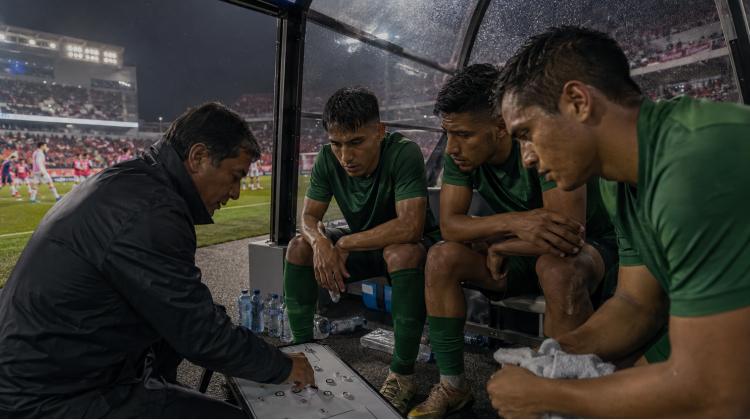
The manner of the defeats still matters. Bolivia struggled with defensive spacing, second balls, wide deliveries and rapid attacks after losing possession. Once the match moved against La Verde, the team lacked the control required to reduce the damage.
Improving before 2030 begins with making away performances more competitive. Bolivia does not need to dominate every strong opponent. It does need to stay organized long enough to give its attacking players a realistic chance to influence the result.
El Alto Must Be An Advantage, Not The Entire Identity
Playing at extreme altitude remains an important part of Bolivian football. The Estadio Municipal de El Alto helped La Verde create one of the strongest home environments in South America during the 2026 qualifying cycle.
Using that advantage is legitimate. Every national team builds around its climate, travel conditions, stadium atmosphere and local playing characteristics.
The problem appears when Bolivia’s tactical identity becomes too dependent on conditions that cannot travel.
At home, La Verde can press aggressively, accelerate matches and test opponents who have limited time to adapt to the altitude. Away from Bolivia, the physical equation changes. Opponents can sustain pressure for longer, recover more quickly after transitions and force Bolivian defenders to cover greater spaces.
The 2030 project therefore needs two compatible versions of the team. At home, Bolivia should remain proactive and use the intensity of El Alto. Away, it requires a more compact structure capable of defending deeper, retaining possession and choosing carefully when to press.
That does not mean abandoning attacking football. It means giving the attack a stable platform.
Defensive Organization Must Become The First Tactical Priority
Bolivia’s immediate challenge is not a lack of attacking talent. It is the frequency with which the team concedes during vulnerable phases.
Iraq scored near the start of each half. Scotland scored after five minutes and reached four goals before halftime. Algeria turned a one-goal advantage into a comfortable victory shortly after the interval.
Those patterns point toward preparation, communication and game-state management. The opening minutes after kickoff and halftime should be among the most rehearsed periods in any tactical plan. Bolivia must know whether it intends to press, protect central spaces or allow the opponent to hold possession in less dangerous areas.
The midfield also needs to provide more consistent protection. When fullbacks advance or central midfielders press simultaneously, the space behind them becomes difficult for the center backs to defend. Better spacing would reduce the number of direct runs and second-ball situations reaching Bolivia’s penalty area.
Set-piece defense requires similar attention. The opening goal against Iraq developed after a corner, and Scotland created repeated danger through deliveries from wide areas. Assignments must remain clear even when the lineup changes.
A reliable defensive structure would not make Bolivia a negative team. It would allow Terceros, Paniagua and Ramiro Vaca to receive the ball in situations where one attacking mistake does not immediately expose the defense.
Terceros And Paniagua Should Anchor The New Cycle
Bolivia’s strongest reason for optimism is the age and potential of its attacking core.
Terceros scored seven times during South American qualifying, finishing behind only Lionel Messi’s eight goals and level with Colombia’s Luis Díaz. He then converted the decisive penalty against Suriname. His ability to receive between the lines, carry the ball forward and finish from different areas gives Bolivia a player around whom a more sophisticated attack can be built.
Paniagua’s playoff performances were equally significant. He entered against Suriname and changed the match with the equalizer before scoring again in the final against Iraq. FIFA highlighted how Óscar Villegas had worked with Paniagua since giving him his senior club debut at Always Ready in 2022.
Their emergence should influence selection throughout the next cycle. Bolivia cannot wait until the final year of qualifying to define the partnerships around them.
The coaching staff needs to determine which forwards complement their movement, which midfielders can progress the ball under pressure and which fullbacks can provide width without destabilizing the defense.
Young players also need continuity at club level. National-team camps are too short to compensate for limited competitive minutes. The FBF should maintain close communication with clubs and create clear physical and tactical plans for players moving between domestic football and leagues abroad.
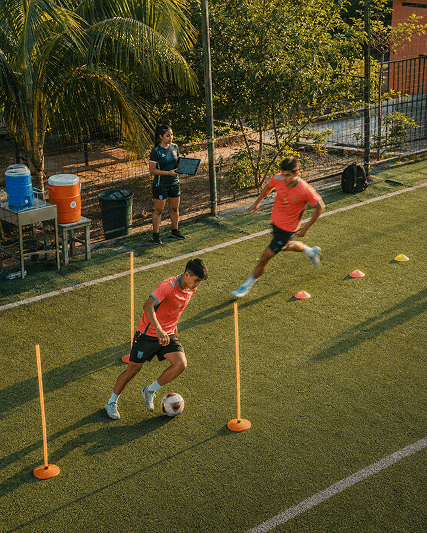
Bolivia Needs A Deeper International Player Pool
The March playoff squad showed that Bolivia’s football base is beginning to extend beyond its domestic league.
The Bolivia playoff roster included footballers based in Spain, Bulgaria, Russia, Ukraine, Canada, Peru, Uruguay, Morocco, Qatar, South Korea and Bolivia. That geographic range creates opportunities for players to experience different tactical systems, training standards and competitive environments.
Having players abroad is not automatically a solution. They must play regularly and hold meaningful roles at their clubs.
Bolivia should focus on preparing prospects for international moves rather than treating any transfer as evidence of development. Language support, physical preparation, contract guidance and realistic club selection can determine whether a young footballer progresses or disappears from the national-team picture.
The federation also needs a wider scouting network for eligible players raised outside Bolivia. Efraín Morales, Lucas Macazaga and other dual-national or foreign-developed players illustrate how the pool can expand. Those decisions must be based on football fit and long-term commitment, not short-term reactions to one qualifying window.
A deeper pool would create genuine competition. That is especially important in central defense, at goalkeeper and in the holding-midfield positions, where injuries or poor club form can currently change the quality of the team significantly.
Friendly Windows Must Become Competitive Laboratories
Bolivia was correct to schedule Scotland and Algeria. Both had qualified for the 2026 World Cup, and both presented tactical and physical challenges that could not be replicated through easier opposition.
The scores were damaging, but avoiding strong opponents would hide the same problems rather than solve them.
Future friendly windows should be designed around specific development goals. One match could test a compact defensive block against a team that controls possession. Another could examine Bolivia’s ability to build from the back under pressure. A third could give young defenders meaningful minutes beside experienced players.
The evaluation should extend beyond the final score. Coaches need to measure how often Bolivia escapes pressure, where possession is lost, how quickly the defense recovers and whether the team creates chances after regaining the ball.
The next official FIFA ranking will be released on October 7. A short-term rise would provide encouragement, but the more important evidence will be visible on the field: fewer early goals conceded, more controlled away performances and a clearer connection between midfield and attack.
The 2030 Standard Is Consistency
Bolivia’s 77th-place ranking reflects a national team positioned between promise and repeated structural limitations.
The road to the 2026 World Cup produced meaningful progress. La Verde reached the intercontinental playoff final, discovered important young players and restored belief that qualification was possible. FIFA’s post-playoff assessment described the process as a foundation for the next cycle rather than something that should be discarded after the loss to Iraq.
The June defeats demonstrated why continuity cannot mean complacency.
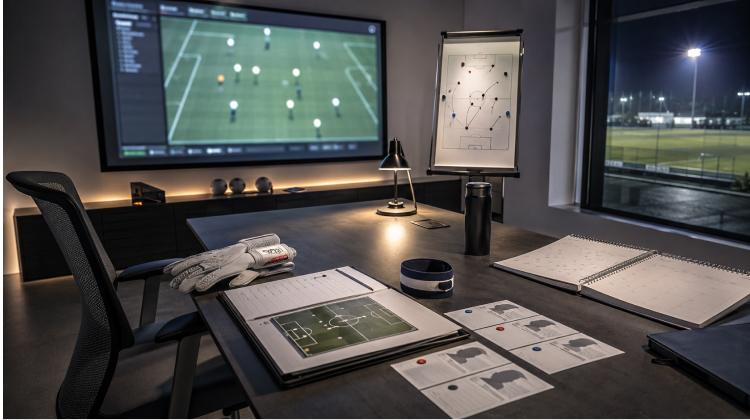
Bolivia must preserve its young attacking core while improving defensive discipline, away-match control and player development. El Alto should remain a competitive weapon, but the team’s identity must function in Monterrey, Kansas City, Buenos Aires, Montevideo and every other environment the next qualifying campaign demands.
A better FIFA ranking will follow if La Verde becomes harder to break down, develops more players in demanding leagues and stops treating strong away performances as exceptions.
The objective before 2030 is not simply to climb from 77th place. It is to build a national team whose results, tactical structure and player development make that climb sustainable.