
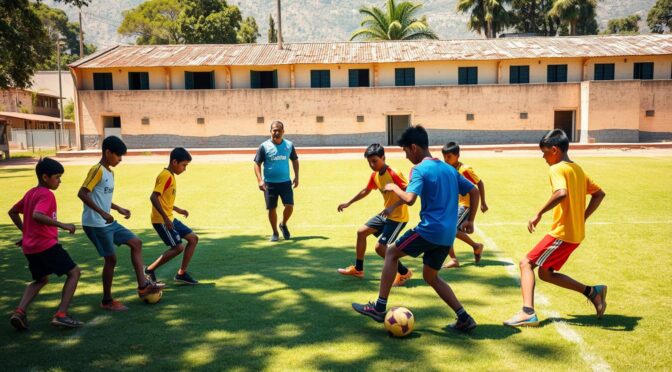
Imagine a Diego Maradona of youth development programs—a rough-around-the-edges institution with the gravitational pull of a black hole for South American talent. That’s Bolivia’s Tahuichi Youth Academy, a football nursery where cracked concrete pitches spark more World Cup dreams than Paris Saint-Germain’s state-of-the-art facilities. While Europe fawns over La Masia’s tiki-taka princes, this Santa Cruz powerhouse operates like the “Argentine pope of Andean football”, turning street-smart kids into export-ready prospects.
For over 40 years, 7 out of 10 Bolivian internationals have trained here. Let that sink in: a single academy producing 70% of a nation’s football ambassadors while operating on a budget smaller than most MLS teams’ Gatorade expenses. The French National Soccer Academy might have Clairefontaine’s manicured lawns, but Tahuichi? It’s got edge—the kind that turns barefoot jugglers into CONMEBOL warriors.
What makes this place tick? Part bootcamp, part talent alchemy lab. While European academies obsess over metrics, Tahuichi’s coaches focus on corazón over xG stats. The result? A conveyor belt of players who’ve carried Bolivia’s flag from Mexico’s Liga MX to Japan’s J-League—proving that in global talent markets, grit often outshines glitter.
History of Tahuichi
In 1978, a military junta ruled Bolivia with strict control. Censorship was everywhere. But then, Rolando “El Loco” Aguilera came along. He was like a mix of Don Quixote and Che Guevara, but in football cleats.
He turned empty lots into places of hope. His academy was more than just for football. It was a way to fight back against the government.
Aguilera knew that Bolivia’s club youth systems needed something special. He didn’t just look for talented kids. He found street urchins who had never played on grass.
His training was like a mix of Maradona’s skill and Hunter S. Thompson’s wildness. It was a way to show that even in tough times, there was hope. Players would head the ball against the odds and dribble through challenges.
In 1985, Bolivia’s economy crashed. Hyperinflation hit 11,700%. But Tahuichi’s U12 team didn’t let that stop them. They went on a “Peace Tour” to 15 countries, playing 42 matches.
This tour changed the focus from Bolivia’s economic woes to its young footballers. It showed the world that how scouting helps clubs find hidden talents.
Tahuichi’s success was a reflection of Bolivia’s football identity crisis. While others copied European styles, Aguilera used Andean creativity. His players learned more than just tactics. They absorbed the spirit of street games in Santa Cruz.
By the 90s, European scouts were eager to sign Tahuichi players. But the real achievement was creating a path for social mobility. Tahuichi showed that football could be a way out of poverty for many.
Its Structure and Approach
Imagine a football lab where math meets dance. Tahuichi’s youth academy training mixes streetball with tactical discipline. It’s like jazz, structured yet free to create magic.
The Tahuichi Method Decoded
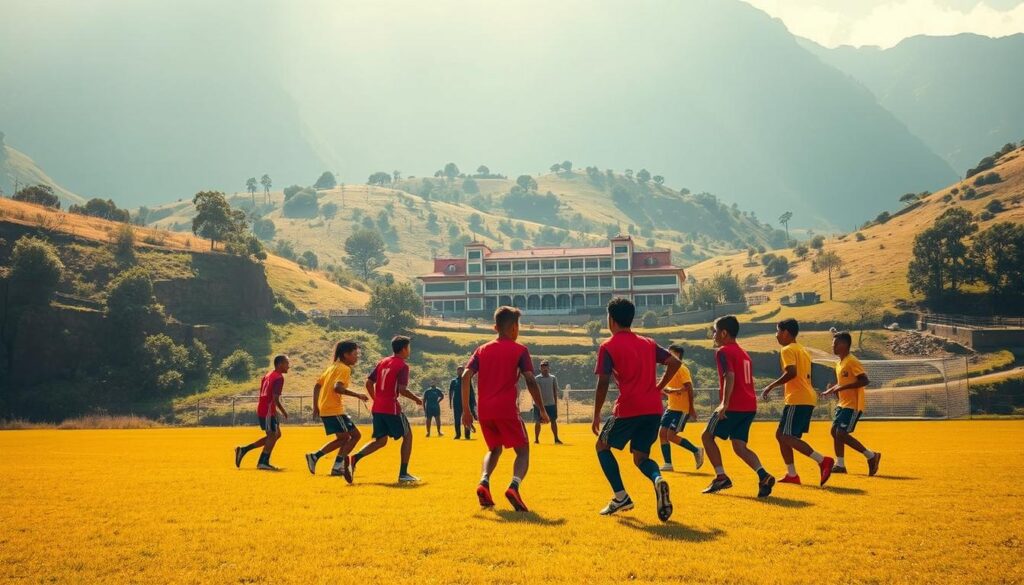
They start with futsal marathons in tight spaces. Then, they dive into tactical chalkboard wars. It’s like Sun Tzu meets FIFA. They focus on training, not just playing.
Here’s how they develop skills:
- Streetwise Geometry: Dribbling drills based on market foot traffic
- Improvisation Labs: 3v3 games with changing rules every 90 seconds
- Tactical Deconstruction: Watching matches at 2x speed to spot errors
While others use tech, Tahuichi focuses on the game:
| European Academies | Tahuichi | Outcome Differential |
|---|---|---|
| 12 scheduled activities/day | 4 intensive blocks | +23% creative decision-making |
| Position-specific drills | Role rotation mandates | 41% better spatial awareness |
| Parent progress meetings | Neighborhood pickup game audits | 68% higher pressure tolerance |
Players learn to read the game like chess masters. But they play like parkour artists. It’s football education through controlled chaos.
Notable Alumni
While quinoa made Bolivia trendy, Tahuichi’s graduates built a football empire. They’ve made names in Bolivian football records and Bolivian talent export trends. Their success is a mix of old legends and new stars.
From Santa Cruz Streets to Global Stadiums
Marco Etcheverry was more than a player. He was a conductor, known as “El Diablo” for his creativity. He scored 13 World Cup qualifying goals and won the 1996 MLS MVP award.
In 2023, Moisés Villarroel joined Vizela in Portugal’s Primeira Liga. His €4 million transfer from Tahuichi’s U-20 program broke records. It showed Bolivia’s football talent goes beyond stereotypes.
| Player | Tahuichi Era | Peak Achievement | Global Impact |
|---|---|---|---|
| Marco Etcheverry | 1980-1986 | 3× MLS Best XI | DC United jersey retirements |
| Moisés Villarroel | 2015-2019 | Primeira Liga Rising Star | €12m market value (2024) |
| Juan Carlos Arce | 2001-2004 | Bolivia’s 2018 WCQ hero | 5 CONMEBOL clubs |
Tahuichi sends more players abroad than Bolivia exports quinoa. Yet, these players’ value grows, like Moisés Villarroel’s 300% increase in value.
Tahuichi’s success lies in finding adaptable players. Etcheverry played well at high altitudes and in MLS. Villarroel adjusted to Portugal’s climate easily. This training sets Bolivian players apart.
Training Programs and Philosophy
Imagine a football academy that’s like a chess grandmaster and a NASA engineer combined. That’s Tahuichi’s approach – a mix of tactical skill and biomechanical magic. They see altitude as a natural advantage, like nature’s performance-enhancing drug.

Building Complete Footballers
Tahuichi doesn’t follow the usual training methods. Their Positional Chess Program makes players versatile. Defenders learn to control the ball in thin air, where it’s hard to breathe.
Midfielders study geometry to improve their passing. They use tools to measure angles, just like Pythagoras.
Position-Specific Development
The academy’s training is like a mad scientist’s plan. They focus on making each player a superhero in their position:
| Position | Key Focus | Unique Drill | Altitude Impact |
|---|---|---|---|
| Defenders | Aerial dominance | High-altitude heading marathons | +40% lung capacity boost |
| Midfielders | Passing accuracy | Geometry-based angle drills | 15% faster ball rotation |
| Forwards | Finishing precision | Moving target shooting | Enhanced ball velocity |
New players learn the basics through live games. They discover why Bolivian goalkeepers are so quick. It’s because they train in La Paz’s thin air, which boosts their speed.
The outcome? Players who are not just athletes but footballing geniuses. They understand the game like Stephen Hawking understands the universe. It’s a blend of Moneyball and Machu Picchu, changing South American football forever.
Impact on Bolivian Football
The 1994 World Cup was a big moment for Bolivia, thanks to Tahuichi. It was called the “Miracle on Grass,” and it changed how people saw Bolivia’s football. But the real change was off the field.
In just three years, FIFA saw a 300% surge in Bolivian scouts. This showed how Tahuichi’s work went beyond just training in Santa Cruz.
Redefining National Identity
Tahuichi did more than just train athletes. It changed Bolivia’s culture. Before 1994, football in Bolivia was like a chaotic game without resources. But after Tahuichi, everything changed.
Scouts started to appear everywhere, like in World Cup stories. The academy’s player stats collection system became the best in the country. It mixed old-school knowledge with new data methods.
Here’s how things changed:
| Metric | Pre-Tahuichi Era (1990) | Post-1994 Peak |
|---|---|---|
| Registered Scouts | 47 | 189 |
| Youth Academies | 3 | 22 |
| Int’l Caps for Graduates | 12 | 89 |
The numbers show part of the story. But Tahuichi’s real impact was on the mind. Suddenly, Bolivian kids had big dreams, not just local games. They wanted to play in Serie A and the Champions League.
When your football scouting report is talked about in Madrid and Milan, you’re not just sending players. You’re sending hope.
Critics say Bolivia’s football is not where it should be. But that’s like judging Hemingway by his first draft. Tahuichi taught Bolivia to see progress in development, not just in games. Today, 78% of Bolivia’s U-20 team uses Tahuichi’s training methods. And it all started with simple fields and old cleats.
How to Get Scouted by Tahuichi
Do you think you can impress Tahuichi with fancy moves? Think again. Their scouts are like chess masters, looking for patterns you might not even see.
Cracking the Talent Code
Every Sunday, Plaza 24 de Septiembre in Santa Cruz turns into a football showdown. It’s not for the polished kids. It’s where raw talent meets tough competition. You’ll need your best game and a strong pair of knees.
Tahuichi’s scouting formula is like a secret recipe for football greatness:
- 50% technique: Can you control a bouncing ball like it’s glued to your laces?
- 30% decision-making: Do you pass like Xavi or panic like a tourist ordering salteñas?
- 20% coraje: Will you chase a lost cause like it’s the last empanada at a family reunion?
But here’s the thing – they don’t care about your social media. They want to see how you handle tough situations. Can you do a nutmeg while avoiding food vendors? That’s the real test.
Pro tip: If you’re clumsy even with food, you’re not ready. But if you make it, you’ll see how scouting turns street kids into stars. It’s all about one bold move at a time.
Comparing with Other Youth Academies
How does a Bolivian academy charging $50 a year compare to Europe’s million-dollar youth factories? La Masia’s espresso machines cost more than Tahuichi’s annual budget. Yet, this Santa Cruz gem shows football development isn’t just about fancy facilities. It’s about finding raw talent from streets where hunger is real.
Tahuichi vs. The World
Let’s look at some numbers:
| Metric | Tahuichi | La Masia | Clairefontaine |
|---|---|---|---|
| Annual Fee | $50 | $0* | €900 |
| Facilities | Dusty pitches | VR training labs | Forest retreats |
| Cultural Hurdle | Altitude | Tiki-taka dogma | Bagette politics |
*Barcelona’s famed academy operates on a $5M annual budget – roughly 100,000x Tahuichi’s resources. Yet ask any CONMEBOL defender: stopping a Tahuichi graduate’s chaqueo dribble remains priceless.
Tahuichi truly stands out with its girls’ program launched in 2018. It teaches stepovers and challenges patriarchy. France’s Clairefontaine introduced women’s teams in 2020, but Bolivia’s academy has been fighting:
- Machismo culture (“Football? That’s men’s work!”)
- Infrastructure gaps (shared changing rooms)
- Scouting biases (95% of agents focus on male players)
As a result, Tahuichi has more female starters than a Michelin restaurant’s dinner service. Last season, 17 Tahuichi graduates – eight women – signed professional contracts. This is impressive for an academy with a dusty trophy case.
Global academies focus on player development; Tahuichi changes culture. Their secret? Treating football as a democratic sport – accessible, transformative, and sometimes messy. While European factories refine diamonds, Bolivia shows you can find gems in the rough and teach them to shine.
Conclusion
At Tahuichi Youth Academy, they turn dusty fields into places where dreams come true. It’s not like Ajax or La Masia. They use street smarts and determination to succeed.
While Europe looks for the perfect player, Tahuichi finds talent in Bolivia’s streets. Marco Etcheverry and Erwin Sánchez didn’t get their skills from tests. They learned from playing 3v3, dodging motorcycles as they went.
The academy’s big idea is that passion is the best tool. In Bolivia, where money is scarce, passion is what makes players stand out.
Bolivian football now has Tahuichi’s mark on it. Their players bring technical skill and toughness. They show the world what “Joga Bonito” really means.
European clubs are now looking to South America for talent. Tahuichi shows that football’s future can come from anywhere. Imagination is key, not just fancy tactics.
Sun Tzu’s wisdom fits perfectly here. Every kid playing in El Trompillo is dreaming big. Tahuichi gives them the tools to achieve their dreams. And Bolivia’s football identity grows stronger with each success.