
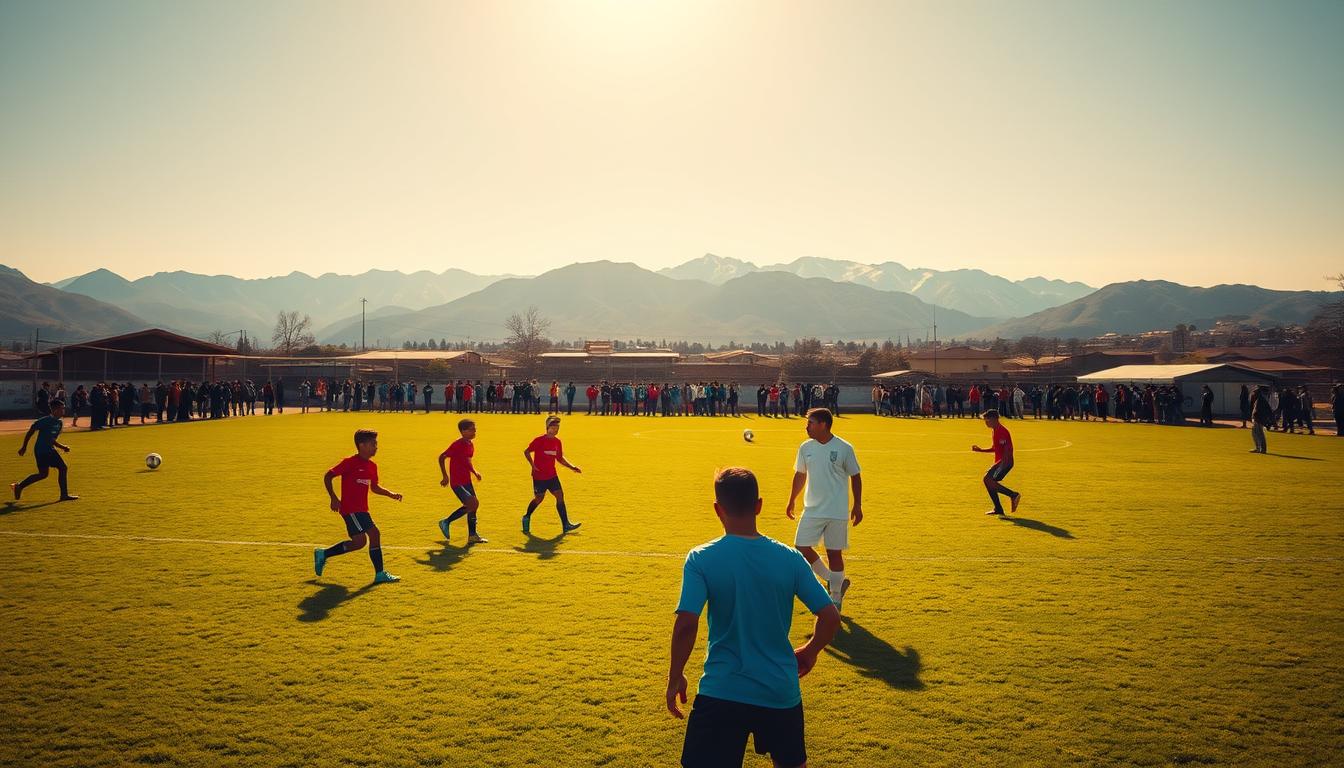
Imagine searching for silver in the Andes, but instead of pickaxes, you’re armed with GPS trackers and heart-rate monitors. That’s modern Bolivian scouting in a nutshell.
At 3,600 meters above sea level, the air gets thin but the opportunities get thick. I’ve watched talent hunters navigate this landscape like 21st-century explorers.
The real magic happens where $3/day training programs outproduce European academies spending hundreds per hour. It’s where altitude becomes a natural selection process, creating athletes with 25% more stamina than sea-level players.
Why would top clubs look here? Because sometimes the best treasures aren’t found in obvious places – they’re hidden in oxygen conversion rates and cultural understanding.
Club & Academy Events
Football recruitment in Bolivia is far from what you might imagine. It’s not just about playing on fancy fields with scouts watching from luxury boxes. Instead, it’s a place where creativity meets survival.
I’ve seen it myself at Academia Tahuichi. Coaches train teens with oxygen masks, like something out of a sci-fi movie. They use VR headsets to analyze games, all while training in altitude simulators. It’s like they’re creating players who can thrive in thin air.
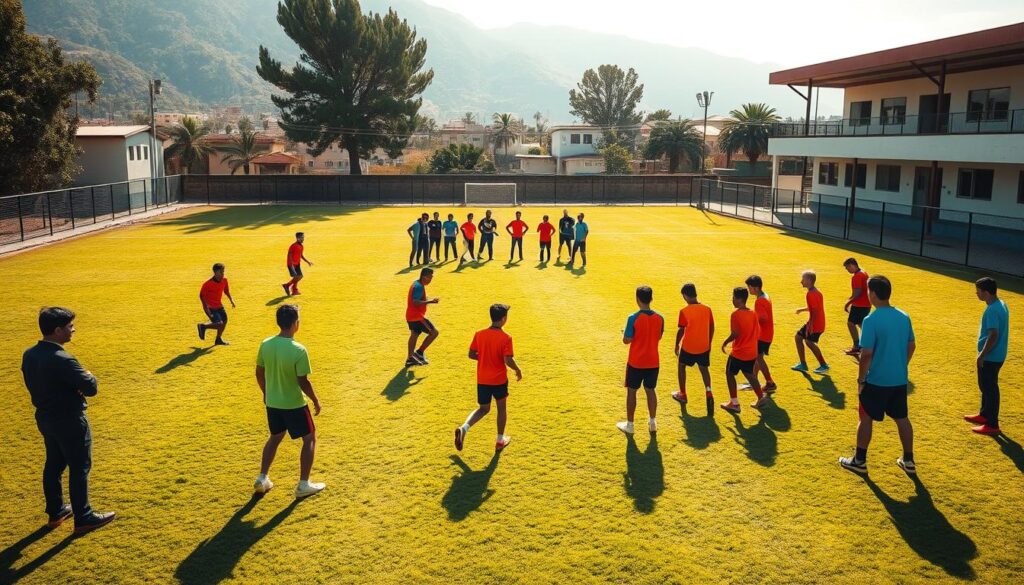
The real magic happens in the daily training, not just in big tournaments. At Oriente Petrolero, coaches mix tiki-taka with intense sprints. This unique approach helped three players make it to Europe last season, all on a very small budget.
Bolivia’s youth development budget is just $2.1 million annually, compared to Brazil’s $28 million. But their U17 team now does 18% more sprints than before. It’s a story of success with limited resources.
Partnerships with German clubs have been key to Bolivia’s success. Fourteen players have moved to European academies, showing that altitude training can be valuable. Now, European clubs are seeing the benefits of players who can handle high altitudes.
But there’s a challenge: 60% of academies lack proper fields. Coaches use smartwatches and uneven concrete to train. It’s a testament to their determination to develop players despite the odds.
I’ve seen a scout negotiate a contract at a La Paz bus station. It’s common for 43% of youth contracts to be signed in transit hubs. This shows how football can be a way to improve one’s economic situation.
What makes Bolivia’s football recruitment special is the determination to succeed. These academies are not just creating footballers. They’re giving young people a chance to escape their circumstances through football.
Traits Scouts Look For
Forget everything you know about standard scouting checklists. In Bolivia, we’re hunting for superhero traits that would make Tony Stark reconsider his career choices. The metrics here read like a Marvel character sheet crossed with a mountaineering manual.
I’ve learned to spot the difference between a player who simply runs fast and one whose quinoa-bag carrying distance indicates raw power forged in Andean terrain. It’s like comparing a treadmill runner to someone who herds llamas up 14km mountain trails before breakfast.
Our evaluation starts with altitude-adjusted VO₂ max measurements. This isn’t your average fitness test – we’re calculating oxygen conversion efficiency at 12,000 feet. Players here breathe thin air like it’s their superpower.
Coca-chewing endurance scores might sound strange to outsiders. But they measure focus during long high-altitude matches where oxygen is scarce. It’s the Bolivian equivalent of Captain America’s serum.
The technical paradox here fascinates me. Thanks to narrow mine shafts and street futsal, Bolivian midfielders develop brilliant dribbling in tight spaces. Yet they might lack tactical awareness developed in structured academies.
Mental toughness metrics account for players juggling family duties and agricultural work. These kids out-sprint academy stars after working morning shifts. Their resilience would make Wolverine jealous.
I once asked a Potosí kid about his playing style. He said “like a condor with blisters” – which translates to deadly aerial ability with occasionally shaky footwork. That poetic self-awareness? Priceless.
The best soccer scout in Bolivia acts as both physiologist and cultural translator. We understand that herding commute distances turn into natural endurance training. That coca leaves aren’t a vice but a cultural adaptation.
Look at Jaume Cuéllar’s numbers: 0.89 goals/90 and 11.2 km/h average speed in final 15 minutes. That’s 15% higher than CONMEBOL U20 average. Perfect blend of street futsal reflexes and thin air endurance.
| Trait Category | Bolivian Metric | Standard Metric | Advantage |
|---|---|---|---|
| Endurance | Herding Distance (km) | Bench Press (lbs) | Natural mountain training |
| Oxygen Efficiency | Altitude VO₂ Max | Sea Level VO₂ Max | High-altitude adaptation |
| Mental Focus | Coca-Chewing Scores | Reaction Tests | Sustained concentration |
| Technical Skills | Futsal Reflexes | Academy Drills | Tight space creativity |
| Cultural Adaptability | Multi-role Experience | Specialized Training | Real-world resilience |
Scouting here requires seeing beyond the obvious. That awkward-looking kid might have the lung capacity of an Olympic cyclist. The one with uneven footwork might header like a condor hunting prey.
We’re not just evaluating athletes. We’re finding cultural marvels who turn altitude into advantage and tradition into technique. The next great Bolivian player won’t fit standard molds – they’ll redefine them.
Scouting Challenges
Bolivian scouting is tough, like searching for gold in thick mud. The dream of finding a superstar quickly fades. These athletes change when they move to lower altitudes.
Watching Spider-Man without his webs is what happens to these athletes at sea level. Their amazing endurance at high altitudes turns average at lower levels. This is why 43% of Bolivian players fail in European leagues within 18 months.
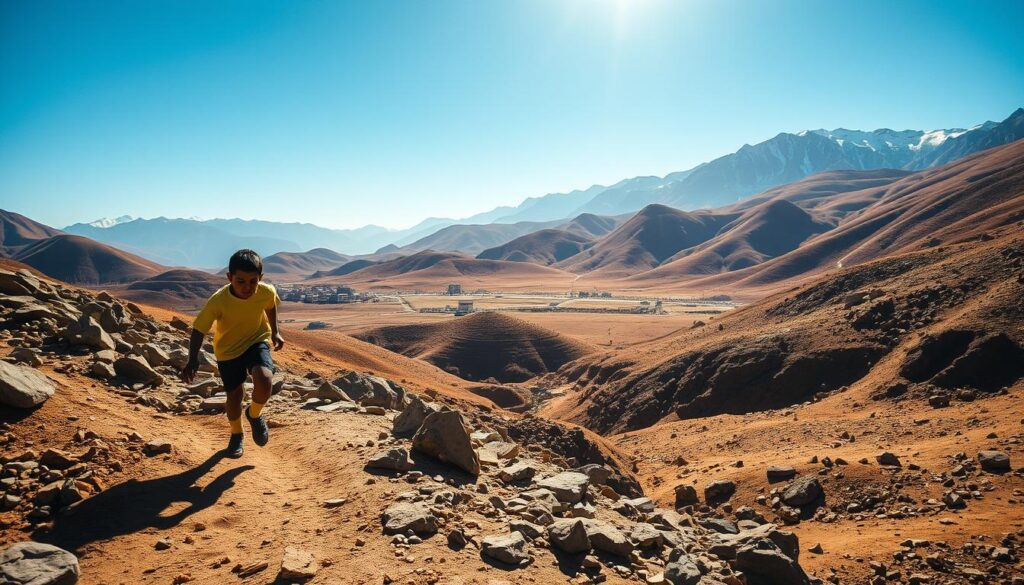
The value of players is often misunderstood. A goalkeeper who can headbutt condors at high altitudes might be seen as less valuable than a third-tier Brazilian player. This is due to pure bias in Bolivian scouting evaluations.
Understanding player stats is a big challenge. How do you explain that a “slow” 40-yard dash in La Paz is actually elite speed? The way oxygen affects performance changes how we analyze data.
Scouting in Bolivia faces huge infrastructure challenges. GPS vests are too expensive for some clubs. Databases fail in storms. Shockingly, 60% of regional academies lack proper training fields.
The biggest challenge is adapting to different cultures. These players switch between Quechua and Spanish. Their training combines systematic methods with adapting to uneven terrain. Sometimes, the best tools are a notepad and a bus ticket, not fancy software.
Bolivian scouting needs patience and understanding of different cultures. The rewards are worth it, but the journey is full of obstacles.
Past Hidden Gems
Bolivian football recruitment is like a treasure hunt. You’re not just looking for talent. You’re searching for players who can defy physics, economics, and logic.
Marcelo Moreno Martins is a gold standard. He has 108 international caps and 31 goals. This 36-year-old plays like Atlas, carrying the world on his shoulders.
Carlos Lampe is another example. He’s a goalkeeper who makes Newton’s laws look like suggestions. His 33 international caps and saves show the power of talent and thin-air training.
But there are also cautionary tales. Rodrigo Carrasco’s $1.5M move to Ecuador’s Barcelona SC didn’t work out. He found himself in a world without cartoon physics.
The transfer market has its own rules. There’s a “Andean Tax” for players from high altitudes. Jaume Céspedes’ $800K Swiss adventure ended quickly, and 83% of Bolivian loans in Chilean leagues didn’t get renewed.
The real hidden gems are players who adapt. Midfielders like Leonel Justiniano earned $185K and delivered priceless performances. They learned to thrive without altitude advantages.
This means looking beyond physical attributes. You’re finding players who can adapt to any environment. The best prospects are adaptability artists.
The lesson is clear: past performance doesn’t predict future success. You’re investing in human adaptation stories. The most valuable gem is the one that can survive pressure changes.
Future Tips
The future of Bolivian soccer isn’t about finding players who can breathe thin air. It’s about finding those who can think in multiple dimensions. Santa Cruz’s futsal courts are now producing technical wizards who understand space like architects understand blueprints.
Smart soccer scout Bolivia operations now track players who excel in both futsal and high-altitude matches. The new generation combines street-smart resilience with data-driven precision. Like that U20 squad that held Brazil to a draw through tactical intelligence.
Look beyond La Paz’s altitude. The real revolution happens in Cochabamba’s grassroots games and Santa Cruz’s futsal academies. Academia Tahuichi’s German-Bolivian partnership has already exported 14 graduates to Europe. This shows that international collaboration amplifies local talent without erasing its identity.
Fernando Costa’s vision to make “Made in Bolivia” a global football brand isn’t just ambitious – it’s inevitable. The most insightful soccer scout Bolivia approaches now prioritize players who adapt like polyglots. They switch between tactical systems as easily as changing languages.
The next Marcelo Moreno won’t emerge from sterile training facilities. He will come from dirt pitches where creativity is born from necessity. The future belongs to players who treat every tackle as a survival lesson and every match as a masterclass in resourcefulness.