
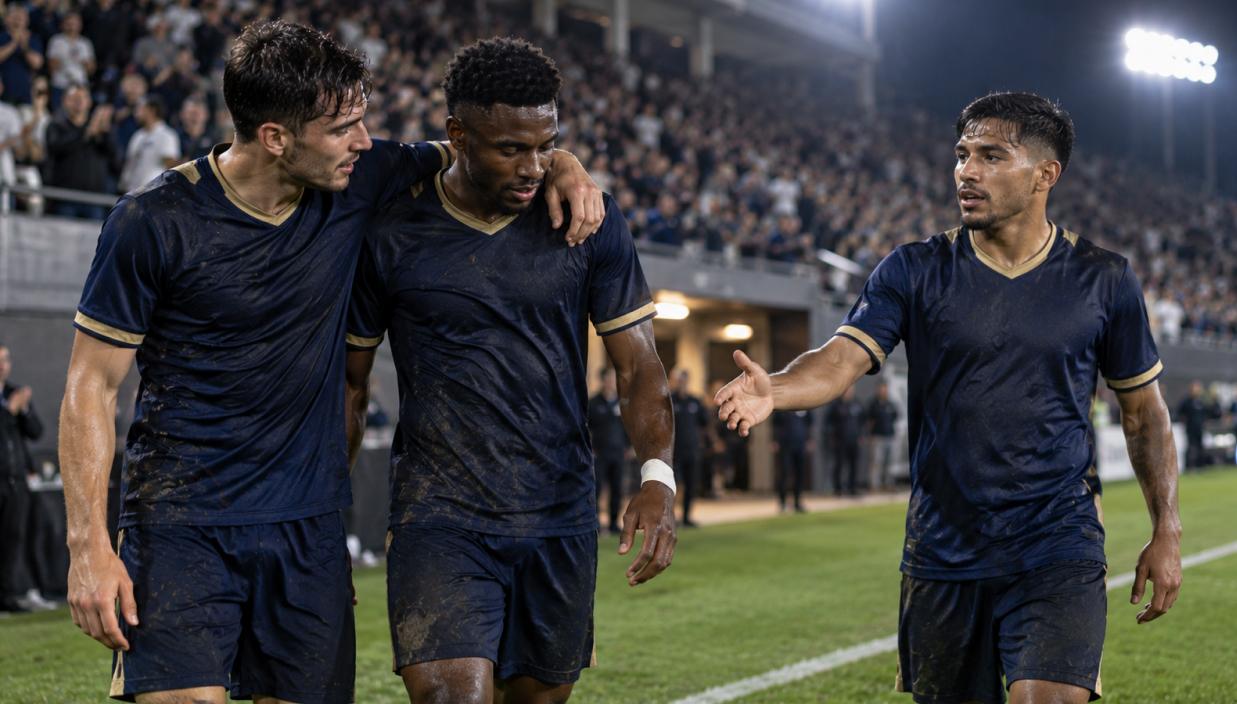
Philadelphia Union turned a three-goal halftime deficit into a 4–3 victory over Sporting Kansas City on September 19, 2026, extending its MLS unbeaten run to 11 matches. Four second-half goals at Sporting Park in Kansas City, Kansas, transformed an approaching defeat into another significant result for a team rebuilding its season.
The comeback strengthens Philadelphia’s case as an increasingly dangerous playoff contender. The more persuasive evidence, though, extends beyond one dramatic evening: the Union has recorded nine wins and two draws during its unbeaten stretch.
There is a distinction between becoming harder to beat and becoming a complete postseason team. Philadelphia’s attacking response demonstrated the first. Conceding three times in the opening 16 minutes showed why the second remains a work in progress.
Four Goals In Nine Minutes Change The Match
Sporting Kansas City established a commanding early position through two goals from André Luiz and a header from Wyatt Meyer. Philadelphia reached halftime trailing 3–0 and did not begin its scoring response until the 64th minute.
Bruno Damiani supplied the first goal. Cavan Sullivan followed in the 66th minute, and Milan Iloski equalized in the 68th. A Zorhan Bassong own goal in the 73rd completed the turnaround. Philadelphia’s official comeback report confirms that the victory matched the club’s longest league unbeaten run.
The speed of the reversal is striking, but the distribution of contributions matters just as much. Three different Union players scored before pressure produced the winner. Sporting could not contain the recovery by shutting down one finishing option.
Philadelphia then faced a different assignment: protecting the advantage it had worked so hard to create. Completing that final phase gave the comeback practical value. Recovering to 3–3 would have preserved the unbeaten run; winning secured two additional points.
The Unbeaten Run Carries More Weight Than One Comeback
MLS reports that Philadelphia has gone 9–0–2 since returning from the World Cup pause. That represents 29 points from 33 available, or approximately 2.64 points per match across the stretch. The record appears in the league’s Union form report.
An unbeaten sequence can sometimes conceal a team drawing frequently without gaining much ground. Philadelphia’s run is different. Nine victories show that it has repeatedly converted competitive performances into maximum points.
That is the strongest basis for treating the Union as a more serious postseason threat. A single comeback can depend on unusual finishing, an opponent’s collapse, or an own goal. Winning consistently across 11 matches requires a broader level of performance.
The streak still should not become a prediction of automatic playoff success. Opponent quality, player availability, and the situations within individual matches all affect how well regular-season form transfers to elimination soccer.
The useful interpretation is that Philadelphia has established a sustained improvement. Its next task is to make that improvement less dependent on recovering from difficult positions.
The Opening Sixteen Minutes Still Demand Attention
The final score should not remove the first-half problems from the review. Luiz repeatedly threatened Philadelphia, and Meyer’s goal came from a corner. Those attacks tested different parts of the Union’s defensive work.
A team preparing for the postseason needs reliable responses to both individual dribbling and deliveries into the penalty area. Allowing an opponent to build such a large advantage reduces the margin for every subsequent decision.
Sporting’s match report and statistics recorded a relatively close overall contest: Philadelphia led 11–10 in shots and 7–5 in shots on target, with possession divided almost evenly. Sporting finished the night at 5–17–3, and Philadelphia at 10–10–6.
That context limits claims that the comeback established dominance over a leading contender. Philadelphia showed the ability to escape a severe problem against a struggling opponent. It also allowed that opponent to create the problem in the first place.
The coaching review should separate excellent opposition finishing from preventable defensive exposure. Simply asking for a faster start would offer little guidance. The more useful questions concern pressure on the ball, cover behind the first defender, and marking during set pieces.
Cavan Sullivan Gives Philadelphia More Than A Scoring Threat
Sullivan’s goal and assist against Sporting took his regular-season production to seven goals and 12 assists. His contribution fits a larger pattern of young players influencing the Union’s results rather than appearing only in limited supporting roles.
For Philadelphia, the value lies in having a player who can contribute at different stages of an attack. A scorer needs service. A creator needs teammates capable of finishing. A player contributing in both areas gives the team more ways to connect possession with chances.
NoticiasBo’s earlier examination of Philadelphia’s attacking development provides context for Sullivan’s progress. The latest performance shifts the discussion further toward what his production means for the whole team.
It would still be misleading to reduce the comeback to one teenager. Damiani and Iloski finished important attacks, and Quinn Sullivan helped change the second-half performance after entering at halftime. The result depended on several players making useful contributions within the same short period.
For postseason opponents, that variety presents a more demanding problem than a team whose offense consistently runs through one final action.
Academy Production Is Becoming A Competitive Asset
Philadelphia’s recent progress has a clear development dimension. Before the Kansas City match, the club reported that nine different players had scored during the preceding 10-game unbeaten run. It also announced first senior U.S. national-team call-ups for Cavan Sullivan, Neil Pierre, and Frankie Westfield.
The club’s homegrown player report identifies interim head coach Ryan Richter’s role in Sullivan’s emergence as a starting midfielder.
The competitive significance is broader than recognition for academy graduates. Young players are filling meaningful positions within a team pursuing results now. Their development and Philadelphia’s immediate ambitions are increasingly connected.
That creates opportunity and responsibility. Coaches must provide clear roles, experienced support, and room to respond to mistakes. A difficult opening period should become material for improvement rather than a reason to make sweeping judgments about young players.
International selection introduces another practical consideration. Recognition can benefit a player’s development, but travel and time away from club training require planning. Philadelphia’s squad must sustain its standards when the preferred lineup is unavailable or preparation time is reduced.
The Attack Has Shown Multiple Ways To Produce
The Kansas City comeback followed other productive attacking displays. Against FC Cincinnati earlier in September, Damiani scored a hat trick, Quinn Sullivan contributed a goal and two assists, and Cavan Sullivan registered three assists. Philadelphia detailed those performances in its Matchday 25 honors report.
That evidence strengthens the argument that the latest comeback belongs to a wider offensive improvement. Different players have already delivered substantial contributions in different matches.
The next question is how effectively those options function against opponents who deny space and force longer possessions. A team chasing a game may find opportunities as the opponent’s defensive decisions become uncertain. A tightly organized playoff opponent can present a less forgiving test.
Philadelphia needs its combinations to remain effective when the match offers fewer transitions and fewer immediate shooting opportunities. Patience, movement away from the ball, and the ability to recycle possession will matter alongside finishing.
Orlando Offers A Test Of Greater Control
Philadelphia’s next scheduled home match is against Orlando City SC at Subaru Park in Chester, Pennsylvania, on September 26. The fixture offers an opportunity to extend the run through a more controlled performance.
The Union does not need another extraordinary recovery to demonstrate progress. Avoiding early defensive exposure, creating chances through several players, and managing the score after taking a lead would offer equally valuable evidence.
As of September 22, the answer to the playoff question is cautiously positive: Philadelphia’s sustained winning form and shared attacking production make it a stronger contender than a single comeback alone would suggest. The remaining weakness is the amount of defensive risk it sometimes has to overcome.
The most useful next step is to preserve the attacking confidence without requiring another rescue. A team that can recover from 3–0 down is difficult to dismiss. A team that combines that scoring capacity with consistently secure openings becomes much harder to prepare for.