
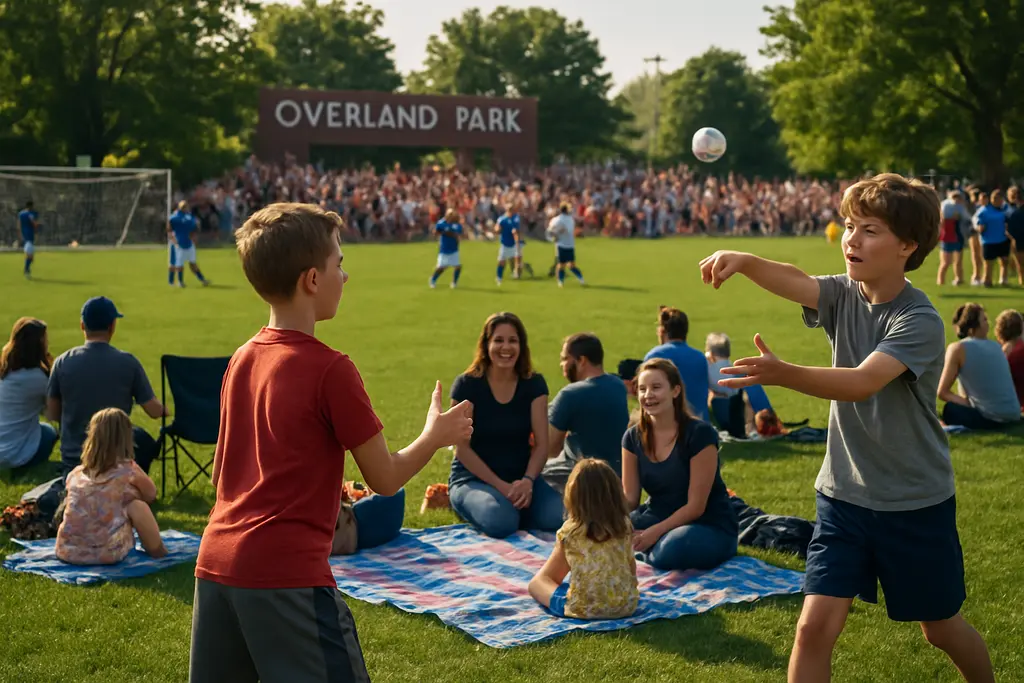
Overland Park sports tourism moved from a promising civic strategy to a measurable economic force in 2025, when reported visitor-economy figures showed the city crossing $1 billion in total economic impact for the first time. The figure was tied to 5.3 million visitors, a scale that places tournament travel, hotel demand, food spending, and facility planning at the center of the city’s sports-business story.
The growth did not come from one event alone. The available figures point to a layered model: youth soccer, multiday competitions, lodging strength, food and beverage spending, and public investment in venues. That mix matters because sports travel tends to reward cities that can pair fields or courts with hotels, restaurants, and repeat scheduling. In historical terms, the formula is familiar. Communities that built durable sports calendars often did so through dependable venues first, then used those venues to attract governing bodies, clubs, and families back year after year.
Why Overland Park sports tourism Grew
Overland Park sports tourism By The Numbers
The 2025 figures marked a clear step beyond the 2024 baseline. In 2024, Overland Park recorded 5.1 million visitors and $964 million in direct visitor spending, a 4.8% increase over 2023. Overnight visitor spending was reported at $646 million, more than two-thirds of the total. That ratio is central to the sports-tourism case because multiday tournaments create more chances for hotel stays, restaurant visits, and related spending than single-day local events.
For Overland Park sports tourism, the lodging and dining figures show why tournament calendars carry weight beyond the playing surface. In 2024, lodging visitor spending rose 8.1% year over year to $198 million and was reported above pre-pandemic levels. Food and beverage spending grew 6.2% to $265 million, accounting for 27% of visitor spending. These categories are not side details; they are the parts of the visitor economy that often make sports events attractive to cities.
Events That Filled The Calendar
The 2025 sports calendar included multiday events that had moved from other markets, including the 1st Phorm Monster Games, relocated from Joplin, Missouri, and the NIRSA National Soccer Championships, relocated from Texas. The evidence supports a cautious reading: Overland Park was not simply benefiting from general travel recovery, but from an event-acquisition strategy that placed sports at the center of visitor growth.
Soccer remained one of the clearest anchors. The U.S. Youth Soccer Midwest Regional Championships, held annually at the Scheels Overland Park Soccer Complex, drew more than 6,800 attendees in 2024 and generated an estimated $8.2 million in direct economic impact each year. That type of event is valuable because it brings athletes, families, coaches, and staff into a defined area for several days, often during a schedule that local hotels and restaurants can plan around.
Infrastructure And Event Strategy
Bluhawk And Facility Investment
Overland Park sports tourism has also been shaped by venue investment. In 2022, the city broke ground on the Bluhawk multi-sport complex, part of a mixed-use project valued at more than $400 million. In its first year of operation, the complex was projected to drive $3.8 million in economic impact, according to the Kansas Department of Commerce announcement. The key point is not only the dollar figure, but the type of asset: a multi-sport facility can give a city flexibility across seasons and age groups.
That flexibility is useful in a market where sports travel is not limited to one code. Soccer may be the most visible example in the available data, but multi-sport infrastructure gives event organizers more options and allows a city to court competitions with different field, court, and scheduling needs. For those interested in other sports insights, readers can explore golf coverage on a related site within the same network.
Soccer, Multiday Stays, And Repeat Use
The Scheels Overland Park Soccer Complex illustrates the importance of repeat use. Annual events build operational knowledge: hotel blocks, traffic patterns, volunteer staffing, food service, and field maintenance become easier to plan when an event returns. In football history, the best host cities have rarely relied on novelty alone. They have built credibility by staging competitions cleanly and giving organizers reasons to return.
That is the likely advantage Overland Park is trying to protect. The research shows the city’s strategy has focused on multiday sporting events, not only one-off showcases. From an economic standpoint, that distinction matters. A single match can bring attention, but a tournament can produce several waves of spending as teams arrive, compete, recover, and stay through elimination rounds or finals.
Public Finance And Policy Signals
Tax Revenue And Household Offset
If Overland Park sports tourism is to remain a civic priority, tax impact will be part of the debate. Visitor-generated state and local tax revenues in 2025 were reported at $108 million, up from $103 million in 2024. The same reporting stated that visitor spending offsets about $1,280 per household in property taxes. Those figures help explain why sports events are often framed not just as entertainment, but as fiscal tools.
That framing still requires caution. Economic-impact figures can describe activity, but they do not answer every public-policy question. They do not automatically settle debates about facility costs, opportunity costs, neighborhood effects, or how benefits are distributed across workers and businesses. The supported conclusion is narrower: the reported visitor and tax figures show that sports-related travel has become a significant part of Overland Park’s visitor economy.
Kansas Grant Discussion In 2026
The state policy discussion also reflected the growth of the sector. In March 2026, Kansas legislative records for HB 2346 described a proposal to create a dedicated sports tourism grant fund, intended to help cities attract and retain major sporting events. The minutes recognized sports tourism as one of the fastest-growing segments with broad economic potential, as recorded in the HB 2346 minutes.
Because the available research only confirms the discussion in March 2026, it would be unsafe to treat the proposal as enacted here. What can be said is that Kansas policymakers were weighing a more formal role for the state in the competition for events. For cities such as Overland Park, that could matter if grant support helps cover bid costs, event servicing, or facility needs. The record supports the existence of the policy debate, not any final result beyond that point.
Sports Tourism In Overland Park
What The 2025 Marker Means
The strongest reading of Overland Park sports tourism is that it has matured into a coordinated economic strategy backed by facilities, repeat tournaments, and measurable visitor spending. The 2025 crossing of $1 billion in total economic impact is the headline, but the supporting details explain the structure beneath it: 5.3 million visitors, nearly 11,000 supported jobs, $496 million in labor income, and a tax base strengthened by visitor activity.
Across Johnson County, which includes Overland Park, Olathe, and Lenexa, visitor spending reached $2.1 billion in 2025, with sports complexes and youth tournaments cited as major drivers. That countywide figure places Overland Park inside a broader regional sports corridor rather than as an isolated case. The city’s challenge after 2025 was not proving that sports travel could draw people; the data already showed that. The more durable test was whether facility quality, event retention, and public finance could stay aligned without overstating what sports tourism alone can solve.