
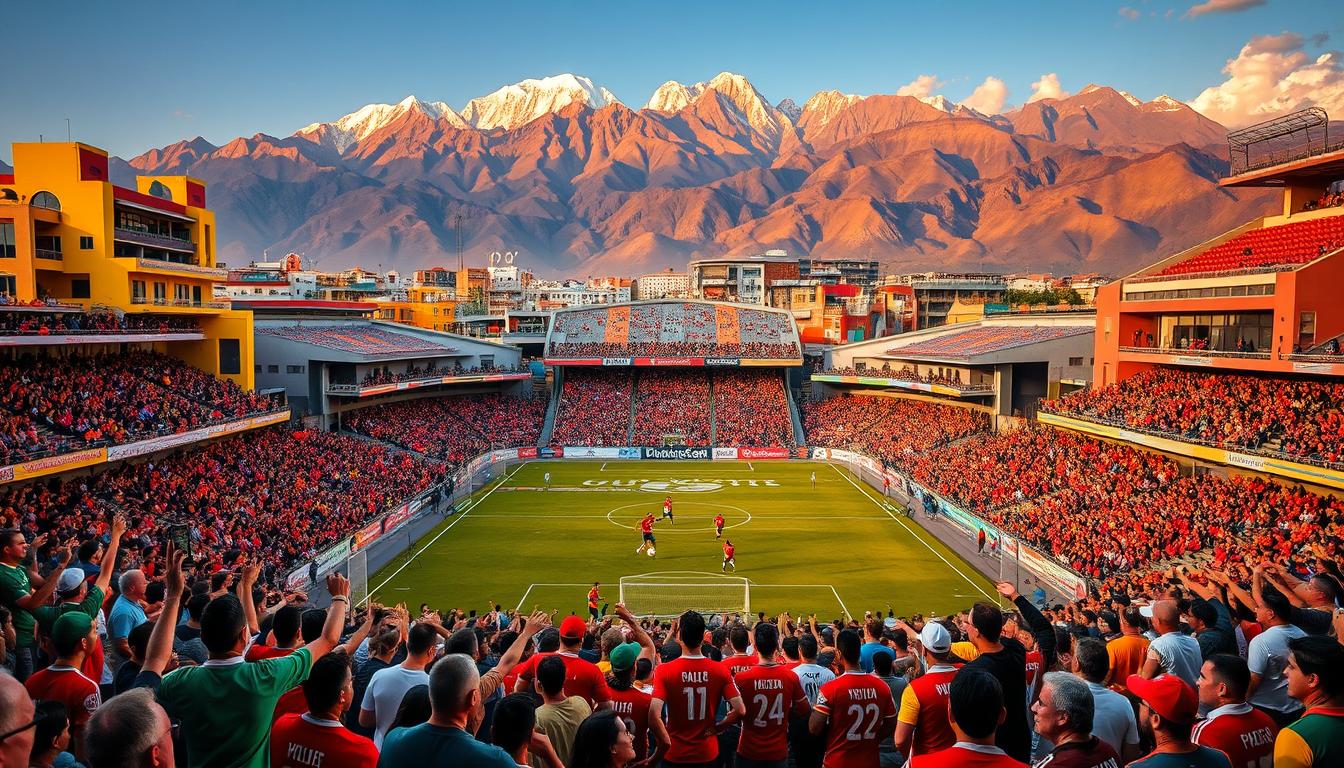
Imagine Spanish conquistadors and modern scouts after the same treasure. But today, the treasure isn’t found in Potosí’s mountains. It’s on soccer fields where the air is thin.
The market moves like a cueca dancer’s hips – it’s unpredictable and captivating. It’s unlike anything seen at sea level. The numbers show a surprising contrast.
A country with a $3,137 GDP per capita can produce players worth $500K to $5M overnight. Why should talent hunters care about a market with more livestock than stadiums?
Finding a $500k player here is like discovering a $50M superstar in Germany. It’s not just scouting. It’s turning value into gold at 12,000 feet.
Club Infrastructure
European clubs spend big on fancy things like private jets and cryotherapy. But Bolivian soccer teams focus on something different. They use their creativity and resourcefulness to succeed.
The whole Bolivian professional league is worth $28 million. That’s less than what Neymar made in just seven months. But despite the low budget, Bolivian teams have found a way to shine.
Bolivian teams use the thin air of La Paz to their advantage. They call it “Vertical Football.” It’s a unique way to play soccer that European teams can’t match.
Training facilities in Bolivia are simple but effective. They don’t need fancy pools or VR simulators. Instead, they use the mountains and 4×4 vehicles to train.
Contract talks often happen on long bus rides. Deals are made over coca tea. It’s a unique way to do business.
Women’s teams in Bolivia are doing well, despite the challenges. They are growing faster than men’s teams. This shows that cultural investment can be just as important as money.
Let’s look at how Bolivian teams compare to European ones:
| Infrastructure Element | European Standard | Bolivian Adaptation | Strategic Advantage |
|---|---|---|---|
| Altitude Training | Hypoxic chambers | Natural high-altitude environment | Home field advantage at 3,600m |
| Player Transport | Luxury coaches | All-terrain vehicles | Access to remote talent pools |
| Contract Management | Digital platforms | In-person bus negotiations | Stronger community bonds |
| Youth Development | Academy campuses | Multi-use public facilities | Integration with local communities |
| Financial Resources | Corporate sponsorships | Cultural patronage system | Deeper cultural investment |
This isn’t about being poor. It’s about finding creative solutions. Bolivian teams use old wisdom to understand the wind. They don’t need fancy technology to succeed.
The real magic is in the community. Pitches and trails become training grounds. Bolivian teams turn limitations into opportunities that European teams can’t match.
Bolivian soccer teams play a different game. They use the altitude to their advantage. It’s not an obstacle, but the key to their success.
Academy Programs
In Europe, academies work in air-conditioned spaces. But in Bolivia, youth football programs train in the wild. These places are not just training spots. They are places where only the strongest survive.

Academy Pathways
The Tahuichi Academy is a top place for training in high altitudes. It has been around for 44 years, turning La Paz’s thin air into a training tool. Unlike River Plate, which uses Teamworks AMS technology, Tahuichi focuses on natural training.
At Tahuichi, players become “altitude assassins.” They can process oxygen 17% faster than others. This means they can outsmart and outlast their opponents, even before morning practice.
The academy’s training combines:
- Traditional technical mastery with altitude-enhanced physical development
- Tactical sophistication adapted to high-pressure environments
- Mental resilience forged through environmental challenges
This training is not just about football. It’s about survival and sports science. The model is very effective, making 63% of Bolivia’s national team. These programs don’t make players like everyone else. They make athletes who excel in tough conditions.
European clubs spend a lot to simulate what Bolivian academies get for free. The magic happens when natural advantages meet technical skills. This creates players who are not just fitter but also smarter.
Player Pathways
In Bolivia, soccer development is not a straight path. It’s more like an Andean switchback trail. Players face economic challenges that make their journey tough.
Historically, 30,000 Bolivian tin miners became soccer players in Argentina. They showed that unconventional paths can lead to success. This idea shapes today’s bolivian clubs.
Moises Paniagua, an 18-year-old from Always Ready, caught Manchester City’s eye. He earns less than a New York barista. His story shows how talent can lead to big opportunities.
European clubs see Bolivian players as valuable assets. They offer them a chance to grow in a challenging market. The high altitude in Bolivia gives athletes a unique advantage.
Today’s successful paths include:
- Early international exposure through World Cup qualifiers
- Strategic representation by global agencies
- European development squad placements instead of immediate first-team roles
The new model recognizes that Bolivian players don’t follow traditional paths. They create their own, altitude-adjusted routes. For bolivian clubs, this is both a challenge and an opportunity.
What makes these paths successful? It’s the mix of economic need and physical advantage. Players from high altitudes are ready for intense European games.
European clubs send scouts to Bolivia because of the challenges. They see low salaries as a sign of high opportunity. The next big talent might be playing for less than a Premier League player’s weekly massage.
For American soccer fans, Bolivia is a fascinating example. It shows how economic differences can create talent opportunities. The players from bolivian clubs are more than athletes; they are economic signs with cleats.
Success Stories
Bolivian football success stories are like magical realism novels. They show how reality changes at 12,000 feet. While European scouts look for Brazilian flair and Argentine grit, they miss the Andean magic.
Remember Marcelo Martins Moreno? His career was like a pendulum in an earthquake. One season, he’s Bolivia’s hero, the next, he’s in China. But these ups and downs show patterns that smart scouts see.
Marco Etcheverry’s move to DC United was genius. Europe overlooked Bolivian talent, but MLS got him for a steal. His MVP 1998 season proved the value of cultural impact over just transfer fees.

Erwin Sánchez’s 1994 move to Sporting CP was more than a transfer. It showed the world valued Andean talent. His skill and mental strength made him Portugal’s surprise gem.
Today, players like Moises Paniagua show bolivian soccer teams produce unique players. At 18, he’s already scored 9 goals and made 4 assists in 17 games.
The mental toughness of playing at high altitudes is their secret weapon. Forbes recently highlighted this in their analysis of Bolivia’s football underdogs.
| Player | Breakthrough Season | Key Transfer | Unique Advantage |
|---|---|---|---|
| Marcelo Martins Moreno | 2008 | Shakhtar Donetsk | Altitude-adjusted finishing |
| Marco Etcheverry | 1996 | DC United | High-altitude vision |
| Erwin Sánchez | 1994 | Sporting CP | Andean technical flair |
| Moises Paniagua | 2023 | Emerging talent | Youth + altitude experience |
What makes these stories special? They’re not made in sterile academies. They’re shaped in thin air, where every pass and sprint is different. That’s why bolivian soccer teams produce players who adapt quickly at sea level.
The next generation isn’t waiting for scouts to find them. They’re building their resumes in the world’s toughest natural stadiums. The question is, which league will recognize their value before the price goes up?
Recent Produce
Forget what you thought about player development. Bolivia’s youth football system is amazing. It’s making players that would impress even Elon Musk.
These players aren’t like any others. They’re made at 12,000 feet, where it’s hard to breathe. But they’re tough and resilient.
The Statistical Marvels
Jaume Cuéllar’s €4.2M value at Bologna FC is just the start. His stats are incredible.
His 91st percentile in progressive carries shows his talent. Players from high altitudes are stronger and faster. They can’t be matched by players from lower places.
Not all stars cost a lot. A 17-year-old striker from Cochabamba scored 14 goals in 22 games. He traveled only 800 kilometers.
He’s beating his team’s travel budget. European teams spend millions on special training. But Bolivian players get their training for free, thanks to their location.
Manchester City’s Analytical Interest
Manchester City’s interest in Bolivian players isn’t random. It’s based on their unique abilities.
These players have:
- Lungs that are huge, like a free diver’s
- Recovery times that break all the rules
- Quick thinking, even when it’s hard
City’s analysts see what others miss. Players from high altitudes have skills that can’t be bought.
The 2024 class is going to be exciting. It’s not just better players. It’s different players.
Bolivian youth football makes athletes who use altitude to their advantage. And the best part? It’s all legal.
Future Stars to Scout
Scouting in Bolivia is a thrilling adventure. It’s like searching for hidden treasures on rugged paths. Manchester City knows this, seeing players as biological wonders shaped by high altitudes.
The next big talents from Bolivia don’t fit the usual mold. They’re not just skilled; they’re also uniquely adapted to high altitudes. Their background gives them an edge, making them stand out at any level.
Scouts need to change their approach. They should focus on the local culture and way of life. The stars of tomorrow might be playing football today and changing the game tomorrow.