
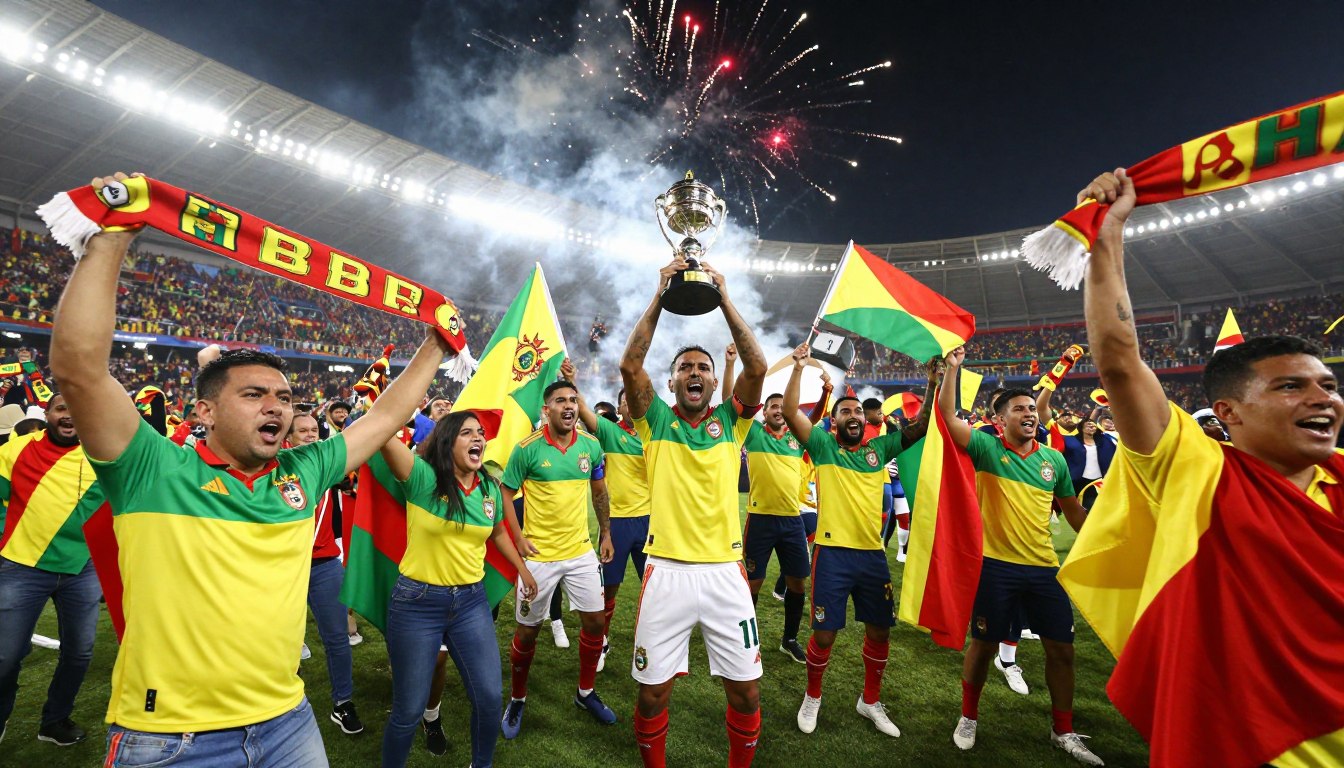
While fans watched Lionel Messi’s farewell, the real excitement was in El Alto, Bolivia. At 13,615 feet, Bolivia didn’t just beat Brazil. They made a bold move in the football world.
Miguel Terceros’s penalty was the key to Bolivia’s win. But Colombia’s 6-3 win over Venezuela was the real twist. It gave Bolivia a chance to move forward.
This was like a thrilling sports story where every outcome was important. Ecuador shocked Argentina, and Paraguay beat Peru. Chile and Uruguay tied. Bolivia’s win put them in 7th place, securing a spot in the March 2026 World Cup playoff tournament.
The altitude of El Alto is more than just height. It’s a symbol of Bolivia’s quick rise in football. Now, they have a chance to play in the playoffs, shaking up the football world.
Domestic league developments
La Paz isn’t the first city that comes to mind when thinking of soccer powerhouses. But a historic win over Brazil in El Alto showed the world something. You don’t beat a giant by playing its game. You build a fortress.
The Bolivian domestic league is that fortress. It’s different from European soccer, where teams focus on possession and pressing. In Bolivia, the main variable is oxygen. The league is a place where players adapt to the high altitude.
Clubs like Bolívar and The Strongest are more than teams. They create a specific type of athlete. They focus on tactical endurance, not just fancy skills.
This style is built to use the altitude to their advantage. When the national team needs players, they look for those already used to the thin air.
The celebrations after beating Brazil were more than just a win. They showed the value of the domestic league. It can produce a team that excels in its unique environment.
So, how does this system work? What do player updates from the Bolivian league look like? Let’s look at the key parts:
- Physiological Priming: Players train at extreme altitudes. Their bodies adapt, giving them a huge advantage. Visitors face not just the team, but the altitude too.
- Tactical Pragmatism: The game is fast and direct. Possession is a tool, not everything. This is perfect for tournament soccer where chances are rare.
- Mental Fortitude: Playing in tough conditions builds grit. These players are not coddled stars. They are battlers.
But is this model sustainable, or just a clever trick? The table below shows how the league’s giants help the national team.
| Club | Home City & Altitude | Development Focus | Contribution to National Team |
|---|---|---|---|
| Club Bolívar | La Paz (~11,975 ft) | Technical skill within a high-tempo system. Often blends local talent with savvy foreign imports. | Provides seasoned professionals who understand both the physical and tactical demands of altitude games. |
| The Strongest | La Paz (~11,975 ft) | Emphasizes physical resilience, defensive organization, and exploiting set-pieces. | Supplies the defensive backbone and aerial threats for the national team’s style. |
| Domestic League (Overall) | Various (High-Altitude Focus) | Creates a unified style of play: direct, physically demanding, and acclimatized. | Serves as the exclusive proving ground for acclimatized players, ensuring a seamless transition to the national squad. |
The league and national team have a strong bond. But this isolation can be a double-edged sword. Players might struggle at sea level, limiting their chances abroad. Yet, for the national team, this specialization is key.
Playing in El Alto is more than a soccer match. It’s a test for visitors. For Bolivians, it’s just another game. The league is the constant, grueling test. It develops players and gives them an unfair advantage. And as long as games are played high up, that advantage will stay.
National team implications
Bolivia’s chance to play in the World Cup playoffs has changed the national mood. It’s no longer just about ‘what ifs.’ It’s about figuring out how to make it happen. This is more than a sports story; it’s about pressure, politics, and the nation’s desire for redemption after 30 years.
The March playoffs are tough. Six teams will compete, and only two will get to the World Cup. The odds are against Bolivia, but in football, legends often win over logic. Qualifying would be a miracle, rewriting history for a whole generation of fans.
Coach Oscar Villegas has a tough decision to make. Should he use La Paz’s high altitude to his advantage or create a more flexible team? His choice will shape Bolivia’s football story. Will he play it safe or go for a bold attack? The answer could decide Bolivia’s fate in 2026.
The team carries the weight of history. Every player remembers 1994. This is the burden of history, whispering doubt in every empty stadium. To overcome it, they need to forget the past.
There’s also a strange subplot. The team’s flight was delayed in Venezuela, with officials calling it “sabotage.” This shows how soccer and politics mix in South America. It’s a reminder that in this region, sports and statecraft are closely linked.

This incident adds a twist to the rivalry. It turns the game into a spy story. For those following Bolivia football news, it means looking at more than just the game. Diplomacy, logistics, and even aviation politics are now part of the game plan.
So, what’s the path to success in March? Let’s look at the challenges Bolivia faces. The table below shows the tough road ahead. It’s not for the faint of heart.
| Potential Opponent | Key Strength | Historical vs. Bolivia | Bolivia’s Best Chance |
|---|---|---|---|
| Uruguay | Tactical discipline, world-class strikers | Poor; frequent losses | Catch them on an off day, exploit set pieces |
| Paraguay | Gritty defense, counter-attack prowess | Mixed; occasional upsets | Win the midfield battle, control tempo |
| Peru | Technical midfield, home crowd energy | Competitive; close matches | Capitalize on defensive errors, use width |
| Chile | High pressing, experienced squad | Difficult; psychological hurdle | Weather early storm, strike on transition |
Bolivia needs more than passion to succeed. They need smart tactics, mental strength, and a bit of luck. Coach Villegas must build a team that’s strong in mind and body. They must forget 1994 and focus on 2026.
Funding and development are at stake. Qualifying means more money from FIFA. It means investing in young players. The next big talent could be discovered in Bolivia, not Spain. The impact would last for decades.
This moment is critical for Bolivian soccer. It’s about moving from ‘almost’ to ‘yes.’ The March playoffs will decide. Every action on the field will be watched closely by a nation hoping for success.
To follow this story deeply, our team offers comprehensive coverage of Bolivian football. We look at the scores and the stories behind them.
The stakes are high. This is about Bolivia’s identity. It’s about showing that a small country can shine on the world stage. The Bolivia football news cycle in March will tell a story of hope and determination.
Player movement trends
The final whistle in a World Cup qualifier isn’t just an end; it’s the starting gun for the global transfer rumor mill. This latest round of South American drama served as a prime-time showcase, showing clear player updates for scouts and sporting directors worldwide.
Miguel Terceros went from a local prospect to a national icon with one swing of his leg. That penalty didn’t just secure a point; it launched his career on a vertical climb. His name is now in the databases of clubs looking for a clutch performer.

Luis Díaz’s four-goal demolition of Venezuela was less a performance and more a predatory statement. For Liverpool, it’s a delightful affirmation. For any other European giant watching, it’s a tantalizing “what if.”
Díaz didn’t just score goals; he cemented his status as a premium asset. His explosiveness translates directly to the international stage. In the calculus of modern football, such displays are the ultimate leverage.
Contrast that with the enduring value of a veteran like Enner Valencia. Scoring against the world champions, Argentina, at this stage of his career is a different kind of player update. It screams reliability. It tells mid-table leagues and ambitious smaller clubs that here is a warrior who can deliver when the lights are brightest.
This is the broader ecosystem at work. The young prospect (Terceros), the established star (Díaz), and the aging champion (Valencia)—all received their live audition. International breaks are the ultimate open market. Every intercepted pass, every mazy run, and every decisive finish is a line on a public CV.
The subsequent player movement—be it a mega-transfer, a shrewd loan, or a contract extension—is directly influenced by these 90-minute job interviews.
So, what’s the trend? Heroics on the continental stage no longer just boost national pride; they trigger speculative fever in the transfer market. A player’s stock is now a volatile currency, and the qualifiers are a major trading floor. For the latest on how these performances reshape careers and club rosters, keen observers always check the Noticias BO. The drama off the pitch is just getting started.
Why it matters regionally
Bolivia football news is more than just about Bolivia. It’s a test for the whole continent. For years, South American football has been a known story. Argentina and Brazil are the stars, with Uruguay, Colombia, and Chile adding drama.
Bolivia and Venezuela are the surprises. They shake things up. If Bolivia makes it to the 2026 World Cup, it’s a big deal. It shows that CONMEBOL’s tough qualifying is real.
The 2026 World Cup is special because it’s in North America. But for South American teams, it feels like home. The close cultural ties and travel make it unique. Adding Bolivia’s spirit makes it even more real.
More South American teams at the 2026 World Cup means more fans and money. It shows football as a common language across the hemisphere. For fans in Miami or Los Angeles, following Bolivia’s story teaches them about the continent and determination.
Global football can feel too polished. Bolivia’s story is raw and true. It’s about the underdog who won’t give up. The 2026 World Cup needs this real story.