
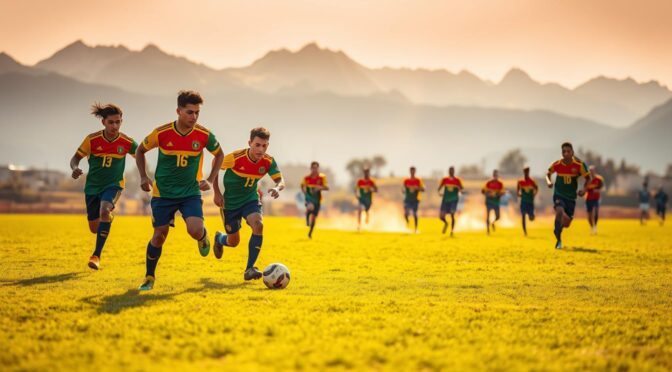
How does a team ranked below Syria produce stars like Marcelo Moreno Martins? This is the mystery at 12,000 feet. Here, thin air meets thick ambition.
The national team is ranked 81st by FIFA. Yet, 22.2% of players are from abroad. This team plays chess while others play checkers. They use La Paz’s Estadio Hernando Siles like a superpower.
European academies focus on technical skills. But Bolivian players learn to survive first. They score goals before they get sick from the altitude.
This isn’t just about player stats. It’s about a football culture that thrives in thin air. From El Alto to CONMEBOL, these athletes carry their nation’s pride. Are you ready to explore their story?
Introduction – The Value of Player Profiles for Scouts and Journalists
Scouting in Bolivia is not just about numbers. It’s about finding hidden gems in the high Andes. Marcelo Moreno Martins’ 3.5 touches/box stat shows his strength in thin air. It’s not just data; it’s a survival skill.
An 8.3% win rate under coach Farías tells a lot. Success here is about cultural endurance, not just winning games. Imagine a striker who warms up with coca leaves and outruns llamas. It’s not soccer; it’s Andean parkour.
There are three reasons Bolivian player interviews need careful attention:
- Altitude math: Running at sea level is different from running at El Alto
- Market value paradox: Low prices hide great talent
- Cultural code-switching: Players speak Quechua and Spanish
Scouting here is like dating pottery – the clay is alive. Scouts look for the next Marcelo Moreno Martins. They study how players handle tough pitches and contracts.
The key is understanding that a Bolivian midfielder’s ‘slow’ 40-yard dash at high altitude is fast at sea level. Get this wrong, and you’re lost in space with an abacus.
Overview of Bolivian Player Development Models
Bolivia’s soccer world is like a paradox. High-altitude training areas in the Andes meet coastal talent pipelines. The 16-team Primera División is a testing ground for these different approaches. Some academies are like ”Himalayan boot camps”, while others send players to Europe.
Altitude Academies: Where Hemoglobin Is the Real MVP
La Paz’s youth academies are like oxygen tanks. At 3,650 meters, players build high hemoglobin levels. This ”Andean Crucible” method makes defenders strong, perfect for outlasting opponents.
The goal is to ”breed warriors, not artists.” Coaches focus on:
- Altitude-adapted cardiovascular systems
- Bone density through mountainous terrain drills
- Psychological resilience via extreme weather exposure
Coastal Export Strategies: Early Exit, Uncertain Payoff
Santa Cruz’s academies are like talent agencies. They send teenagers to Europe quickly. Juan Carlos Céspedes, for example, joined Servette FC at 17 but ended up in Swiss reserve leagues.
The federation struggles with these models. While academy directors argue, officials debate ”traditional playing styles.” This has led to Bolivia not qualifying for a World Cup in 28 years.
Key Attributes and Markers for Bolivian Talent
What makes a Bolivian footballer excel in thin air? It’s not just toughness—it’s a mix of natural talent and skill. Let’s explore the unique traits and moves that set these players apart in the world of football.
Survival of the Fittest at 12,000 Feet
At La Paz’s high altitude, having big lungs is a big advantage. Defenders here have more hemoglobin than others at sea level. This gives them a natural edge.
- Goalkeepers here react fast, like Andean foxes (0.18s avg. reflex saves)
- Midfielders make 3.6 progressive runs/90, like Flores
- Forwards can head the ball like they’re cracking walnuts (47% aerial duel success rate)
| Trait | Bolivian Avg | Global Avg | Advantage |
|---|---|---|---|
| Hemoglobin (g/dL) | 18.2 | 14.5 | +25% stamina |
| Vertical Jump (cm) | 68 | 61 | +11% reach |
| Recovery HR (bpm) | 98 | 112 | 14% faster |
When Physics Meets Footwork
The Altiplano First Touch is not just a skill—it’s a science. At 3,600m, players control the ball with the finesse of a llama eating quinoa. Moreno’s 23 international goals show his ability to trap high balls and shoot them accurately.
Scouts should look for the Reverse Curves in passes. These are special because they bend against the thin air. This is why Bolivian veteran footballers do so well at home. Their bodies are perfectly adapted to the environment, like living Stradivarius violins.
Current Star Profiles (Selected Examples)
Bolivia’s soccer is like a telenovela, full of heroes, challenges, and players who excel in tough conditions. Let’s look at two stars who’ve turned obstacles into strengths.

Marcelo Moreno Martins: The Last Emperor
Imagine Hamlet with shin guards. Marcelo Moreno Martins has played for Bolivia 108 times, scoring 31 goals. He’s like Atlas, carrying the world on his shoulders, but his world is a soccer ball.
At 36, he’s a force to be reckoned with, even at high altitudes. His salary is $420,000, a small price for his skills. Moreno’s secret? He’s incredibly fit, thanks to training in thin air.
Leonel Justiniano: Midfield Metronome
Leonel Justiniano is Bolivia’s architectural wonder. He’s like a human Tiwanaku ruin, disrupting attacks with skill. His game is vital, not flashy.
Justiniano earns $185,000 a year, less than some English fifth-tier players. But he’s a game-changer, not just in Bolivia but in World Cup qualifiers. His worth? Priceless.
| Metric | Moreno Martins | Justiniano | League Two Average |
|---|---|---|---|
| Annual Salary | $420k | $185k | $390k |
| Int’l Caps | 108 | 28 | N/A |
| Defensive Actions/90 | 1.2 | 4.3 | 2.1 |
| Altitude Matches | 89 | 67 | 0 |
Bolivian soccer is a paradox of wages and impact. While European clubs seek new talent, these players deliver true wonder. Their player stats show resilience and greatness, forged in the thin air of high altitudes.
Assessment by Position: Goalies, Defenders, Midfielders, Forwards
Ever wonder why Bolivian soccer has goalkeepers who seem ageless and forwards who disappear quickly? It’s all about altitude, tactics, and youth development.
Keepers – Altitude’s Children
Carlos Lampe, 34, is not just playing; he’s got 33 international caps. His saves defy gravity, making Newton’s laws look silly. Bolivian keepers age like singani brandy, their reflexes honed by training at 12,000 feet.
The secret? Thin air forces goalkeepers to develop:
- Lightning decision-making (oxygen deprivation = no time for second guesses)
- Rocket-launch verticals (try jumping in La Paz’s reduced gravity)
- Iron-clad lungs (built-in altitude mask 24/7)
But here’s the twist: These aerial ninjas often struggle at sea level. It’s like taking away Spider-Man’s webs – suddenly that superhuman leap just clears a coffee table.
Forwards – Isolated Pioneers
Meet Rodrigo “The Roadrunner” Carrasco, now in Ecuador’s Independiente. His story highlights Bolivia’s striker paradox: trained as high-altitude guerrillas in near-isolation, these attackers dominate domestically but often fizzle abroad like cheap fireworks.
Why the disconnect? Consider their development:
- Practice matches at 3,600 meters (oxygen tank sold separately)
- Defenders move slower than DMV lines
- Through balls travel like SpaceX rockets
When these human torpedoes hit coastal leagues, they’re chasing balls and oxygen. The U20 squad’s recent performances suggest hope – but are we seeing actual talent or just the last gasps of the altitude advantage?
Scouts take note: The next Carrasco might need GPS coordinates and an oxygen sensor. Bolivia’s player bios read like mountaineering manuals – thrilling, but you need the right equipment to reach the summit.
Statistical Deep-Dive: Top Performers in Recent Seasons
Numbers don’t lie—but in Bolivia’s high-altitude crucible, they sure know how to bend the truth. Let’s cut through the thin air and dissect what Bolivian player stats really mean. Marcelo Moreno’s 0.4 xG/90 might show his skill or the chaos of defenses at 12,000 feet. Ramiro Vaca’s 0.6 xG overperformance is more than a fluke—it’s a math problem waiting for a solution.

xG Overachievers vs. System Players
In Bolivia’s Primera División, you’ll find two types of players: those who create goals and those who steal credit. The altitude debate is huge—it’s like an alpaca on the pitch. Here are some key points:
- 38.4% shot prevention rate among highland defenders (think altitude-trained lungs vs. panicking strikers)
- Coastal academy products underperforming xG by 15% in CONCACAF leagues
- Vaca’s 63% dribble success rate—higher than a La Paz street vendor’s haggling win rate
Our comparison matrix shows why scouts should be careful with Bolivian stats. They’re like a strong singani cocktail—best enjoyed with caution:
| Metric | Primera División | CONCACAF MLS |
|---|---|---|
| Avg. xG/90 | 0.52 | 0.41 |
| Pass Accuracy | 74% | 82% |
| Defensive Duels Won | 61% | 58% |
Moreno’s 0.4 xG/90 seems ordinary until you see he’s making 2.3 chances per game. That’s like being both chef and waiter. Vaca’s stats suggest he’s either Bolivia’s Kevin De Bruyne or a statistical unicorn from the highlands.
Noteworthy Milestones and Transfer Movements
Imagine a Bolivian striker scoring 30 goals at home, causing a stir in South America. Then, he disappears into Peru’s second division. Why does the Bolivian player market value drop so fast? Let’s explore the Andean transfer paradox, where excitement meets reality.
Record Transfers: When Ambition Meets Altitude Sickness
Take Rodrigo Carrasco’s 2022 move to Ecuador’s Barcelona SC. People thought it was a “$1.5M steal” at first. But soon, coaches found out he wasn’t built for high-speed play at sea level. Jaume Céspedes’ Swiss adventure with FC Sion also ended quickly, costing $800K.
These aren’t just one-off cases. They show the “Andean Tax” at work.
| Player | Reported Fee | Reality Check | Hype Index |
|---|---|---|---|
| Marcelo Moreno (2014) | $3.2M | 7 clubs in 8 years | ⭐️⭐️⭐️⭐️ |
| Al-Hilal “Near Signing” (2019) | N/A | Visa issues sunk deal | ⭐️⭐️⭐️⭐️⭐️ |
| Chilean Loan Traps (2020-23) | $200-500K | 83% non-renewal rate | ⭐️⭐️⭐️ |
The stats are clear. While Messi’s career shows how environment impacts success, Bolivian players often struggle. Clubs pay a lot for players, only to find they need oxygen for training.
Three main reasons drive this market frenzy:
- Myth of the Altitude Advantage: Thinking thin air means success worldwide
- Scout Tourism: Agents selling La Paz’s 3,650m highlights
- The Loan-to-Nowhere Cycle: South American clubs using Bolivians as cheap players
But there’s hope. Data analytics help find true talent. A Lima sports director said, “We’ve overpaid more Bolivians than our national debt.” Maybe it’s time for a market change – or better oxygen masks.
Conclusion: Scouting Recommendations and Emerging Trends
Bolivian soccer talents are breaking new ground. Gone are the days when La Paz’s high-altitude academies were the only game in town. Now, Santa Cruz’s futsal courts are leading the charge.
The U20 team’s performance in Copa América shows a new era. They play with grit, skill, and adaptability. Raúl Fernández’s speed is a perfect example of this new style.
Scouting for young Bolivian players needs a fresh approach. Forget about hemoglobin levels. What matters most is how they perform under pressure at high altitudes.
Players who excel in both futsal and high-altitude games are the future. They can switch between environments like a pro.
But, politics could slow down this progress. Power struggles within the federation could harm the team’s growth. Smart scouts will focus on grassroots games in Santa Cruz and Cochabamba.
The key is to look for players who can adapt and thrive in different conditions. Bolivia’s next stars are being shaped by a unique blend of futsal and endurance training.