

AT&T Stadium technology has become a central part of how the Dallas Cowboys present game day in Arlington, Texas. As of October 15, 2026, the most recent upgrades are no longer theoretical plans; they are installed or introduced features tied to connectivity, wayfinding, mixed-reality activations, premium-space refreshes, and network resilience. The supported facts point to a venue trying to handle large crowds while also giving fans more tools to move, connect, purchase, and interact inside the building.
The timing matters. AT&T and the Cowboys formally extended their long-running partnership on September 18, 2026, with the agreement covering new fan experiences and technology for the 2026 season, including smarter stadium navigation, immersive mixed-reality, AI-powered moments, and improvements in 5G, Wi-Fi, and fiber-based infrastructure, according to AT&T’s partnership announcement. That agreement arrived after a major building refresh that had already altered premium clubs, concessions, video displays, and internal finishes.
AT&T Stadium Technology After The 2025 Refresh
AT&T Stadium Technology And The Extended Partnership
The Cowboys’ 2026 technology push sits on top of a larger renovation cycle. The venue’s $295 million renovation was completed as of mid-2025 and was described as the most significant refresh since the stadium opened in 2009. The work included an upgrade of the center-hung HDTV video board to 4-K technology, a full refresh of interior premium clubs and suites, added permanent concession and bar locations, updated finishes, enhanced tech displays, redesigned suite corridors, and new wellness spaces, according to the Cowboys’ stadium refresh document.
That sequence is important because not every venue technology change begins with an app or a screen. Some start with the building’s physical organization: how corridors feel, where concessions are placed, how suite areas are configured, and whether displays can support the operational needs of a high-attendance event. In that sense, the value of AT&T Stadium technology is tied to both visible fan-facing features and less visible systems that keep the venue functioning.
Video, Premium Areas, And Stadium Use
The center-hung board’s move to 4-K technology gave the Cowboys another major display upgrade inside a stadium already known for its large in-bowl screen presence. The research also notes that Phase 1 display work began in November 2024 with seven LG MAGNIT Micro LED walls installed in the renovated Bank of America Founders Club. That installation was part of broader stadium work ahead of the 2026 FIFA World Cup.
The premium-space changes matter beyond luxury seating. Clubs and suites are often where stadium operators test higher-end hospitality, display, and service models before wider building adoption. The research does not provide attendance-by-area data or fan satisfaction numbers, so it would be premature to declare which additions changed behavior most. What can be said is that the Cowboys’ improvements connected technology with premium hospitality, concessions, and building flow rather than treating those areas as separate projects.
Network Capacity On Cowboys Game Day
Fiber, Wi-Fi, And Antenna Density
On a normal game day with more than 90,000 fans, the stadium’s network system supported about 22 terabytes of data traffic during the period cited in the research, approximately three weeks before mid-October 2026. That number illustrates the scale of the task. Mobile tickets, social posting, in-seat communication, food ordering, operational messaging, and app-based directions all compete for bandwidth in a dense environment.
The building’s network foundation is substantial. The research states that the stadium maintains more than 261 miles of fiber backbone inside its campus with dual-diverse paths, meaning two independent fiber routes are designed to reduce the chance that one cut would take down major services. It also lists about 3,000 Wi-Fi access points supporting both fan-facing services and internal operations. The stadium operates one of AT&T’s largest Distributed Antenna Systems in the United States, with the stated aim of providing cellular coverage comparable to Plano, Texas.
For AT&T Stadium technology, capacity is not only about headline speed. It is about redundancy and coverage across seats, concourses, entrances, clubs, and roof-support areas. A report in the research dated October 8, 2026, noted almost 1,000 antennas spread across the stadium’s width and roof support. Those antennas help support functions such as seat-based food ordering, roughly 1,200 points of sale, augmented-reality kiosks, interactive maps, and ticketing.
Peak Demand And Fan Tasks
The 2026 season also introduced Turbo Live by AT&T, which gave wireless customers from any carrier access to premium connectivity during peak-demand moments on game day. The research does not provide independent performance testing, so the practical effect should be evaluated cautiously. Still, the stated purpose fits a common stadium problem: demand often spikes during arrivals, scoring plays, halftime, weather updates, and exit windows.
The stakes extend beyond convenience. Ticket scanning, concession transactions, venue staff communication, and emergency messaging all depend on network performance. A stadium can have attractive fan activations, but if connectivity fails at a gate or in a concession line, the experience suffers quickly. The Cowboys’ mix of fiber routes, access points, antennas, and carrier systems shows how modern NFL venue planning has moved from entertainment screens alone to full-building digital operations.
Mixed Reality And Wayfinding For Fans
Digital Directions Inside A Large Building
AT&T Wayfinding debuted in 2026 as a digital tool co-branded in the Cowboys’ app, paired with eight interactive kiosks at main entrances. Its stated purpose was practical: help fans locate seats, restrooms, concessions, and other stadium points. In a venue that regularly hosts large crowds, wayfinding is not a side feature. It affects arrival stress, concession access, restroom timing, and how quickly people can return to seats.
The research does not include usage totals for the wayfinding tool or kiosk interactions, so there is no basis to rank its success against other stadium systems. A fair reading is that the Cowboys and AT&T added a tool aimed at reducing friction inside a building where scale can be both a strength and a challenge. The most meaningful long-term measures would include entry times, missed-seat time, concession wait patterns, and postgame exit movement, but those figures were not included in the supplied material.
Augmented And Mixed-Reality Activations
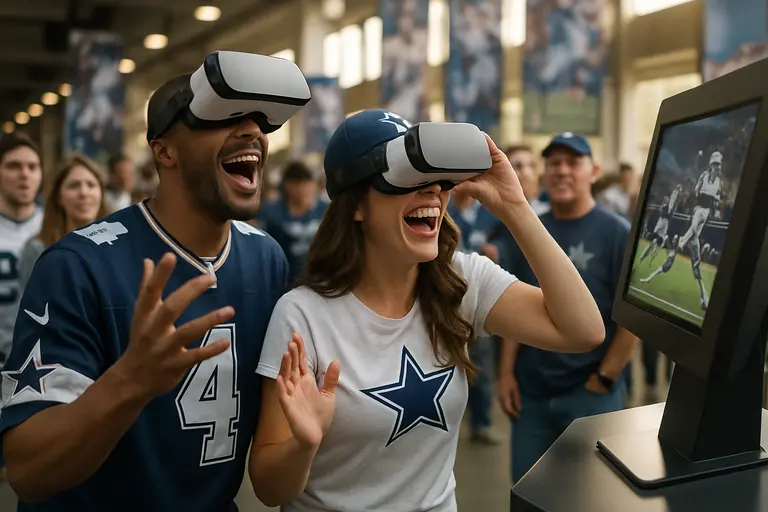
The Cowboys also expanded “Pose with the Pros” in 2026. The augmented-reality photo experience added Cowboys Legends and Cheerleaders, while “Pose with the Pros on the Go” brought the feature into the Cowboys app. The appeal is clear: fans can create a personalized stadium memory without needing a live player appearance at every location. The supported facts do not specify which legends participated or how many users engaged with the feature.
The “Reception Connection” mixed-reality activation also launched in 2026. It allowed fans to catch virtual passes from Dak Prescott, with scores posted on leaderboards and prizes for top performers each game and across the season. This form of activation turns the stadium concourse into a participatory space rather than only a passageway. For a franchise with a large national following, such features can extend the identity of the game day beyond the field while still keeping the football connection clear.
There is a broader sports-venue thread here. Stadiums across the NFL have invested in video boards, concessions, premium spaces, and entry systems. A related example is the way M&T Bank Stadium renovations changed fan-facing areas after completion on August 14, 2026. Readers who compare football infrastructure with baseball venues may also find useful context at Books on Baseball, where you’ll discover insights into the intersections of ballpark memory and venue design.
What The AT&T Stadium Technology Upgrades Show
The clearest takeaway from the supported record is that the Cowboys’ venue strategy combined infrastructure, entertainment, and operations. The $295 million refresh addressed physical spaces and displays. The 2026 AT&T partnership extension centered on connectivity, AI-powered moments, mixed reality, and wayfinding. The network data points—22 terabytes on a large game day, 261 miles of fiber backbone, about 3,000 Wi-Fi access points, one of AT&T’s largest U.S. DAS deployments, and nearly 1,000 antennas—show the technical load behind what fans see on a phone screen or kiosk.
There are still limits to the public record. The research provides vendor and venue claims, feature descriptions, dates, and infrastructure counts, but it does not include independent latency testing, fan survey results, outage logs, or transaction-time comparisons before and after the upgrades. That means any analysis should stop short of declaring the Cowboys’ system superior to every other NFL venue. What is supported is narrower and still significant: the team and AT&T materially expanded the stadium’s connected experience before October 15, 2026.
AT&T Stadium technology now reads as a layered project. At the base are fiber routes, antennas, Wi-Fi access points, and distributed cellular coverage. Above that sit ticketing, concessions, maps, kiosks, and point-of-sale systems. At the fan-facing level are augmented-reality photos, virtual passing games, improved displays, and app-based tools. The Cowboys’ approach reflects where major sports buildings have moved: the game remains the center, but the building around it is increasingly judged by how well it supports the minutes before kickoff, the breaks between plays, and the movement of tens of thousands of people through one venue.