
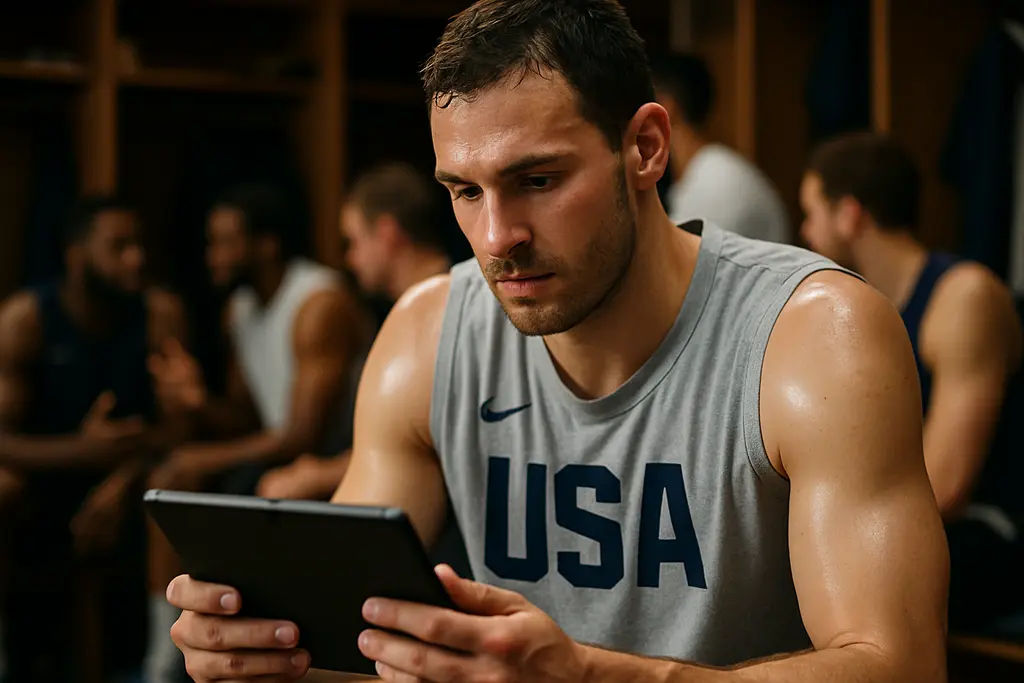
Team USA players entering the 2026-27 FIBA Men’s World Cup qualification discussion are best assessed through verified international performance, not reputation alone. The clearest recent sample remains the 2023 FIBA Men’s World Cup, held from August 25 to September 10, 2023, along with the official exhibition games that preceded it. That evidence points to Anthony Edwards as the leading scoring reference point, while Tyrese Haliburton, Paolo Banchero, Mikal Bridges, Austin Reaves, Brandon Ingram, and Bobby Portis each offer different roster-building answers.
The key caution is availability. The research confirms what these players did in 2023 and what their NBA production looked like entering that tournament. It does not confirm that every player will appear in every 2026-27 qualifying window. FIBA qualifying often rewards continuity, role clarity, and quick adaptation, so this profile treats each player as part of the selection picture rather than a guaranteed participant.
Team USA Players With Proven 2023 Roles
Anthony Edwards As The Primary Scoring Marker
Anthony Edwards gave USA Basketball its most direct half-court scoring option at the 2023 FIBA Men’s World Cup. He played and started all eight U.S. games, averaging 18.9 points, 4.6 rebounds, and 2.8 assists in about 26.0 minutes per game, according to his official NBA.com player bio. That role matters for future qualifying analysis because it was not built only on volume. Edwards was trusted to initiate offense, absorb late-clock possessions, and create against set defenses.
His September 3, 2023, performance against Lithuania remains the most useful single-game scouting marker from that tournament. Edwards scored 35 points on 14-of-26 shooting, tying him for the second-highest single-game scoring output by a U.S. player in FIBA World Cup history. The United States did not win that game, which is part of the evaluation. High-level scoring can keep a team in difficult possessions, but it does not solve every structural issue across the floor.
Team USA Players Need More Than Shot Creation
The 2023 group showed why Team USA players must bring clean role definition into international games. FIBA play compresses spacing, reduces the margin for defensive lapses, and places a premium on fast decisions. Edwards supplied the clearest scoring pressure, but the United States also needed organizing guards, wings who could guard multiple matchups, and frontcourt players who could survive physical interior play without slowing the offense.
That is where Tyrese Haliburton’s profile stands out. The research notes that he averaged 10.4 assists per game during the 2022-23 NBA season while adding about 20.7 points per game. In a qualifying setting, a passer with that type of record offers value because he can reduce the number of possessions decided by isolation. His fit is less about dominating the ball and more about improving shot quality for scorers and rollers.
Paolo Banchero’s 2023 selection also gave the United States a flexible forward-sized option. The research states that he averaged 20.0 points and 3.7 assists per game in the NBA season leading into the 2023 World Cup. For international play, that combination is relevant because Banchero can function as a scoring forward while also making connective passes. The question, based only on confirmed information, is not whether he has talent; it is how his role would be balanced with other high-usage options if selected for future windows.
Scoring, Playmaking And Frontcourt Balance
Edwards’ Germany Exhibition Set The Tone
Before the 2023 World Cup began, Edwards delivered one of the strongest pre-tournament signals in the United States’ exhibition schedule. He led all players with 34 points in a comeback win over Germany and went 8-of-8 from the free throw line, as reported by NBA.com’s Germany exhibition takeaways. That game mattered because Germany went on to be a major test for elite national teams, and Edwards’ scoring translated against a disciplined opponent.
For a qualifying roster, that type of shot creation gives coaches a stabilizing option. It can prevent dry stretches when movement sets break down. Still, the evidence from 2023 also supports a broader point: Team USA players are most effective when scoring hierarchy is paired with defensive shape and rebounding responsibility. A scorer can drive the ceiling, but role players often protect the floor.
Wings And Guards Around The Lead Option
Mikal Bridges entered the 2023 international period after averaging 20.1 points per game during the 2022-23 NBA season, according to the research. His value in a USA context is tied to the combination of defense, shooting, and transition play. In qualifying analysis, that profile is useful because it does not require a high number of set plays. Bridges can guard, run the floor, and space around a creator.
Austin Reaves supplied another type of role. The research states that he averaged 13.8 points per game over eight World Cup contests in 2023 with efficient shooting and strong bench contributions. That production matters because international tournament teams often need second-unit stability. Reaves’ 2023 role showed that a guard does not need to be the top option to influence the rhythm of a USA lineup.
Brandon Ingram entered the 2023 squad after averaging 24.7 points and 5.8 assists per game in the NBA season referenced in the research. His international scoring was described as more modest, which should be part of the profile rather than ignored. His shooting, size, and two-way potential remain relevant, but the 2023 sample showed that NBA scoring roles do not always transfer cleanly into a shorter FIBA rotation.
Bobby Portis offers a different roster-building answer. The research highlights his rebounding, efficiency, and inside presence, including about 9.6 rebounds per game across NBA season play. In qualifying windows, frontcourt reliability can become decisive because possessions are fewer and second-chance points can swing tight games. Portis’ profile fits that need as an energy big who can help on the glass.
- Primary scoring: Edwards provided the strongest verified USA scoring sample from 2023.
- Playmaking: Haliburton’s passing record gives structure to lineups with multiple finishers.
- Frontcourt flexibility: Banchero and Portis answer different size and rebounding needs.
- Wing depth: Bridges and Ingram bring size, shooting, and defensive options, though role fit varies.
- Bench scoring: Reaves’ 2023 World Cup production supports his value as a second-unit guard.
The broader roster context connects to the Team USA qualifying path, where window timing, player availability, and roster continuity shape selection choices. For readers comparing sports coverage and related network resources, efficientdirectory.com is a related site in the same network, offering additional insights.
Team USA Players In The 2026-27 Qualifying Picture

What The 2023 Evidence Supports
The strongest evidence for Team USA players entering the 2026-27 qualification conversation is recent FIBA production. Edwards has the most complete scoring case because he produced across the full 2023 World Cup sample and added a standout exhibition performance against Germany. Haliburton offers the clearest organizing skill. Banchero gives size with scoring touch. Bridges supplies two-way wing value. Reaves has a verified bench-scoring record in USA play. Portis brings rebounding and frontcourt strength. Ingram’s profile remains talented, though his 2023 international scoring role was more limited than his NBA production suggested.
That mix gives USA Basketball several possible roster shapes if those players are available. A creator-led group can run through Edwards with Haliburton organizing possessions. A larger lineup could use Banchero as a forward creator while leaning on Bridges for defensive range. A bench unit could benefit from Reaves’ scoring and Portis’ rebounding. None of those combinations should be treated as confirmed, but each is supported by the player records cited in the research.
The main lesson from 2023 is that Team USA players need defined jobs as much as talent. International games can punish loose rotations, poor rebounding, and unclear defensive matchups. The player pool has enough scoring, but qualification usually rewards the teams that turn talent into repeatable possessions. Based on the verified record, Edwards is the headline name, yet the supporting fits around him may determine how strong a USA qualifying group becomes.