
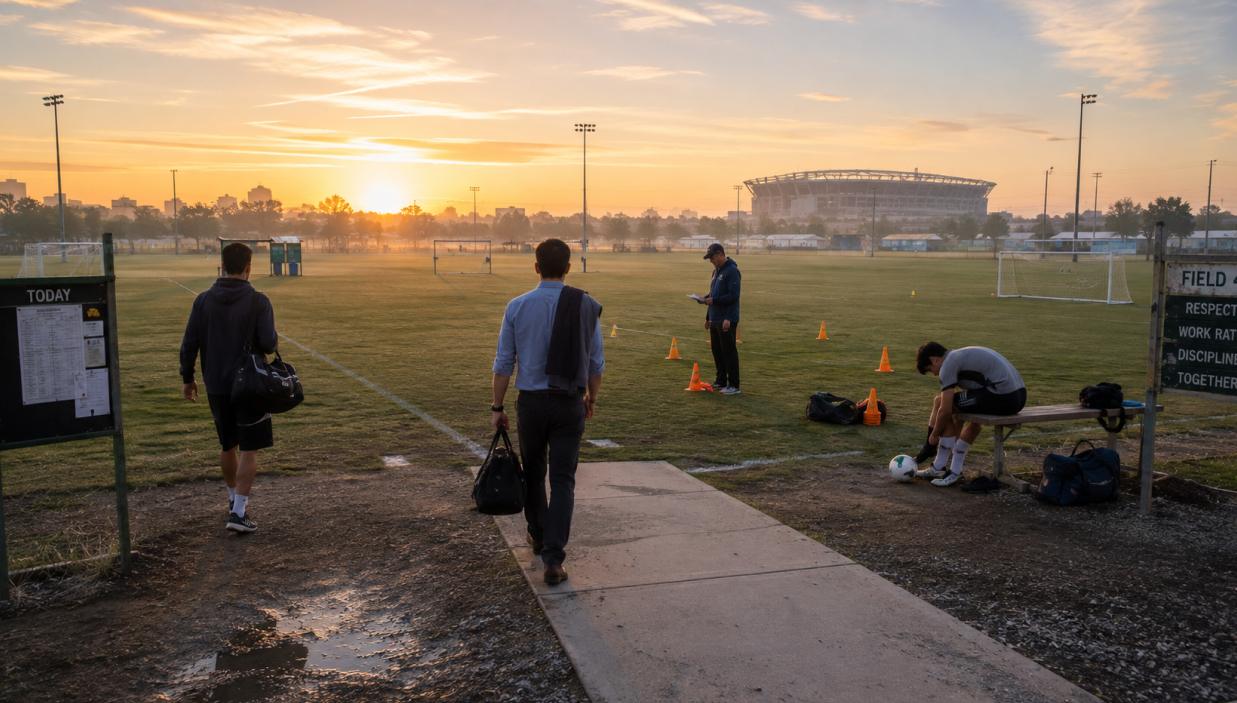
Long before Major League Soccer clubs enter the 2027 Lamar Hunt U.S. Open Cup, dozens of teams far removed from the country’s biggest stadiums will begin competing for the same national championship.
Some will represent established amateur organizations. Others come from regional leagues that receive little national attention. Players will balance soccer with jobs, school and family responsibilities. Clubs will operate with budgets that bear little resemblance to those of professional teams.
Yet the objective is real.
Win enough matches this fall and an amateur club can earn a place in the Tournament Proper, where the possibility of facing professional opposition becomes real.
For the 2027 edition, more teams than ever want that opportunity.
U.S. Soccer confirmed on August 18 that a record 155 Open Division clubs entered the fall qualifying competition. Sixteen additional Open Division teams have already qualified automatically for the Tournament Proper, meaning the amateur side of the competition reaches far beyond the clubs that will eventually appear in the main bracket.
The first qualifying weekend is scheduled for September 12-13, 2026. Fifty-four clubs will contest 27 matches, while 101 teams receive byes into the second qualifying round in October.
The numbers reveal something important about American soccer below its major professional leagues.
At a time when much of the sport’s attention is concentrated on MLS expansion, international stars and the aftermath of the 2026 FIFA World Cup, the country’s amateur club base is also becoming increasingly ambitious.
The question is whether that growth can become sustainable. U.S. Soccer Is Expanding Talent Identification Nationwide: Can It Stop Elite Players From Falling Through the Cracks?
A Record 155 Clubs Entered the Qualifying Competition
The first number worth understanding is 155.
That is how many Open Division clubs entered the 2027 qualifying rounds, according to U.S. Soccer’s official Open Cup announcement.
It represents a record for the competition.
For comparison, qualifying for the 2026 tournament drew 146 clubs from 28 leagues, 29 states and the District of Columbia.
The increase to 155 does not suddenly transform the economics of amateur soccer in the United States. It does, however, demonstrate that clubs continue to see value in pursuing a place in the country’s national knockout competition.
That matters because entry requires more than assembling 11 players for one weekend.
Clubs must satisfy eligibility requirements, maintain appropriate league status, submit rosters, secure suitable venues and accept the financial and logistical responsibilities associated with hosting and traveling.
The willingness of a record number of organizations to do that suggests the Open Cup remains meaningful well below the professional level.
The First Qualifying Round Starts September 12
The road toward the 2027 tournament begins in earnest on September 12 and 13.
U.S. Soccer’s first-round draw placed 54 clubs into 27 matches across the country.
Another 101 clubs received byes directly into October’s Second Qualifying Round.
That imbalance is necessary because the field eventually has to be reduced to 16 qualifying survivors.
The scheduled qualifying windows are:
- September 12-13, 2026
- October 3-4, 2026
- October 31-November 1, 2026
- November 21-22, 2026
By the end of that process, only 16 clubs from the 155-team qualifying field will remain.
Those teams will advance to the Tournament Proper in spring 2027.
The mathematics alone illustrate the difficulty.
For most amateur clubs, simply reaching the main competition will represent a significant achievement.
Thirty-Two Open Division Clubs Will Reach the Tournament Proper
The qualifying tournament is only half of the amateur pathway.
For the third consecutive year, the U.S. Open Cup will allocate 32 places in the Tournament Proper to Open Division teams.
Sixteen will emerge from fall qualifying.
Another 16 have already earned automatic entry through performances in designated amateur and pre-professional competitions.
That group includes clubs from USL League Two, the National Premier Soccer League, the United Premier Soccer League and The League for Clubs, as well as champions from competitions such as the USASA Amateur Cup and Hank Steinbrecher Cup.
The 16 confirmed automatic qualifiers demonstrate the geographic range of the system.
They include Ballard FC of Seattle, Vermont Green FC of Burlington, Laredo Heat SC of Texas, Miami United FC, Little Rock Rangers, Minneapolis City SC, San Francisco City FC, Deportivo Rose City of Portland and El Farolito of San Francisco.
Some are already familiar to Open Cup followers.
Others will make their tournament debuts.
Together, they show how the competition connects soccer communities that rarely occupy the same national conversation.
Asheville City Shows What the Opportunity Can Mean
For an amateur club, reaching the Tournament Proper is not merely ceremonial.
Asheville City SC provided a strong example in 2026.
The USL League Two club defeated professional side Greenville Triumph SC 3-1 in the First Round before meeting One Knoxville SC in the Second Round.
Asheville pushed One Knoxville to penalties before being eliminated.
Its run nevertheless earned the club the John Motta Trophy as the furthest-advancing Open Division side and a $50,000 Open Division prize.
That performance also secured automatic qualification for the 2027 Tournament Proper.
For a major professional organization, $50,000 is relatively small.
For an amateur or pre-professional club, the significance can be very different.
More importantly, defeating a professional opponent provides something difficult to manufacture through normal league competition: national credibility.
That possibility is one reason the Open Cup remains distinctive.
The Open Cup Gives Amateur Soccer a Visible Destination
American amateur soccer is enormous but fragmented.
Clubs compete through different leagues and governing structures.
Many have intensely local identities.
Supporters may know their regional competition well while having little familiarity with equivalent clubs elsewhere in the country.
The Open Cup creates a common destination.
A club does not need to belong to MLS to imagine playing in a national tournament.
It does not need a franchise slot.
It does not need promotion into a professional league.
It needs to satisfy eligibility requirements and then survive qualifying.
That principle is fundamental to the competition’s identity.
The U.S. Open Cup first crowned a national champion after the 1913-14 season and is entering its 112th edition.
More than a century later, its most unusual characteristic remains intact: eligible amateur teams can enter a competition that ultimately includes professional clubs.
Entry Is Accessible, but Competing Is Not Free
The romantic version of the Open Cup can obscure the operational reality.
Entering qualifying requires resources.
For 2027, U.S. Soccer lists an entry fee of $200, a $400 referee fee and a $1,500 performance bond, with the bond returned after elimination if the club satisfies its obligations.
Teams also need an eligible venue.
For qualifying rounds, fields must measure at least 100 yards by 65 yards.
Restroom facilities must be available for teams and spectators.
The hosting club must provide an athletic trainer.
The venue must also be available on designated qualifying dates.
Those requirements are reasonable for a national competition, but they demonstrate why growth cannot be measured purely by how many teams want to participate.
Clubs need enough organizational capacity to follow through.
The 2027 Open Cup entry requirements therefore function as a useful test of amateur soccer’s development.
A growing club culture requires administrators, facilities and financial stability as much as players.
Geography Makes the American Model Unusually Difficult
The United States presents a challenge that many soccer countries do not face at the same scale.
Distance.
A national competition covering California, Florida, Texas, New York, Washington and dozens of states in between creates unavoidable travel demands.
Regionalizing early qualifying helps.
It allows amateur clubs to face geographically sensible opponents before the competition becomes national.
But as teams advance, travel becomes increasingly difficult to avoid.
For volunteer-driven or modestly funded organizations, an unexpected away match can create substantial logistical pressure.
Flights, buses, hotels, field rentals, athletic trainers and staffing all cost money.
The continued growth of qualifying therefore depends partly on keeping participation realistic for clubs whose ambition is greater than their revenue.
Local Rivalries Can Make Qualifying More Valuable
Regional qualifying also creates an opportunity.
The earliest Open Cup rounds can produce matches that mean something locally even when neither club has a national profile.
Two organizations from neighboring cities may share players, coaches, supporters and youth soccer connections.
An Open Cup qualifier changes the context.
Instead of another league fixture, the winner advances toward a national championship.
That creates stakes.
Those local stakes can help amateur clubs develop identities beyond their regular league schedules.
A strong cup match can attract supporters who might not otherwise attend.
It can create social-media attention.
It can give sponsors a more compelling story.
It can provide players with a match that feels different from the rest of the season.
For amateur soccer, those moments have developmental value even when a club never reaches the Tournament Proper.
The 155-Team Field Reflects a Broader Soccer Ecosystem
One of the most interesting aspects of qualifying is the variety of organizations represented.
The field is not produced by a single amateur league.
Clubs arrive from numerous competitions and regional structures.
That diversity reflects both the strength and weakness of American soccer below the professional level.
The strength is participation.
There are serious clubs in markets across the country.
The weakness is fragmentation.
Fans who follow MLS may have little idea that competitive adult clubs operate nearby.
Even soccer supporters can struggle to understand how leagues relate to one another.
The Open Cup temporarily solves that problem.
For several months, the label that matters most is simple:
survive and advance.
The Competition Can Connect Grassroots and Professional Soccer
That connection has become increasingly important as American soccer tries to create clearer pathways.
The country has invested heavily in youth academies, MLS NEXT, MLS NEXT Pro, USL development structures and talent identification.
But player development is only one part of soccer culture.
Clubs need pathways too.
An ambitious local organization may never become an MLS franchise.
That does not mean it cannot build supporters, develop players, compete regionally and test itself nationally.
The Open Cup provides that bridge without requiring a fully integrated promotion-and-relegation pyramid.
It is not a substitute for debates about league structure.
It is something more immediate: a competition in which clubs from different levels can actually meet on the field.
Amateur Clubs Can Become Important Local Institutions
The most sustainable amateur organizations tend to represent more than a roster.
They build relationships with their communities.
They develop youth programs.
They create recognizable local identities.
They find venues supporters can associate with the club.
They build relationships with local businesses.
They give players opportunities after college or academy soccer.
In a country as geographically large as the United States, those organizations can fill markets that major professional leagues will never fully cover.
The Open Cup gives those clubs a national incentive without requiring them to abandon their local character.
That is one reason the record entry number deserves attention.
It indicates that more organizations believe national competition is worth pursuing.
El Farolito Represents the Competition’s Older Amateur Tradition
Not every successful Open Division club is new.
San Francisco’s El Farolito represents the opposite side of the story.
The club won the U.S. Open Cup in 1993, when the competition was still known as the National Challenge Cup, and remains connected to the Bay Area’s long amateur soccer tradition.
For 2027, El Farolito automatically qualified after winning both the USASA Amateur Cup and the NPSL championship.
Its continued presence illustrates something valuable about the Open Cup.
New clubs can emerge without erasing older ones.
A tournament that connects established amateur institutions with recently formed organizations creates historical continuity that franchise-based competitions often struggle to reproduce.
Vermont Green Shows What a Modern Amateur Club Can Become
Vermont Green FC offers another model.
Founded only in 2021, the Burlington-based organization has rapidly developed a recognizable identity and competitive record.
The club won the 2026 USL League Two championship, earning automatic entry into the 2027 Open Cup.
Its rise shows how quickly a well-organized lower-level club can become relevant within its community and national amateur soccer.
Ballard FC in Seattle offers another example.
Founded in 2022, Ballard won USL League Two in 2023, finished runner-up in 2025 and has reached the postseason every year of its existence through 2026.
These clubs are important because they challenge the assumption that meaningful soccer culture in the United States must always begin with a top-division franchise.
Sometimes it can grow from the neighborhood upward.
Professional Upsets Give the Tournament Its Competitive Meaning
The possibility of an upset is essential.
If amateur clubs were permanently separated from professional teams, qualifying would still produce a champion.
But it would lose much of its larger significance.
Asheville City’s victory over Greenville Triumph in 2026 mattered because the teams came from different competitive levels.
Miami United has previously defeated professional opposition in the Open Cup.
El Farolito has built part of its modern reputation through similar cup runs.
Those results are unusual precisely because professional teams normally possess greater resources.
That imbalance creates the drama.
The amateur team is not expected to win.
Sometimes it does.
The 2027 Format Gives Amateur Clubs a Defined Target
The structure is demanding but understandable.
A record 155 teams enter qualifying.
Sixteen survive.
Sixteen others receive automatic entry.
That produces 32 Open Division clubs in the Tournament Proper.
For an amateur organization beginning its campaign in September, that target is concrete.
It does not need to imagine winning the entire U.S. Open Cup immediately.
First, survive qualifying.
Then reach the main tournament.
Then see who appears on the other side of the bracket.
That progression gives clubs achievable milestones inside a competition whose ultimate prize remains extraordinarily difficult to win.
Growth Should Be Measured Beyond Entry Numbers
A record field is encouraging.
It should not be the only measurement.
The health of amateur soccer should also be evaluated through retention.
Do clubs return year after year?
Can they afford participation?
Do supporters attend qualifying matches?
Are local sponsors interested?
Can teams secure suitable venues?
Do players see these organizations as worthwhile competitive environments?
Are clubs developing stronger administrative structures?
A tournament can attract 155 entrants and still contain fragile organizations.
The more meaningful achievement would be turning record participation into durable clubs.
The Post-World Cup Moment Creates an Opportunity
The timing is significant.
The United States has just emerged from co-hosting the 2026 FIFA World Cup with Canada and Mexico.
Much of the discussion around the tournament focused on stadiums, television audiences, tourism and the USMNT.
The long-term test is different.
Can World Cup attention strengthen soccer below the elite level?
A person inspired by the World Cup may never live near an MLS stadium.
But there may be an amateur or lower-division club nearby.
That club can turn global enthusiasm into local participation.
The U.S. Open Cup can help because it gives local organizations a connection to the national soccer structure.
The route may be difficult.
But it exists.
America’s Soccer Culture Will Not Be Built Only From the Top
MLS will remain central to the growth of professional soccer in the United States.
The NWSL is expanding women’s professional soccer.
USL competitions serve markets throughout the country.
Those leagues matter enormously.
But a mature soccer culture also needs organizations beneath the most visible professional level.
It needs clubs that exist because a community wants them to exist.
It needs players who continue competing after youth or college soccer.
It needs local rivalries that do not require national television.
It needs volunteers, coaches, small sponsors and supporters willing to stand beside modest fields.
The 2027 U.S. Open Cup qualifying field offers a snapshot of that layer of American soccer.
There are 155 clubs trying to earn 16 places.
Most will never reach the Tournament Proper.
That does not make their participation insignificant.
The record field suggests more American clubs believe there is value in entering a national competition whose door remains open to them.
The challenge now is ensuring those clubs have enough competitive opportunity, local support and organizational stability to keep coming back.
If that happens, the most important growth story in American soccer may not always take place inside its biggest stadiums.
Some of it will begin on September 12 on community fields, with amateur players chasing a place in a tournament that has connected local soccer to the national game for more than a century.