

Bolivia’s effort to strengthen youth soccer gained a new platform in August when the first Copa Patria brought boys’ and girls’ teams from U8 through U16 to Sporting Santa Cruz.
The tournament was scheduled from August 6 through August 9, 2026, with organizers presenting it as more than another youth competition. The stated goal was to create a professionally organized environment in which clubs and academies could compete, learn and eventually make the event a recurring reference point for player development in Bolivia.
The timing makes the project particularly interesting.
Only weeks earlier, thousands of young players were competing across Utah and Tennessee in the 2026 U.S. Youth Soccer National Championships, the final stage of a much larger competition structure that begins at state level and progresses toward national qualification.
The contrast between Santa Cruz and the United States should not be reduced to size or money. Bolivia cannot replicate the American system overnight, and it does not need to.
The more useful question is whether Copa Patria can develop into the type of repeatable, connected competition that gives young players meaningful matches every year and gives coaches, scouts and federations a clearer picture of who is progressing.
According to the Copa Patria launch announcement, Sporting Santa Cruz designed the first edition around U8, U10, U12, U14 and U16 development, including both boys and girls and emphasizing professional refereeing, guaranteed matches, facilities, hydration and organized competition.
That is a valuable starting point.
The harder task begins after the final whistle.
Copa Patria Is Trying To Solve A Structural Problem
Bolivian football has never lacked talented children.
The recurring challenge is what happens between early potential and senior professional football.
A player may stand out at age 10 or 12 but still need hundreds of meaningful matches before he or she is ready for professional competition. Technical ability must develop alongside tactical understanding, physical preparation, decision-making and emotional resilience.
That is why youth tournaments matter.
They give players opportunities to compete outside their normal academy environment. A defender may face a faster winger than he sees every weekend. A goalkeeper may play against a more physical opponent. A midfielder may discover that the time available on the ball in local training disappears against stronger teams.
Copa Patria was designed to create some of those conditions inside Bolivia.
Sporting Santa Cruz described the tournament as a national competition intended to bring together leading clubs and academies while raising organizational standards.
That distinction is important.
Bolivia does not simply need more matches. It needs more useful matches.
A poorly organized tournament with large competitive mismatches provides limited developmental value. A well-structured event that groups teams appropriately, guarantees several games and maintains consistent officiating can give coaches better information.
The ambition should therefore be to make Copa Patria more difficult, more representative and more connected to the rest of the national football system with every edition.
The U.S. Championships Show What A Full Competition Ladder Looks Like
The American comparison is valuable because the national tournament is not designed as an isolated showcase.
The 2026 U.S. Youth Soccer National Championships were held from July 13 through July 23.
Boys played in Salt Lake City and Provo, Utah, while girls competed in Murfreesboro and Smyrna, Tennessee. The competition included age groups from 13U through 19U, with both Super Group and Premier Group divisions.
Each age group contained 32 teams in each competitive tier.
That scale is significant, but the pathway behind it matters more.
Teams reach the national stage through state championships and the U.S. Youth Soccer National League. The tournament therefore represents the final stage of a yearlong competitive structure rather than a collection of invited clubs arriving for one week.
Players and coaches know that qualification itself carries value.
A strong state season can lead to regional or national competition. A national tournament can then expose players to opponents from different parts of the country.
That creates continuity.
The strongest lesson for Bolivia is not that Copa Patria needs 32 teams in every age group.
It is that local, departmental and national competitions should eventually connect to one another.
Bolivia Needs A Clear Route From Academy To National Competition
A young footballer in Santa Cruz should be able to understand what the next competitive level looks like.
The same should be true in La Paz, Cochabamba, Tarija, Sucre, Oruro, Potosí, Beni and the rest of the country.
That progression does not always appear clearly in youth football.
Some academies have strong internal structures. Professional clubs operate their own developmental teams. Departmental associations organize competitions. Private tournaments create additional opportunities.
The missing element is often connection.
A national youth pathway becomes stronger when results at one level lead naturally into another.
Copa Patria could eventually contribute to that system.
A future edition could qualify clubs through departmental competitions rather than relying primarily on invitations. Regional events could feed a national final. The strongest players could then be identified for federation camps or professional-club monitoring.
The tournament itself would not need to become a federation championship.
It could still function as an independent development event while becoming a recognized point on Bolivia’s youth calendar.
The United States Uses Competition To Create Information
The U.S. championships also demonstrate why structured competition is useful for scouting.
The 2026 event concluded with national champions in both Super and Premier divisions across six age categories. Illinois clubs were particularly successful, while champions also emerged from states including Texas, Utah, Michigan, Alaska, California, Connecticut, Nebraska, North Carolina and others.
That geographical range provides scouts with a much broader sample of players than one metropolitan tournament could produce.
The official 2026 championship review also identified Golden Ball, Golden Boot and Golden Glove recipients across the various divisions.
Those awards should not be mistaken for professional predictions. USA’s U-20 Pipeline Is Already Moving Toward 2028: What Bolivia Can Learn Before the 2027 South American Championship?
The important point is that the structure creates recorded performances.
Players compete in group matches, quarterfinals, semifinals and finals. Coaches can observe how they respond as pressure increases. Goalkeepers can be evaluated in knockout matches. Forwards can be assessed against strong defenses. Midfielders can be compared across several opponents.
That information becomes part of the development process.
Bolivia needs more environments where the country’s leading youth players repeatedly compete against one another under similar conditions.
Copa Patria’s Girls Divisions Are Especially Important
One of the most promising aspects of Copa Patria is the inclusion of female categories.
Bolivian women’s football needs a deeper player base if it is going to become more competitive internationally.
That development cannot begin at senior level.
By the time a player reaches 18 or 19, many of the technical habits that determine her ceiling have already been shaped. The strongest football countries give girls regular structured competition much earlier.
Including girls from U8 through U16 creates the possibility of establishing that rhythm.
The next question is whether those teams have enough matches outside Copa Patria.
One four-day tournament cannot substitute for a season.
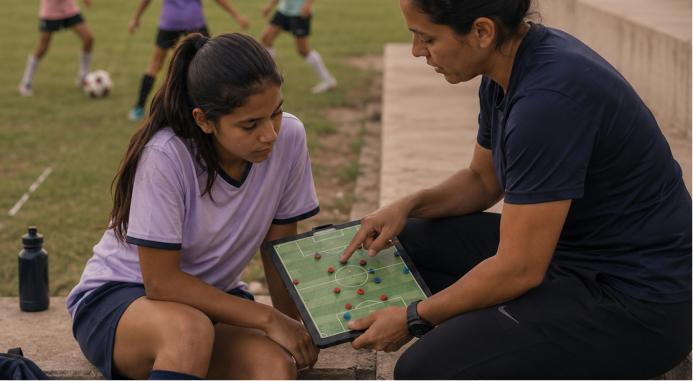
What it can do is show clubs, parents and organizers that there is enough interest to create additional competition.
If the girls’ divisions grow, Copa Patria could become a useful meeting point for academies that otherwise play in separate local environments.
It could also help identify players for future national youth teams.
Match Volume Matters More Than Tournament Branding
One danger in youth football is confusing a prestigious event with a complete development program.
A professionally organized tournament can look impressive while still providing only a small fraction of the matches a young player needs.
The American model illustrates the importance of volume.
Teams arriving at the national championships have already played throughout the year. Once they reach the final stage, they play three group matches before progressing through quarterfinals, semifinals and the championship final.
That structure rewards consistency.
A team cannot rely only on one exceptional performance.
Bolivia should pursue the same principle across the broader calendar.
Players need league matches, tournament matches and occasional international competition.
The goal should be to reduce the number of long periods in which talented youth players train frequently but compete irregularly.
Competitive Balance Will Determine Copa Patria’s Long-Term Value
As Copa Patria develops, one of the organizers’ biggest challenges will be creating balanced fields.
Youth soccer can be distorted by enormous differences in physical maturity and academy quality.
A strong professional academy can gain little from repeatedly defeating inexperienced teams by large margins. The weaker side also learns less once a match loses competitive tension.
The best youth events attempt to produce meaningful matches.
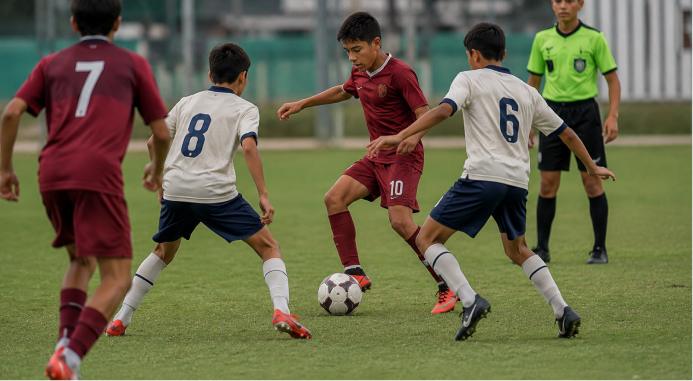
That can involve seeding, multiple divisions or advancement structures that progressively match teams of similar ability.
The U.S. championships use Super and Premier groups partly because the national player pool is large enough to support different competitive levels.
Bolivia may not need the same solution immediately.
But organizers should study results from every Copa Patria edition and identify where divisions are too uneven.
The objective is not merely finding a champion.
It is creating four days in which as many young players as possible are forced to solve difficult football problems.
Scouts Need To Be Part Of The Environment
A national youth tournament becomes more valuable when clubs and federations know it exists and regularly observe it.
Copa Patria can become a practical scouting hub.
Professional clubs should be able to watch players from academies outside their normal recruitment areas.
Youth national-team coaches can compare athletes from multiple regions in the same competitive environment.
Academies can identify players who may benefit from stronger training environments.
The process must be responsible.
Young children should not be treated like transfer-market assets, and parents should not be encouraged to believe that one strong tournament guarantees a professional career.
Scouting at these ages should focus on development potential.
Technical quality, decision-making, competitiveness, coordination and ability to learn often matter more than who is physically strongest at 12.
Coaching Standards Matter As Much As Player Talent
Tournaments also provide an opportunity to evaluate coaches.
A strong youth system requires coaches who understand that winning and development are not always the same thing.
At younger ages, a coach may improve short-term results by selecting only the most physically mature players and playing direct football.
That approach can produce trophies while slowing technical development.
Good youth coaching requires a longer horizon.
Players need to learn how to receive under pressure, build from the back, defend space, combine in small areas and understand multiple positions.
Copa Patria can help raise those standards if organizers complement competition with coaching workshops, post-tournament analysis or technical exchanges.
The United States has built an increasingly large coaching-education ecosystem around its youth structures.
Bolivia does not need to copy its scale, but improving the coaches who work with U8 to U16 players may produce a greater long-term return than almost any single tournament result.
The Next Step Is Connecting Santa Cruz To The Rest Of Bolivia
The first Copa Patria was staged at Sporting Santa Cruz, giving the tournament a clear home and an established training complex.
Long-term national relevance will depend on participation from beyond Santa Cruz.
A truly national event should eventually involve clubs and academies from multiple departments.
Travel costs will be one of the main obstacles.
A strong U12 team from Oruro, Sucre or Tarija may have the football quality to participate but not the resources to send players, coaches and families across the country.
That is where sponsorship, federation cooperation or regional qualifying events could become important.
Instead of requiring every academy to finance national travel independently, a future system could use regional phases to reduce costs.
The strongest teams would then progress to Santa Cruz or another rotating national venue.
That would make qualification meaningful while expanding geographic representation.
Bolivia Should Measure What Happens After U16
The most important Copa Patria statistic will not appear in 2026.
It will emerge several years later.
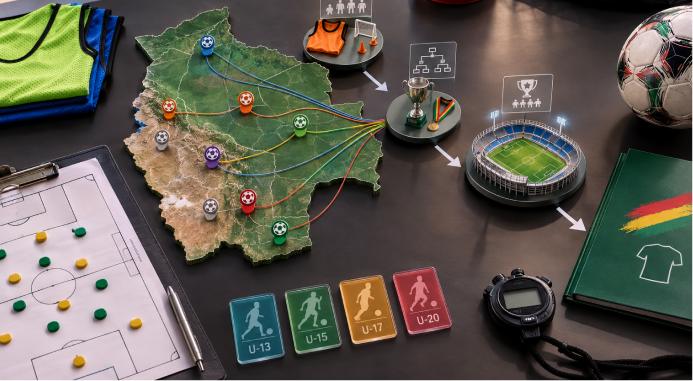
How many players from the first U14 and U16 divisions reach professional reserve teams?
How many enter Bolivia’s U-17 or U-20 national teams?
How many continue playing competitive football at 18?
How many girls remain in organized football after leaving the youth categories?
Those questions determine whether the tournament contributes to a genuine development system.
Youth football often loses players during the transition between academy and senior competition.
Bolivia needs better bridges through that period.
Professional clubs, developmental leagues and national-team programs must be ready to absorb the strongest players rather than forcing them to search for opportunities independently.
Copa Patria Can Become A National Reference If It Keeps Growing
The first edition should not be judged by whether it immediately resembles a U.S. national championship.
The American structure was built over decades and benefits from a player population and resources Bolivia does not possess.
Copa Patria should instead be judged by whether its second edition improves on the first.
Does it attract more departments?
Does the girls’ competition expand?
Are matches more balanced?
Do more professional scouts attend?
Are coaches given development opportunities?
Can organizers publish reliable schedules, results and player recognition without turning children into marketing products?
Can the event eventually connect with regional qualifying competitions?
Those are practical benchmarks.
The U.S. Youth Soccer National Championships show what happens when a youth tournament becomes the endpoint of a larger system.
Copa Patria is much earlier in that process.
Its value lies in creating another place where Bolivian players can compete seriously before reaching professional football.
If Sporting Santa Cruz and the participating clubs can turn the event into an annual national reference, Bolivia will gain something more important than another youth trophy.
It will gain another layer in the competitive structure required to identify, challenge and develop the players who could eventually reach La Verde.