

Forget sleek European conveyor belts. The engine room for Bolivia youth prospects is a high-altitude forge. Here, thin air and tough reality shape raw talent. It’s less La Masia, more Hogwarts built on a mountainside.
My analysis starts at 12,000 feet. Here, academies like Tahuichi operate like democratic public libraries for football. With 85% of kids on scholarships, they turn raw talent into midfield maestros. This isn’t just sport; it’s socio-economic alchemy.
The secret? A brutal, three-tiered curriculum. Mornings are for technical drills in nature’s hyperbaric chamber. Afternoons demand algebra, because game intelligence beats fancy stepovers. Evenings are for community service, building character alongside calf muscles.
This philosophy—socialist football meets Moneyball—was pioneered by Rolando Aguilera in 1978. While others scout genetic lottery winners, this system bets on grit. It leverages altitude to craft players whose lung capacities leave sea-level coaches in awe.
So, when we talk about the next generation, we’re analyzing a unique cultural experiment. The output is a testament to a grassroots-to-pro pipeline forged in the Andes. For real, up-to-date insights into this talent machine, you’ve come to the right place.
Recent youth selections
Getting a U20 call-up in Bolivia used to mean you were tough. Now, it means you’re ready for the world. The national team is a showcase of Bolivia’s best athletes.
The Prototypes: From Street Geometry to Data Points
Bolivia’s youth has always been unique. Icons like Marco Etcheverry and Juan Manuel Peña were shaped by the high altitude. They learned from the streets, not classrooms.
Today’s youth is different. They’re analyzed by advanced software. Romel Quiñones, for example, trained with coca-leaf sacks. Now, his skills are studied by complex algorithms.
| Era | Player Archetype | Proving Ground | Key Metric | Path to Success |
|---|---|---|---|---|
| 1990s (Legacy) | The Intuitive Virtuoso | Tahuichi Academy, Street Football | Grit, Creativity, Game IQ | Domestic League → Europe |
| 2020s (Modern) | The Quantifiable Phenom | CFG Academy, Data-Driven Clinics | xG Contribution, Sprint Distance at Altitude, Pass Completion % | Academy → Global Football Group Network |
| Future | The Hybrid Ambassador | Integrated National Academy System | Cultural Fluency, Media Score, Technical + Data Composite | Direct Placement in International Markets |
The New Scout’s Playbook: iPads and Tinku Dances
Scouts today look for more than speed. They want players who can celebrate like they do in Bolivia. They also need tactical smarts.
They’re searching for the “Andean Mbappé.” This player has natural speed and tactical skills honed in futsal.
The Academy Algorithm: Building the Quantifiable Phenom
Modern academies focus on creating complete players. They use a four-pillar system:
- Altitude Alchemy: They maximize the natural edge of high altitude.
- Futsal Foundation: It teaches quick thinking and decision-making.
- Tactical Coding: Players learn systems and patterns like code.
- Media Training: They learn to handle interviews and build their brand.
A U20 call-up today means a player is ready for the world. It shows they’re not just talented but also marketable. They’re the future of Bolivian football.
Development benchmarks
In Bolivia, scouting reports are replaced by precise measurements. A youth prospect’s future is checked with a pulse oximeter at 4,000 meters. The path is clear, with specific, scientific milestones.
What are the real benchmarks for a genuine Bolivia youth prospect? Let’s break it down.
- The Physiological Cheat Code: By 16, top players have lungs 12% bigger than sea-level peers. This isn’t just training. It’s a natural advantage from high altitude.
- The Temporal Reality: Bolivian pros debut at 19.3 years old, three years later than some Europeans. This isn’t a delay. It’s a slow maturation process, where talent grows with resilience. Patience is key here.
- The Foundational Prerequisite: Futsal is essential. 63% of the national team plays on concrete courts. Dribbling in tight spaces is a must for creative play.
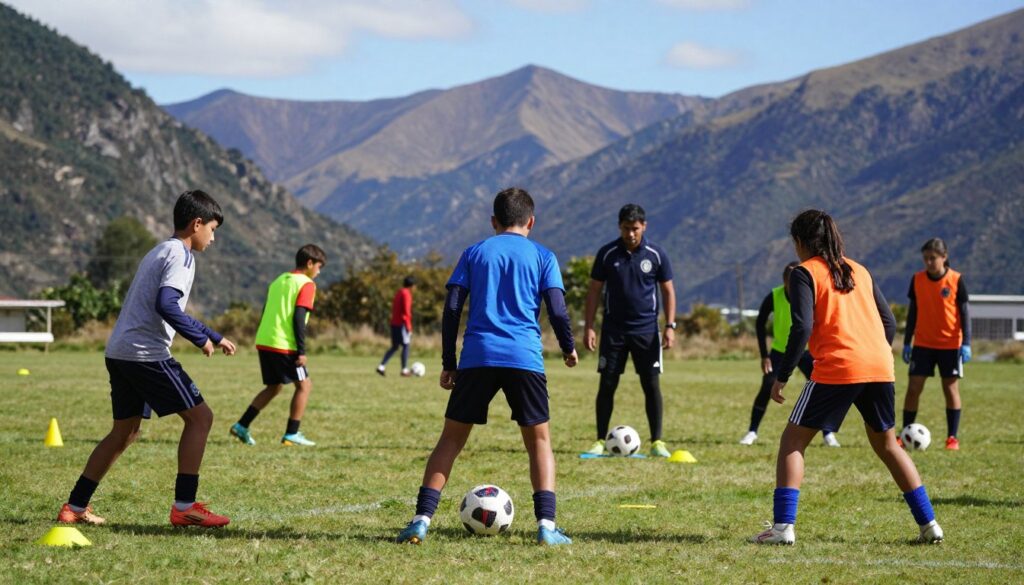
At places like Tahuichi, the daily routine is strict. Altitude sprints start at 5:30 AM. By 8:00 AM, it’s calculus. Futsal begins at 10:30. They’re not making influencers. They’re building resilient, smart athletes.
The real test isn’t just a highlight reel. It’s playing at 12,000 feet while thinking about your next pass. This approach helps with life skills, too, aiming to improve youth employability and labor income.
So, when looking at Bolivia’s youth prospects, don’t just look for flash. Look for the altitude, futsal skills, and patience. That’s true Andean excellence.
Projection to senior level
Which U20 call-ups will make it to the senior squad? It’s a big question. Bolivian football needs to be optimistic but also realistic. It must see the talent and face the challenges.
Groups like City Football Group’s Cochabamba academy help young players. They send them to Europe to train. But, for every Marcelo Moreno, there are many who face setbacks.
Success isn’t just about a debut. It’s about leaving a lasting impact. Players need to overcome many obstacles. It’s not just about talent, but also about the system’s support.