

Justin Ellis gave the United States another reason to take its emerging forwards seriously. The 19-year-old Orlando City striker scored in the 29th minute as the USMNT defeated Canada 1–0 at Allianz Field in St. Paul, Minnesota, on October 6, 2026. It was his second goal in his first three senior international appearances, helping the Americans finish their four-match window with four victories.
For Mauricio Pochettino, the significance extends beyond another friendly win. Ellis is providing early evidence that the national team can introduce young attacking players and receive an immediate contribution. The question is whether those contributions can develop into dependable options across different opponents, match situations and competitive demands.
The USMNT’s striker pool looks broader, but reliability remains something these players must establish over time. Ellis’s performance against Canada strengthens his case for further opportunities while also highlighting how much a center forward depends on the team around him.
Ellis’s Winning Goal Showed The Value Of Timing
The decisive move connected three players. Alex Freeman combined with Malik Tillman on the right before delivering the ball across goal, where Ellis finished from close range. The Associated Press match report detailed the combination that produced the evening’s only goal.
For a young striker, that kind of finish matters because it demonstrates a useful relationship between movement and service. A forward must recognize when a teammate is about to deliver, reach a dangerous position and complete the action before defenders recover.
The finish may appear straightforward once the ball arrives. Creating the opportunity to attempt it requires anticipation.
From a tactical perspective, the sequence offers a clear development target. If the United States can consistently release a wide player into crossing positions, its striker needs to provide a dependable central target. Ellis supplied that final action against Canada.
However, one successful combination does not establish an entire attacking identity. Pochettino will need to see whether Ellis can find similar opportunities when defenders deny the first crossing lane or force the United States to build through the middle.
A Narrow Win Leaves Questions About Chance Creation
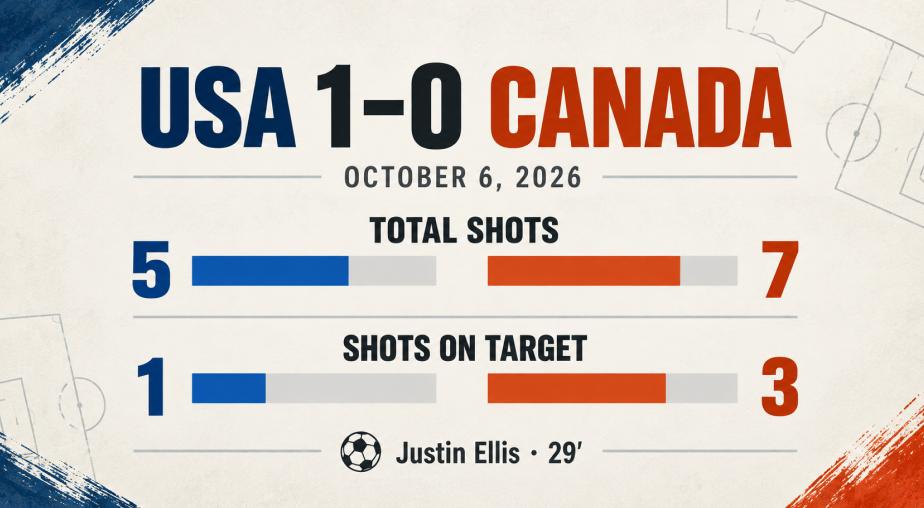
The final score should not obscure the limited attacking volume. Canada outshot the United States 7–5 and led 3–1 in shots on target.
That distinction matters when evaluating USMNT striker depth. A forward can finish efficiently while the wider attack struggles to create enough opportunities. Those are separate questions, and both affect whether a team can reproduce a result.
Ellis delivered the decisive finish, but a system that produces few attempts leaves little margin for a missed chance, a goalkeeper’s intervention or a defensive mistake. Future progress should therefore be measured through the quality and frequency of service as well as the identity of the scorer.
Useful indicators include how often the striker receives inside the penalty area, whether teammates can find him facing goal and whether attacks produce multiple finishing options. Those measures would help distinguish sustainable attacking improvement from an evening decided by one successful move.
The Canada match also offered a different test from a comfortable, open contest. The Guardian’s match coverage recorded a perfect four-game window and a combined 12–3 scoreline. Nevertheless, the narrow finale showed why the aggregate alone cannot explain every performance.
Hall And Ellis Give Pochettino More To Evaluate
Ellis’s breakthrough belongs within a wider discussion about young American forwards. Julian Hall scored in each of his first three senior appearances, against Peru, Chile and Mexico, according to U.S. Soccer’s assessment of the young attackers.
Having more than one emerging striker contribute gives the coaching staff a stronger basis for comparison. It creates opportunities to evaluate different combinations rather than relying entirely on training impressions or club highlights.
The next stage should examine what each player contributes between scoring chances. Can he retain possession under pressure? Does his movement create space for an attacking midfielder? Can he lead an organized press without leaving easy passing routes behind him?
Those responsibilities matter because international strikers cannot expect every appearance to provide several clear opportunities. Sometimes their most useful contribution is helping the team advance, occupy defenders or regain possession.
The broader USMNT youth movement also requires distinctions between roles. A young creator’s breakthrough and a center forward’s scoring run can support the same attack, but they answer different selection needs.
For Pochettino, the objective should be to identify combinations that work together. A growing collection of promising individuals becomes meaningful depth when the team can change personnel while preserving its attacking function.
Orlando’s Development Pathway Provides Important Context
Ellis’s international emergence follows a documented progression through Orlando’s system. On February 20, 2026, Orlando City announced that the academy and Orlando City B product had signed a first-team Homegrown contract. The club identified Wellington, Florida, as his hometown.
That Orlando City signing announcement provides useful context for the national-team attention. His development has involved a club pathway connecting academy football, reserve competition and the first team.
The importance of that pathway now lies in what comes next. International opportunities can accelerate recognition, but regular club work remains central to refining a young striker’s game.
Repeated exposure to senior defenders helps a forward learn when to protect possession, when to release it and how to adjust his runs against different defensive structures. Those lessons are difficult to acquire from occasional national-team appearances alone.
For Ellis, the next assessment should therefore consider his club performances alongside his international scoring. Consistent decisions and useful contributions across a wider sample would provide stronger evidence of readiness than extending a short scoring streak by itself.

Defensive Support And Availability Also Shape Reliability
The United States needed contributions at the other end to preserve Ellis’s winner. Brian Schwake made three saves and kept a clean sheet in his first international start, which was his second senior appearance.
That contribution is relevant to the striker debate. Winning 1–0 reflects the relationship between finishing and protecting a lead. A forward’s decisive moment becomes a winning goal only if the rest of the team prevents an equalizer.
Availability is another consideration. The New York Post’s match report described Ellis receiving treatment after a first-half challenge and being replaced at halftime. That report does not establish a confirmed diagnosis or recovery timetable.
The immediate analytical point is about squad construction. Genuine depth gives a coach alternatives when a player needs to leave a match or cannot complete a window. It should reduce the pressure to depend on any single emerging forward.
The Next Test Is Repeatable Production
Ellis has earned continued attention through a specific, valuable action: converting the opportunity that separated the teams. His early scoring record is encouraging, and the Canada winner adds substance to the discussion about new American attacking options.
The next test is broader than another goal. Pochettino needs forwards who can contribute when service is limited, adjust to different defensive approaches and perform their responsibilities without the ball.
The team also needs to create enough opportunities for that evaluation to be fair. Better striker depth and better chance creation should develop together.
For now, Ellis has strengthened the argument that the USMNT has more attacking talent worth testing. Turning that promise into reliable depth will require sustained club performances and repeated international contributions after opponents have had time to study him.