

Forget the confetti and the back-slapping. In most places, a debut is a personal milestone. In Bolivia, it’s a national alchemical reaction.
We’re not watching a kid step onto a pitch. We’re witnessing the final product of a unique, high-altitude pressure cooker. The air is thin at 12,000 feet, but the expectations for a Bolivia young player are dense enough to cut with a knife.
This isn’t La Masia. This is Tahuichi Academy, the Hogwarts of the Andes. Here, morning drills double as altitude therapy. Afternoon classes are a non-negotiable scholarship for a life beyond the field.
The system is the star. A notable debut here is a triumph of systemic grit over individual luck. It’s the moment a kid from Academia del Balompié proves that world-class talent can be forged in a nation the global rankings love to ignore.
Consider the extreme case: Mauricio Baldivieso, the youngest player to feature in a professional football. His story isn’t just an anomaly; it’s a symptom of the intense, almost paradoxical, environment that shapes these Bolivia young players.
So, what’s in the secret sauce? Let’s dissect the recipe: altitude-forged lungs, futsal-honed feet, and a socioeconomic reality that makes every opportunity taste like gold.
Youth-to-senior transition
The journey from academy star to pro footballer in Bolivia is a unique path. It’s not just a promotion. It’s a journey that European scouts might not understand. Here, we value talent differently, with a focus on patience and learning.
In Bolivia, players debut at 19.3 on average. That’s three years later than in Europe. This isn’t a delay. It’s a choice to develop talent slowly, in the high altitudes and humid environments of Bolivia.
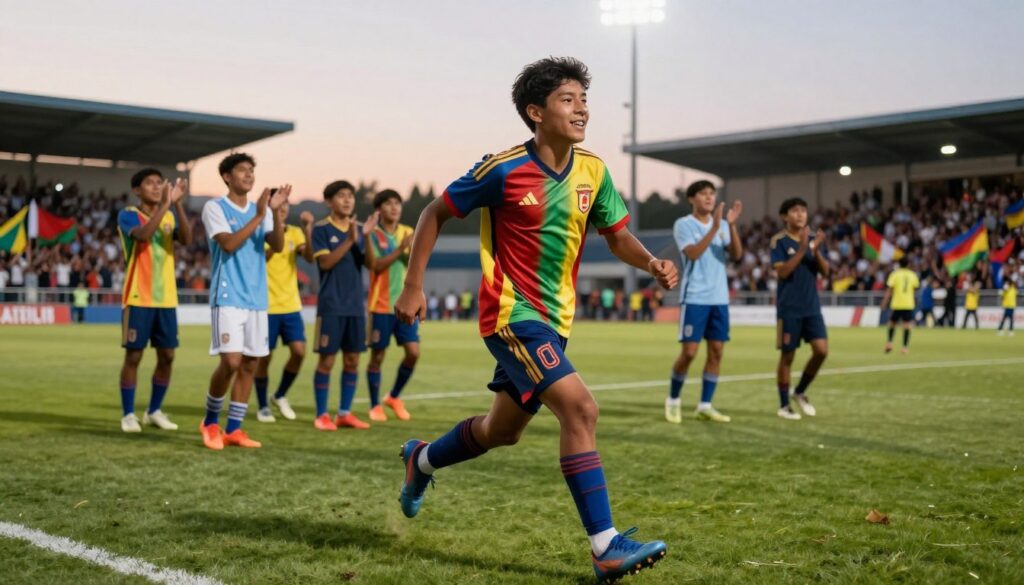
Those extra years are filled with learning and training. A typical day includes school, futsal practice, and tutoring. This approach prepares players for the pressures of football and life.
Futsal is key to this development. Before playing on big fields, kids play on small ones. This builds quick thinking and spatial awareness, turning raw talent into smart play.
First appearances in Bolivia are about more than just showing off. Scouts look for players who can handle the challenges of high altitude and rigorous training. They value resilience over fame.
Legends like Marco Etcheverry and Juan Manuel Peña started with quiet dedication. They mastered the ball in Cochabamba’s lots and learned to defend in tough conditions. Their journeys were long and hard.
This approach makes players more complete when they debut. They’ve faced challenges in small tournaments and big stadiums. They’ve learned to handle pressure and succeed.
The delay in debut is due to Bolivia’s geography and economy. Clubs can’t risk untested players. They wait to see how a player handles pressure and altitude. This patience is part of our mission to understand these systems.
Players who debut later show remarkable longevity and mental strength. They’ve faced unique challenges and balanced school and football. Their careers are long and successful.
So, when you see a Bolivian player make their debut, remember it’s not just a start. It’s a graduation from a rigorous program. They’ve learned physics, philosophy, and football, and passed a test of survival.
Club confidence signals
When a Bolivian club gives a teenager his first contract, it’s more than just a piece of paper. It’s a high-stakes move in the thin air of La Paz. This move shows a mix of hope, desperation, and physical data.
Club Bolívar’s decision to promote young players is not just tradition. It’s a sign that bringing in talent from outside is hard. They’re betting on their own system, from the rough pitches of El Alto to their top team.
On the other side, City Football Group’s academy in Cochabamba is a different kind of gamble. They use data to find the next big talent, like the “Andean Mbappé.” They’re trying to find talent using advanced analytics, asking if technology can uncover the unique qualities of Altiplano players.
This creates a unique scouting approach in Bolivia. Scouts must understand both advanced metrics and the resilience of players raised at high altitudes. It’s a blend of science and intuition.
Choosing a young player over an experienced one is a big decision. It’s not just about talent. It’s also about saving money that could fund a whole youth team for a year. This decision is both smart and hopeful.
Community and family are key in this system. Unlike in Europe, families are deeply involved in a player’s career. This support is not just emotional but also financial, as a player’s success can mean a family’s economic stability.
This decision says a lot about a club’s philosophy. Are they building from the ground up like Bolívar, or making a risky bet like CFG? It shows their approach to football.
This approach also highlights Bolivia’s unique value in football. Players from here face challenges that Europe can’t match. They develop skills shaped by their environment, not just European models.
This method is not new in successful football systems. Look at Orlando City SC’s commitment to young players. The core idea is the same: betting on youth’s promise over proven talent. In Bolivia, this bet is even more significant because of financial constraints.
So, when you see a young player from Potosí make his debut, think beyond the jersey. See the big statement it makes. Understand the scouting that found him. That player is more than just a footballer; he’s a product of a system that turns challenges into opportunities.
Early performance review
In today’s football, a debut is just the start. The real test comes with the early performance review. For a Bolivian player, this is a tough check-up on both physical and mental health.
Can a player used to high altitudes perform well at sea level? The “altitude advantage” is put to the test in first appearances. Is it a real benefit or just a myth that disappears in the air?

Scouts now have more tools than ever. They use GPS, AI, and metabolic data to evaluate players. Let’s look at the facts.
The Altitude Advantage: Myth vs. Data Reality
| The Romantic Myth | The Measurable Metric | The Early Performance Verdict |
|---|---|---|
| 12% greater lung capacity by age 16 creates an unstoppable engine. | VO2 Max efficiency in low-oxygen vs. high-oxygen environments. | Players often show great power at first, but endurance pacing can be off. Too much oxygen confuses the body. |
| Altitude-born players are naturally fitter, dominating the 90-minute game. | Distance covered per match & high-intensity sprint repetition. | Data shows players might burn fuel too fast early on, struggling later. It’s like a “thin air hangover.” |
| They possess a unique psychological toughness from training in harsh conditions. | Pass completion % under pressure & defensive actions in own half. | This is often true. Mental strength is clear in key tackles and calm play. |
The table shows the truth. The advantage is real but complex. It’s about adapting to a new environment, not just having more endurance.
Women’s football in Bolivia faces similar challenges. Players like Maitte Zamorano didn’t just get tactical reviews. They faced societal bias and prejudice.
Every goal and win was a fight against stereotypes. Their early performances were a battle to prove themselves.
When we review a Bolivian debutant, we’re asking big questions. Are they a fascinating case study or a game-changer? The answer lies in their ability to adapt.
The first appearances give us hints, but not the whole story. True talent is shown in adapting to new challenges.
Development outlook
The future of Bolivian football is not straightforward. It’s like a fork in the road at 3,600 meters. One path could make Bolivia a top winter destination in Europe. Bundesliga clubs are already interested in players from there.
The other path focuses on developing coaches from within. This creates a cycle of growth and knowledge.
Take Bruno Miranda’s move to MLS as an example. It shows that players can succeed globally. Jaume Cuéllar’s success at Bologna also highlights the value of Andean athletes. The scouting pipeline is growing, but 62% of talents are lost. This is the harsh reality of development.
Women’s football could be the game-changer. When girls like *karimachu* become coaches, it’s a big step forward. It’s not just about adding women to the game; it’s about changing the system.
Look at the numbers. A $2.1 million investment in youth football brings a 9:1 return. This is much better than the global average. These young players are not just athletes; they are valuable assets.
The academy system shows that altitude can lead to success. It turns promise into lasting achievements.
The outlook is clear: it’s about proving a system works against all odds.