
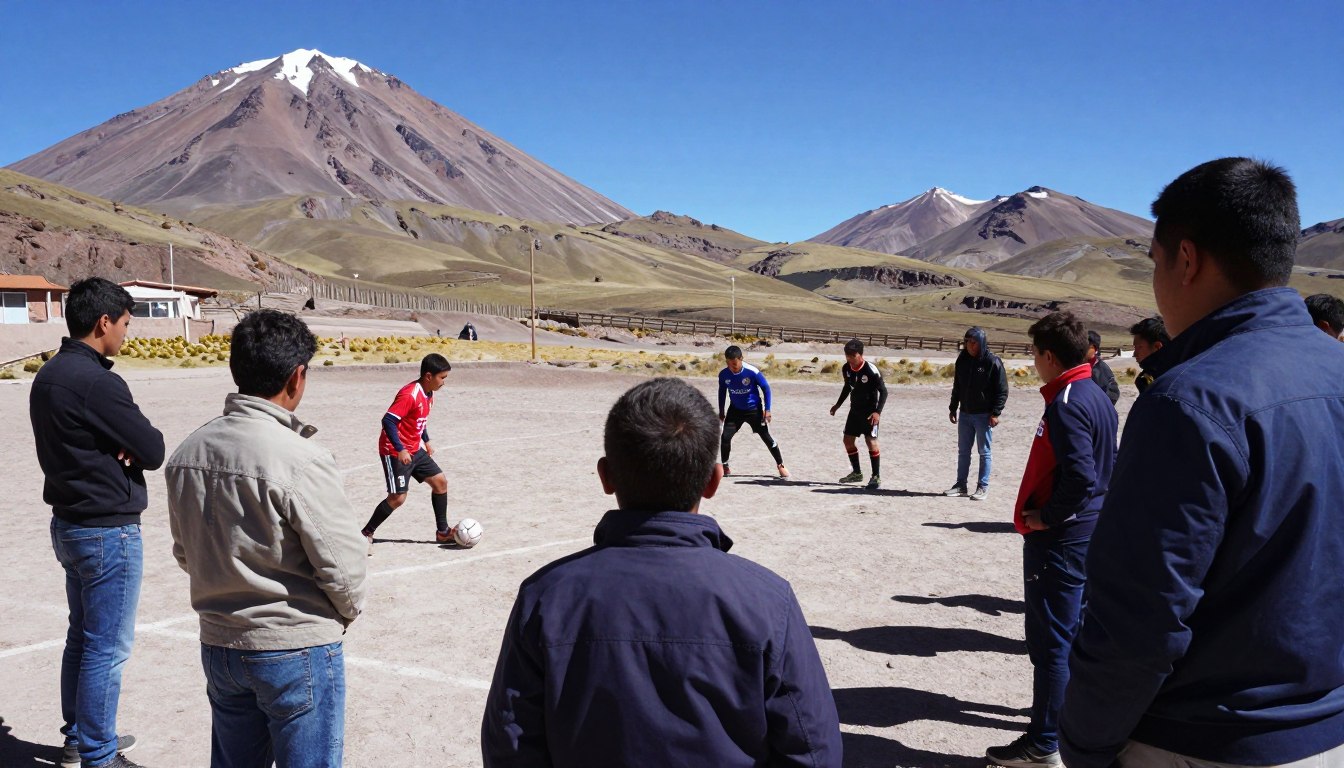
Forget the world of academy pipelines and data dashboards. Here, talent evaluation is like solving a paradox at 12,000 feet.
I’ve seen kids on pitches where the air is so thin it feels like a concept. They have VO₂ max readings that belong in a textbook. This isn’t just scouting; it’s a lesson in understanding the context.
In this place, a $3-a-day training program can outdo European academies spending hundreds per hour. A player’s “herding commute distance” tells more than his bench press.
The report from here isn’t just stats. It’s a story of survival with a first touch. Elite clubs now look beyond obvious football factories to this Andean crucible.
The most valuable traits are shaped by geography and economics. It’s about finding a kid who doesn’t just run fast. Their lungs have learned to live with thin air. This unique environment makes a different overseas player identification and recruitment critical.
Let’s uncover the truth behind this high-stakes game. Welcome to the real Bolivia scouting analysis.
Physical vs technical traits
In Bolivia, the scout’s notepad is like a guide to superhuman abilities. It measures endurance in llama-herding kilometers and technical skill in futsal. Unlike standard player evaluation templates, it’s about understanding a player’s unique biology and culture.
Physical traits are key at 12,000 feet. Players’ lungs and hearts work differently than those at sea level. We use new metrics, like “herding distance,” to measure endurance.
Forget the beep test. We look at how far a player can go before sunrise herding livestock up a mountain. That shows real stamina.
Altitude-adjusted VO₂ max is another important metric. It’s about how well players breathe in thin air. Some players even use coca leaves for focus and energy. These practices are not just cultural; they’re about adapting to high altitude.
| Metric Category | Bolivian Metric (Unique Adaptation) | Standard Metric (Global Benchmark) | Scout’s Insight |
|---|---|---|---|
| Cardiovascular Endurance | Altitude-Adjusted VO₂ Max, Herding Distance | Standard VO₂ Max, Yo-Yo Test | Quantifies natural high-altitude conditioning that grants a late-game stamina edge. |
| Muscular Strength/Endurance | Quinoa-Bag Carrying Capacity | Bench Press, Squat Max | Functional strength built through daily life, not gym isolation. |
| Technical Agility | Futsal-Honed Close Control, Mine-Shaft Dribbling | Passing Accuracy %, Dribble Success Rate | Creativity and touch forged in confined concrete spaces, not manicured pitches. |
Technical traits are just as fascinating. Many players grow up playing fútbol de salón on hard courts. The ball is smaller and heavier, and the space is tight. This leads to incredible dribbling skills.
They can twist and turn in tight spaces. But complex schemes? They might stare blankly. Their skills are honed in street games, not on big pitches.
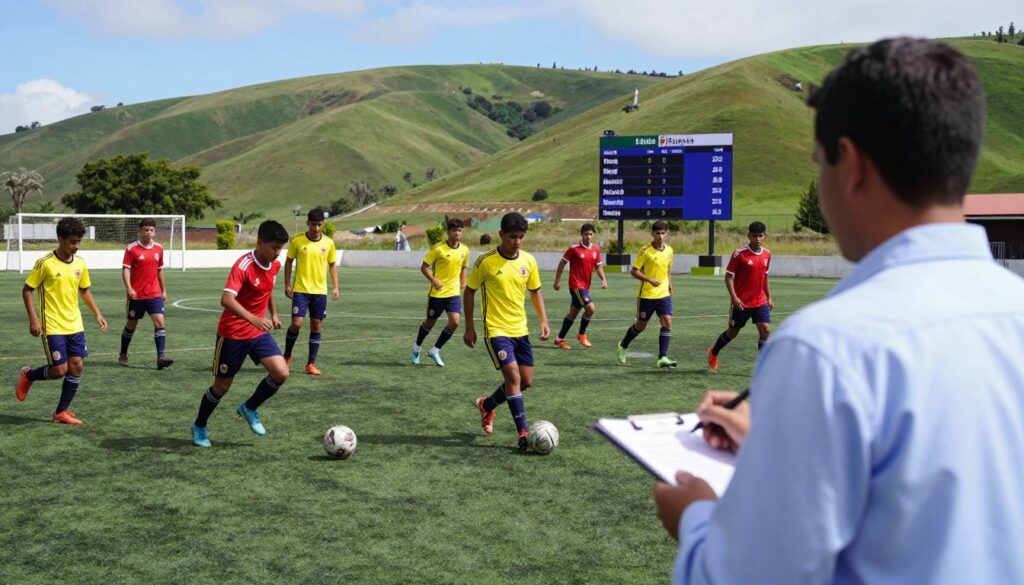
Finding the right player is the scout’s challenge. Jaume Cuéllar, for example, had a 15% higher sprint speed in the final 15 minutes than the CONMEBOL average. That’s the altitude advantage.
But he also excels in tight spaces, spinning away from trouble. It’s a mix of physical and technical skills. My job is to balance these traits for a meaningful evaluation.
In Bolivia, it’s not just physical or technical. It’s about finding the athlete where both traits meet. The player who’s fit in thin air and skilled in tight spaces is what we’re looking for.
League bias factors
Imagine trying to sell a diamond to someone who only understands cubic zirconia—that’s the daily reality of Bolivia scouting analysis. The bias isn’t malicious; it’s a failure of imagination baked into the system.
Scouts watch footage from La Paz and subconsciously apply what I call the “Andean Tax.” It’s that automatic 20-30% discount applied before the player even gets a fair assessment. A goalkeeper dominating his area at 3,600 meters becomes “good for Bolivia” instead of “next Premier League starter.”

The physiological translation is where most evaluations crumble. That blistering pace in thin air? At sea level, without oxygen debt, it might register as merely “above average.” The stats are children of their environment, and we’re asking them to perform in a different family altogether.
Consider this brutal number: 43% of Bolivian players moving to Europe fail within 18 months. Is that a talent problem or a scouting problem? I’d argue it’s the latter—a classic case of misdiagnosis leading to prescription failure.
The cultural misreads are almost comical. A goalkeeper headbutting the crossbar in celebration (a condor reference) gets labeled “unprofessional” instead of “culturally significant passion.” Coca tea consumption becomes a party trick suspicion instead of recognition of centuries-old altitude adaptation.
| Bias Type | Manifestation | Impact on Valuation | Correction Method |
|---|---|---|---|
| Physiological | Misreading altitude-adapted performance as “slow” at sea level | 30-40% undervaluation of athletic traits | Altitude-adjusted metrics, controlled environment testing |
| Cultural | Interpreting passionate celebrations as lack of discipline | 15-25% character discount | Local cultural context education for scouts |
| Economic | Assuming low salary = low ceiling (player earning $1,200/month) | 20-30% underestimation | Value-over-replacement analysis in native context |
| League Prestige | Bolivian league budget ≈ European club’s bench | Automatic “small league” penalty applied | Performance relative to league resources metric |
The economic bias might be the most insidious. When a player outperforms academy stars while surviving on $1,200 a month, that should scream “mental fortitude” and “high ceiling.” Instead, it whispers “low maintenance cost” to budget-conscious clubs.
Overcoming these biases requires acting as a cultural and physiological translator. You’re not just scouting talent; you’re translating an entire ecosystem. The diamond from the Andes isn’t rough—it’s cut differently. Recognizing that difference is what separates true in-depth scouting reports from superficial checklists.
Proper Bolivia scouting analysis means convincing decision-makers that surviving at altitude on local wages isn’t a limitation—it’s a PhD in adversity. The player who thrives in La Paz has already passed tests most European prospects never face.
The bias wall won’t crumble with one brilliant performance. It requires systematic reevaluation of what we value and why. Sometimes the best talent isn’t hiding—we’re just looking at it through the wrong lens.
Projection challenges
Finding talent in Bolivia is easy. The real challenge is predicting how that talent will perform at sea level. This is known as the “Oruro Conundrum.” A player’s explosive power, developed at high altitudes, can become clumsy at lower elevations.
The body, adapted to thin air, often struggles at sea level. Studies show a 43% higher injury risk for players over 25.
The focus shifts from what a player is to who they can become. We look beyond their current abilities. The story of Rodrigo Carrasco teaches us about the risks. On the other hand, Leonel Justiniano’s success shows the power of resilience.
Modern scouting seeks players who can adapt. It’s not just about physical strength. We look for players who can think on their feet and adjust their game.
The future belongs to players who can handle change. This new approach to scouting focuses on mental flexibility. The true gem is the player who can learn and adapt quickly.