

The MetLife Stadium Final will place East Rutherford, New Jersey, at the center of the 2026 FIFA World Cup on July 19, 2026. The match is more than a date on the tournament calendar. It connects an NFL-scale venue, a major American sports market, and a World Cup final lineage that has rarely passed through the CONCACAF region.
That status gives the event clear historical weight, but the case should be made with care. The supported record shows a venue chosen for the final, a stadium with major-event experience, and a host site scheduled for more than one knockout match. Those facts are enough to explain why the assignment matters without stretching into claims that cannot yet be verified.
Why The MetLife Stadium Final Carries Weight
World Cup finals often become shorthand for an era: the host city, the stadium, the winning team, and the broadcast images all merge into one memory. In 2026, that memory will include a stadium that normally serves as the home of two NFL teams but will operate under FIFA tournament conditions for soccer’s biggest match.
Selection And Date
MetLife Stadium was selected as the host venue for the FIFA World Cup 26 final, with the final scheduled for July 19, 2026, according to the official MetLife Stadium announcement. The venue’s place on the calendar gives the New York and New Jersey area the tournament’s closing act, a role that carries sporting and civic importance.
The selection also gives the stadium a different identity for global audiences. Many viewers know the building through American football, especially because it hosted Super Bowl XLVIII in 2014. Soccer audiences may also recognize it from the Copa América Centenario Final in 2016. Those prior events do not guarantee how 2026 will feel, but they show the venue has already handled major championship settings.
MetLife Stadium Final In Regional Context
The MetLife Stadium Final also fits into a selective regional pattern. FourFourTwo notes that the 2026 final will follow Mexico City in 1970 and 1986, and Pasadena, California, in 1994, as World Cup finals staged in the CONCACAF region World Cup final timing. That does not make the venue more important than those predecessors, but it places it in a line of North American finals with lasting football memory.
Mexico City’s two finals and Pasadena’s 1994 final are often discussed because of what happened on the field and because each match reflected a different stage of the sport’s global reach. East Rutherford now becomes part of that same regional record. For historians, that makes the 2026 assignment notable before a ball is kicked.
Venue Scale And Event Memory
MetLife Stadium’s reported seating capacity of 82,500 is central to its hosting profile. Capacity alone does not define a World Cup final, but it shapes the matchday environment and the number of supporters who can be present for the title match. In a tournament spread across North America, the final venue’s scale is part of the story.
Capacity And Prior Major Events
The stadium’s past events matter because finals carry operational demands that differ from regular-season fixtures. Super Bowl XLVIII brought an American football championship to the building in 2014. The Copa América Centenario Final in 2016 gave the venue a major international soccer championship before the World Cup assignment. Those examples do not answer every question about 2026, but they give the venue a documented record with large audiences and high-profile competitions.
For soccer, the prior Copa América final is especially relevant. It shows that the building has already staged a major international final, even though the World Cup carries a broader audience and a different tournament structure. The MetLife Stadium Final will therefore be both a continuation of past event use and a step into a larger global frame.
Temporary Tournament Identity
During the tournament, the venue is set to be known as New York New Jersey Stadium because of FIFA sponsorship rules. That temporary name is not a small detail for historical records. World Cup archives, match programs, broadcast references, and tournament signage can preserve names that differ from the commercial names fans use in league play.
This naming shift also links the stadium more directly to its host market. East Rutherford is the physical site, while New York and New Jersey provide the broader identity used for the tournament. That dual geography is common in major American sports venues, but the World Cup final will project it to a larger international audience.
For readers looking to engage more with related soccer narratives, AP Levante is a related site in the same network and offers additional insights into the sport’s broader dialogue.
Schedule Density Around The Final
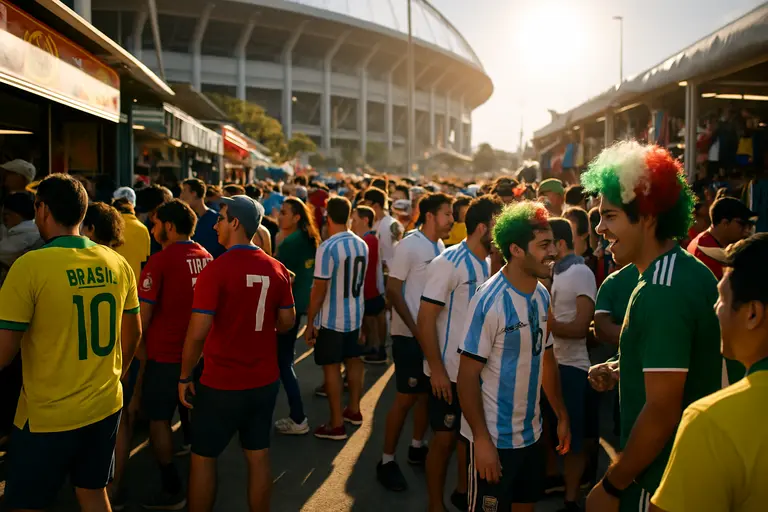
The final will not be the stadium’s only World Cup assignment. The venue is slated to host seven other matches: five group-stage matches, one Round of 32 match, and one Round of 16 match. That schedule gives the building a full tournament arc before the championship match arrives.
Eight Matches At One Site
A site hosting eight matches has a different tournament role than a venue used only for a limited number of games. Group-stage fixtures bring different teams, supporter bases, and match rhythms. Knockout matches increase pressure because the tournament begins eliminating sides. By the time the final arrives, the venue will have already been part of multiple phases of the competition.
This matters for historical interpretation because stadiums are remembered not only for finals but also for the path that led there. A dramatic group match, a Round of 32 result, or a Round of 16 performance can become part of a venue’s World Cup identity. The MetLife Stadium Final will be the headline, but the earlier fixtures will shape how the stadium’s 2026 role is judged.
What The Run-Up Can Tell Us
The match schedule also allows analysts to separate venue history from one-night symbolism. A final is singular by nature, but a venue hosting several tournament matches gives observers more evidence: pitch conditions, crowd movement, atmosphere, and how the stadium presents soccer across different rounds. Those observations should be made during the tournament, not assumed in advance.
The official venue material also describes the 2026 final as expected to be among the most-watched sporting events globally, with projected viewership exceeding 2 billion people. Projections should be treated as projections until the event is measured, but they signal the scale FIFA and host organizers attach to the match.
MetLife Stadium Final In World Cup Memory
The MetLife Stadium Final will be judged first by the football: the teams that qualify, the players who shape the match, and the decisive moments on July 19, 2026. History usually settles around those details. A stadium can frame the moment, but the match itself gives it meaning.
Still, the venue’s assignment is already historically significant in a narrow, evidence-based sense. It brings the World Cup final back to the United States for the first time since Pasadena in 1994. It places the title match in the New York and New Jersey market. It adds another CONCACAF chapter after Mexico City’s two finals and the Rose Bowl’s 1994 place in tournament memory.
The strongest reading is not that MetLife Stadium automatically changes soccer history. The supported reading is that a major American venue, with an 82,500-seat scale and prior championship experience, has been given the closing match of the expanded 2026 tournament. That is enough to make the MetLife Stadium Final a fixed point in World Cup history before the teams are known.