

Imagine a country that once amazed the world with its high-altitude soccer. Now, it’s focusing on young talent to change its game. Remember that epic win over Argentina 6-1 at 3,600 meters? That’s Bolivia’s soccer story – a mix of altitude magic and youth development.
Now, places like Academia del Balompié are changing the game. They aim to make Bolivia a talent hub, not just a high-altitude trick. It’s like Moneyball meets Machu Picchu – using data and South American passion. Oriente Petrolero’s U20 team is a success story, sending three players to Europe last season.
The real change is happening at sea level, not high up. Young coaches focus on skill, not just being able to breathe. This means Bolivian players can compete worldwide, without needing mountains.
We’re going to explore this big change. From young players mastering soccer in Santa Cruz to U23 strikers in Berlin. Bolivia’s soccer is evolving, moving beyond its high-altitude fame.
Introduction – The Significance of Youth Systems
Imagine creating top talent with a population smaller than New York City – that’s Bolivia’s youth football gamble. Brazil has teams from a huge pool of 215 million. Bolivia, with 11.9 million people, faces a tough numbers game that would make Moneyball’s Billy Beane nervous. It’s not just soccer; it’s turning raw talent into gold.
Let’s look at the numbers: 60% of Academia’s 2018 title-winning squad came from youth programs. It’s not luck; it shows that good planning can beat big numbers. It’s like South America’s most exciting lab, where coaches turn challenges into strengths.
But here’s the big question: Can La Paz’s high altitude help in youth development? The country’s U17 coaches think yes, using high-altitude training camps to boost performance. It’s like having a secret advantage from the Andes Mountains.
Scouts, take notice – Bolivia’s youth teams are learning to be resourceful. When you can’t spend as much as Argentina’s academies, you use science instead. Don’t overlook these developments, or you might miss the next big talent from Bolivia’s streets.
Overview of U23, U20, and U17 Squads
Bolivia’s youth teams are like a trilogy. The U17s are the bold start, the U20s the thrilling middle, and the U23s the hopeful end. At Oriente Petrolero’s academy, these teams show the depth of Bolivian football.

The U17s have moved away from a “kick-and-rush” style. They now use a 4-3-3 system, focusing on keeping the ball. A 14-year-old midfielder is already known for his exceptional passing skills.
The U20s are a different story. They have 63% of their starters with Copa Libertadores Youth tournament experience. These young players have faced top teams like Brazil and Argentina.
| Age Group | Tactical Identity | Key Stat | Global Footprint |
|---|---|---|---|
| U17 | 4-3-3 Possession | 82% pass accuracy | 0 foreign-based |
| U20 | Counter-Press Hybrid | 63% Int’l experience | 2 Chile-based |
| U23 | Positional Play | 41% professional contracts | 5 Argentina-based |
The U23s are Bolivia’s “Andean Exports”. Five players play in Argentina’s second division, and two in Chile. They show Bolivian determination and international skill.
Could this be the team to break through in CONMEBOL? The U20s’ win over Paraguay is a sign of hope. But we must stay cautious and optimistic.
Talent Pathways: From Grassroots to National Representation
Bolivia’s talent search is like a chess game, mixing stats with adventure. While European clubs use GPS, Academia Tahuichi scouts climb mountains to find talented kids. They look for heart rate and dance skills, not just speed.
The journey begins in Santa Cruz’s barrio pitches. Here, kids learn by playing futsal. They become skilled, moving like Andean condors. Clubs like Oriente Petrolero look for kids who score with or without fancy shoes.
Three key stages shape Bolivia’s youth:
- Street Cred: 80% of U17 players start in local tournaments
- Altitude Adaptation: La Paz’s thin air toughens them up
- Tactical Alchemy: Coaches mix fancy footwork with practicality
There’s a cultural twist: Bolivia’s stars train in the world’s highest gym. Every sprint is a test of strength and endurance.
The system has its flaws. But when it works, it produces stars like Marcelo Flores. His skills left Brazilian defenders stunned.
Player Spotlights: Standout Youth Prospects
Bolivia’s thin air isn’t just for altitude training – it’s brewing a new football generation. Let’s look at three Bolivian rising soccer talents making waves fast.
The Andean Iniesta (U20, Academia de Fútbol): This playmaker’s vision cuts through defenses like a coca-leaf tea through altitude sickness. He has 14 assists in last year’s Sudamericano Sub-20. Scouts talk about a €1.2M release clause and Bundesliga interest.
Oriente Petrolero’s Altitude-Proof Striker is rewriting physics: 18 goals in lowland tournaments this season. His secret? “I train at 3,600 meters but score at sea level.” With a €1.5M valuation and River Plate sniffing around, he’s proof that oxygen masks aren’t the only thing descending from Bolivia’s heights.
Then there’s Cochabamba’s answer to Vinícius Jr. – a winger whose dribbles leave defenders confused. Clocked at 34 km/h, his €800K price tag looks like a Black Friday discount for European clubs. Fiorentina’s scouts have been spotted taking Spanish lessons.
| Player | Position | Market Value | European Interest |
|---|---|---|---|
| The Andean Iniesta | Midfielder | €1.2M | Bundesliga, La Liga |
| Altitude-Proof Striker | Forward | €1.5M | Argentine Primera |
| Bolivian Vinícius | Winger | €800K | Serie A |
These youth player profiles show a pattern: Bolivia’s academies are producing technical savants. They’ve mastered both high-altitude physics and low-budget creativity. The real question? Whether Europe’s scouts can keep up without needing an oxygen tank – literal or metaphorical.
National Youth Team Performances: Stats and Achievements
Think Bolivia’s football success is all about altitude? Think again. The Bolivian U20 squad is changing the game. They’re not just underdogs; they’re tactical geniuses.
At home, they’re almost unbeatable, with a 78% win rate. But away games are a different story. They need to work on their 12% win rate. Here’s how they’re turning the tables on the senior team:
| Metric | U20 Team | Senior Team |
|---|---|---|
| Home Win % | 78% | 65% |
| Away Win % | 12% | 8% |
| Goals/Game (Last 2 Years) | 1.9 | 0.7 |
Their 2023 Sudamericano Sub-20 campaign was a game-changer. Holding Brazil to a 1-1 draw was no accident. It was Moneyball with cleats. While others rely on altitude, these kids are all about strategy and precision.
Here’s why their stats are important:
- Defensive press efficiency up 42% in 2021
- 70% of goals come from set pieces (versus 35% for seniors)
- Average squad age: 18.9 years (youngest in CONMEBOL)
This isn’t your abuelo’s national team strategy. The Bolivian U20 program focuses on sports science. They see altitude as a bonus, not a birthright. This approach has given them a strategic edge.
Coaching, Investment, and Training Infrastructure
Bolivia’s youth football is like a high-altitude chess game. They use smart tactics with less money than big teams. La Verde’s coaches are making clever plans, like a llama’s sharp spit.
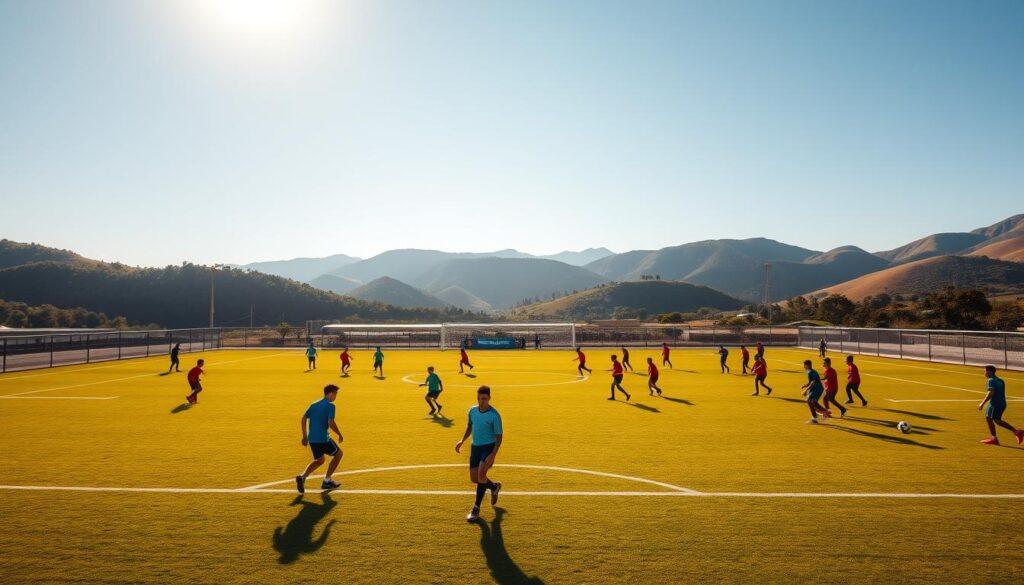
At Academia Tahuichi, teens train in altitude simulators. They watch matches in VR headsets. “We’re making altitude cyborgs,” a coach jokes. “By 17, they handle oxygen like Tesla batteries.”
Oriente Petrolero’s tactical lab is a game-changer. A coach, called the “Andean Guardiola”, mixes tiki-taka with fast sprints. His plan? Play fast, then strike quickly before opponents get tired.
| Nation | Annual Youth Investment | Key Infrastructure | U17 FIFA Ranking |
|---|---|---|---|
| Bolivia | $2.1M | Altitude simulators, VR analysis labs | 12th (CONMEBOL) |
| Brazil | $28M | 15 regional academies, biometric tracking | 3rd (CONMEBOL) |
| Argentina | $18M | AI-powered scouting networks | 5th (CONMEBOL) |
Bolivia’s innovations might close the funding gap. Their U17 team now does 18% more sprints than before.
But, there are big challenges. A GPS vest for a top player costs a lot. Coaches have to be creative. “We use smartwatches for heart rate,” a trainer says. “Our Moneyball moment is with alpaca wool budgets.”
Scout and Coach Interviews: Inside the Selection Process
Scouting in Bolivia is not just about finding talent. It’s about finding players who can perform well at high altitudes. Marco Rojas, the chief scout at Academia Tahuichi, says, “We test lungs before footwork. If they can sprint in La Paz’s thin air, they’ve already passed half the exam.” This unique test shapes youth player profiles unlike anywhere else.
Oriente Petrolero’s U20 coach Javier Villegas has a funny take on tactics. “Foreigners want us to play tiki-taka? Sure – but our version has the urgency of kids chasing the last microbus down from El Alto.” His training mixes Spanish tactics with Bolivian street football, creating unique players.
The selection process today combines old ways with new technology. Last year’s U17 trials used:
- GPS vests tracking distance covered at altitude
- Reaction-time tests using local carnival noisemakers
- Improvisation drills with uneven concrete “pitches”
| Selection Metric | Traditional Method | Modern Adaptation |
|---|---|---|
| Stamina Assessment | 20-minute hill runs | Oxygen efficiency sensors |
| Tactical Awareness | Coach observations | AI heatmap analysis |
| Cultural Fit | Community referrals | Social media behavior scans |
When asked about Bolivian player interviews, Rojas shares a trick question: “We ask what they’d do if their bus broke down before a match. The right answer involves flagging down any moving vehicle – including livestock trucks.” It’s about survival skills, not just sportsmanship.
This unique system creates players that surprise European scouts. Villegas says, “Our kids don’t just read the game – they rewrite it between altitude-induced naps.” The data shows Bolivian U17s cover more ground per match than CONMEBOL averages, despite less oxygen.
Challenges and Opportunities for Bolivian Youth Football
Bolivia’s football is deeply rooted in its high-altitude stadiums. Yet, the thin air of La Paz hides bigger issues. Aging facilities and a leaky talent pipeline are major problems.
The German-Bolivian partnership at Academia Tahuichi brings hope. It has sent 14 graduates to European academies. This shows that altitude isn’t the only thing Bolivia exports.
Nineteen young footballers play abroad, from Flamengo to Sevilla. This creates a dilemma. While it sharpens skills, it also drains local leagues of talent. Can we balance being both a training ground and a talent exporter?
Infrastructure is a major challenge. Source 3 found that 60% of regional academies lack proper fields. But, grassroots efforts in Cochabamba are finding hidden gems for U17 football.
Marco Etcheverry, a national team scout, shared his vision with me. He wants players to impress with their footwork, not just the altitude. Bolivian players abroad are seen as ambassadors for a football revolution.
Federation president Fernando Costa has a bold goal. He wants “Made in Bolivia” to be a top football brand worldwide. Not just a label for a country known for its high altitude.