
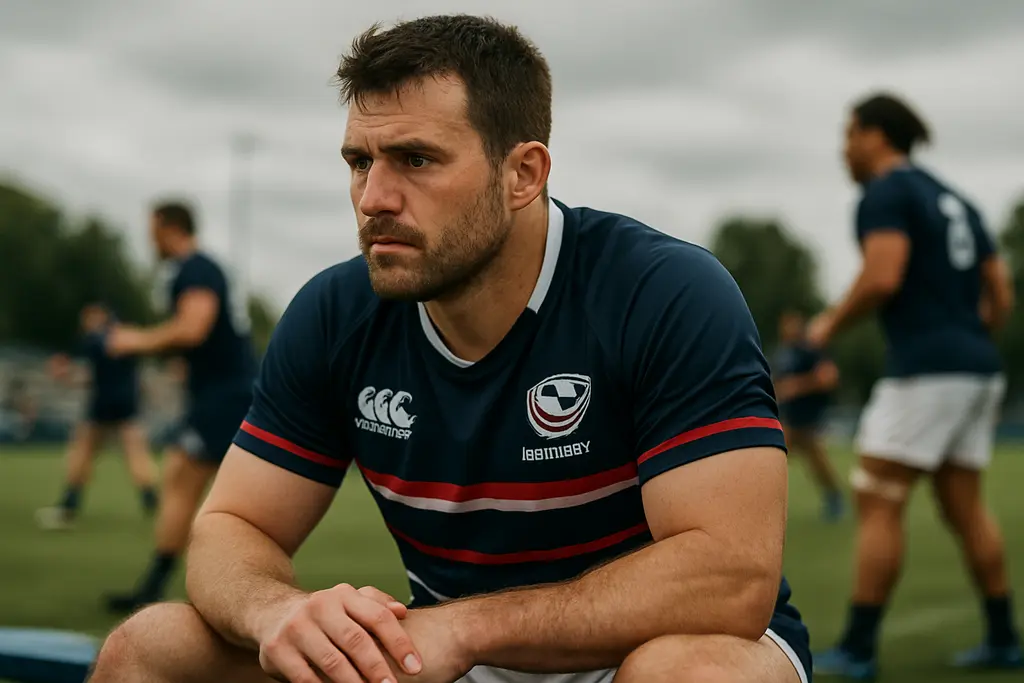
The USA Rugby roster sits in a mid-tournament checkpoint as of September 17, 2026: the Eagles had already played their September 12 semi-final in Osaka, and their final or third-place assignment was scheduled for September 19 at Prince Chichibu Memorial Stadium in Tokyo, per Major League Rugby’s travel notice. That timing matters for scouting. This is no longer a pure tournament preview, but the roster build still offers a clear read on Scott Lawrence’s selection priorities.
World Rugby listed the Men’s Eagles at No. 14 in September 2026, after a July Nations Cup run that included wins against Portugal, Zimbabwe and Spain, according to World Rugby’s USA team guide. The same guide framed Lawrence’s tenure around the “Moonshot 2031” plan, a long-range target aimed at putting the United States in a Rugby World Cup quarter-final by 2031. In that sense, this Pacific Nations Cup roster is not just about one September window. It is also a public marker of how the staff is testing domestic depth under pressure.
USA Rugby roster Snapshot On September 17
USA Rugby roster Built From Domestic Clubs
The clearest roster signal is domestic selection. The touring group was listed at 32 players, with 14 reserves, and World Rugby described the squad as entirely domestic-based. That matters because it ties national-team evaluation directly to the Major League Rugby player pool. The Chicago Hounds supplied the largest club group, with eight players, while California Legion followed with seven. For the USA Rugby roster, that distribution gives the coaching staff a concentrated view of players who share club familiarity, but it also tests whether MLR combinations can transfer into test-match speed and physical demand.
Ranking Context And Recent Form
The 14th-place world ranking offers a useful reference point, but it should not be treated as a full explanation of the group. July form showed that the Eagles could stack wins in a controlled tournament window. The Pacific Nations Cup asked a different question: how much of that form could hold when travel, selection rotation and higher-end opposition arrived in quick sequence? Lawrence’s staff entered the event with a roster that balanced returning test experience, domestic continuity and developmental selection. That mix is measurable, but its ceiling depends on match execution more than labels attached before kickoff.
Forwards Returnees And Set-Piece Questions
Taufete’e And Golla Rejoin The Pack
Hooker Joe Taufete’e was one of the most notable returnees. The research notes list him as returning after an injury layoff, with his last test having come in August 2023, and with 36 capped appearances attached to his name. In a squad with developmental aims, that level of front-row experience carries weight. It does not guarantee selection dominance or set-piece control by itself, but it gives the staff a proven option in a position where timing, throwing rhythm and scrummaging detail are exposed quickly in test rugby.
Second-row veteran Sam Golla also rejoined after rehabilitation. That return added another experienced forward to a group being assessed for both immediate performance and future tournament use. Kaleb Geiger’s return was delayed because of ongoing rehabilitation, which is the limit of what should be said from the confirmed information available. The forward pool, then, was not simply a list of available names. It reflected a staff weighing match readiness, rehab returns and the need to keep building trusted set-piece combinations.
Depth Beyond The Match-Day Group
The 14 reserves attached to the touring party are part of the story. They give coaches a broader practice and contingency group, but they should not be confused with guaranteed match-day roles. In a tournament setting, that reserve layer can help maintain standards in training while giving staff more data on players who may not yet be central test figures. The important scouting point is restraint: depth is visible through selection, but it is validated through minutes, match assignments and repeatable performance.
Backline Choices And Scrum-Half Control
De Haas And Hilsenbeck Shape The Tempo
Ruben de Haas remained an important scrum-half reference point in the research notes, while Chris Hilsenbeck returned to the squad after personal leave. Hilsenbeck’s presence at fly-half adds another experienced organizer to the backline discussion. For the USA Rugby roster, that pairing of scrum-half control and No. 10 direction is central to how the Eagles manage exits, field position and phase tempo. The evidence available points to selection trust, but not to a single fixed tactical script.
Scrum-half is a particularly revealing position for this group because it connects domestic-club rhythm with test-level decision-making. Passing volume, support lines and kicking choices are not isolated skills; they set the tone for forwards working around the ruck and outside backs waiting for usable ball. The staff’s continued investment in the halfback group signals that control is being treated as a development priority, not only a match-by-match selection call.
Younger Backs Offer Development Markers
Michael Baska’s call-up after being left out of the July Nations Cup roster provides another development marker. The notes identify him as one of the younger scrum-halves in the Pacific Nations Cup squad. Davie Coetzer stayed with the touring party as a developmental player, while being unavailable for match-day selection. That distinction is meaningful. A player can be part of the national-team environment without being used in a test, and that arrangement allows coaches to accelerate learning without overstating competitive readiness.
Cassh Maluia’s listed first capped start at inside centre for the September 19 match against Canada, along with Luke Carty at fly-half and Julian Roberts returning on the wing, gives the backline another evaluative layer. Those selection notes point to a staff still gathering information in live tournament conditions. A first capped start is not only a personal milestone; it is a test of communication, defensive spacing and decision speed against an opponent familiar with North American rugby’s physical profile.
September 19 Canada Match And Selection Signals
What The Announced Starts Say
The September 19, 2026, match against Canada was the next confirmed competitive point after the September 12 semi-final date had passed. Fakaosifolau Pifeleti moving from the bench to loose-head prop, as listed in the research notes, is one of the more direct forward selection signals. It suggests the staff wanted another look at front-row balance, though any broader claim about long-term hierarchy would go beyond the evidence.
The Canada matchup also places the roster in a familiar rivalry frame. That can sharpen evaluation because the physical demands are rarely abstract between these programs. Coaches can study how younger or returning players respond to pressure that is regional, immediate and tied to tournament placing. For readers tracking the competition structure in more detail, our earlier Pacific Nations Cup scouting analysis laid out the broader schedule context before the Japan trip.
What Can Be Measured Safely
Several parts of this roster can be assessed without stretching the evidence. The Eagles leaned on domestic players. The staff brought back experienced forwards after confirmed injury-related absences or rehabilitation. The halfback group included both established and developmental options. The club distribution favored Chicago and California, which puts MLR pathways near the center of the discussion. Those are firm observations.
What should be handled with care is prediction. A domestic-heavy squad can help cohesion, but it does not automatically solve test-match issues. Returning veterans can steady a group, but they still need match rhythm. Younger backs can benefit from camp exposure, but selection alone does not prove readiness. The safer read is that Lawrence used the 2026 Pacific Nations Cup to gather evidence under pressure, with the September 19 Canada match serving as another data point before the next stage of planning.
USA Rugby roster At The Pacific Nations Cup
The USA Rugby roster at this Pacific Nations Cup shows a program trying to connect present selection with a longer development plan. The 32-player touring squad and 14 reserves gave Lawrence’s staff a wide base. The domestic-club emphasis kept the evaluation close to MLR performance. The returns of Taufete’e and Golla added experience in the pack, while Hilsenbeck, de Haas, Baska, Coetzer and the September 19 backline choices highlighted the continuing search for reliable control and depth.
As of September 17, 2026, the responsible reading is measured rather than dramatic. The Eagles had already moved beyond their September 12 assignment and were preparing for the September 19 fixture in Tokyo. The roster tells a clear development story, but the match evidence still has to do the harder work. For broader sports coverage from a related site in the same network, banatzayed.com offers a useful point of comparison in how player pathways are framed across competitions.