
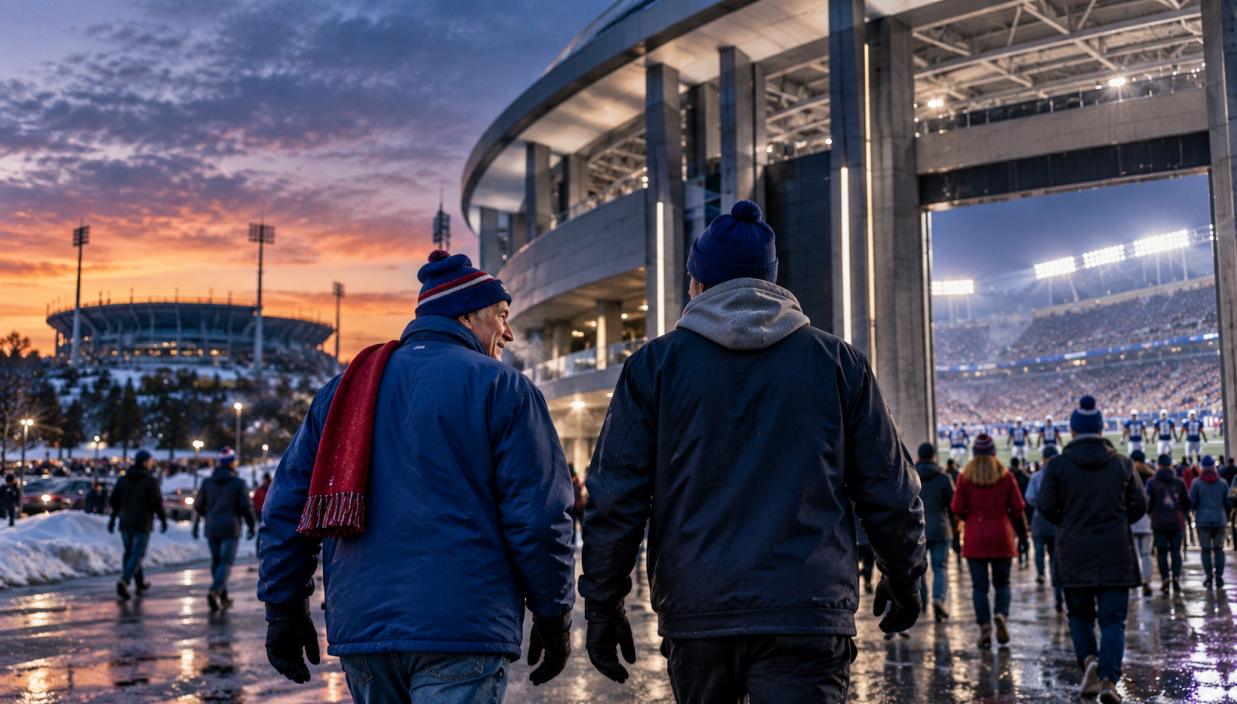
For more than half a century, Buffalo Bills home games in Orchard Park were defined by a particular combination of football, weather and supporters.
The stadium changed names repeatedly. The experience around it changed much less.
Fans arrived hours before kickoff. Winter weather became part of the identity. The stands sat exposed to Western New York’s wind and snow. Visiting teams understood that playing Buffalo late in the season could mean dealing with Josh Allen, one of the NFL’s loudest fan bases and conditions capable of changing the character of a game.
On September 17, 2026, that history enters a new building.
The Buffalo Bills host the Detroit Lions at 8:15 p.m. ET on Thursday Night Football, the first regular-season game at the new Highmark Stadium in Orchard Park.
Both teams arrive 1-0. Buffalo opened its season by defeating Houston 36-31, while Detroit edged New Orleans 31-30. The matchup therefore gives the NFL’s newest stadium an immediate competitive test rather than a ceremonial opening against a rebuilding opponent.
The larger question goes beyond one night.
Buffalo spent decades developing one of the league’s most recognizable home environments. The old Orchard Park stadium hosted the Bills from 1973 through the end of the 2025 season, producing hundreds of games and generations of memories.
Now a $2.1 billion stadium with 60,108 seats, a natural-grass field, extensive weather protection and modern premium spaces must accomplish something architecture cannot automatically guarantee.
It has to become home.
Buffalo Is Opening the Stadium Against a Serious Opponent
The NFL could hardly have selected a more visible regular-season debut.
Detroit and Buffalo meet in prime time with both teams unbeaten after Week 1.
The Bills’ official home-opener schedule places the first game under the lights on Thursday night, giving the stadium a national television audience immediately.
Buffalo also enters with momentum.
The Bills scored 36 points against Houston in their opener, while Detroit produced 31 against New Orleans.
For the stadium itself, that matters.
A venue develops sporting identity through competitive moments rather than ribbon-cutting ceremonies.
The new Highmark Stadium officially opened on June 23. Fans have already entered the building for events, including the team’s August Blue & Red practice.
But September 17 is different.
This is the first regular-season result that will become part of the stadium’s permanent record.
The Old Stadium Leaves Behind 53 Years of History
Replacing Buffalo’s previous home was never going to be a normal stadium transition.
The old venue opened in 1973 as Rich Stadium.
It later became Ralph Wilson Stadium, New Era Field, Bills Stadium and eventually Highmark Stadium.
The names changed.
The location and identity remained remarkably stable.
According to Pro Football Reference, the venue hosted 429 Bills games between 1973 and 2025.
Buffalo went 247-163 in regular-season home games there and 16-3 in playoff games.
Its first Bills game came on September 30, 1973, when Buffalo defeated the New York Jets 9-7.
Its final regular-season game came on January 4, 2026, when the Bills defeated the Jets 35-8.
That creates an unusually clean historical transition.
One stadium began with the Jets.
More than five decades later, it ended its regular-season history against the same opponent.
Across the street, a new building now inherits the expectation that Orchard Park should remain difficult territory for visiting teams.
The New Highmark Stadium Cost $2.1 Billion
The scale of the replacement is substantial.
New York State announced the completed project at $2.1 billion, making it the largest construction project in Western New York history.
The facility covers approximately 1.6 million square feet on a 242-acre site.
Its official capacity is 60,108, plus standing-room areas.
The project was constructed through a public-private partnership involving the Buffalo Bills, New York State and Erie County. Under the original stadium agreement, New York committed $600 million and Erie County $250 million toward construction, while the Bills were responsible for the remainder and cost overruns beyond the original project budget.
The final cost therefore became considerably larger than the approximately $1.4 billion figure attached to the early agreement.
The new stadium is also tied to a 30-year commitment designed to keep the Bills in Western New York.
That means the project is not merely a replacement for an aging sports facility.
It is intended to define Buffalo football for another generation.
The Stadium Is Smaller on Purpose
One of the most interesting design choices is capacity.
The old stadium could accommodate more spectators than its replacement.
The new building has 60,108 fixed seats, although capacity can expand for certain events.
That reduction reflects a broader change in modern stadium economics and design.
New NFL venues increasingly emphasize sightlines, premium areas, hospitality, technology and fan comfort rather than maximizing raw seat count.
For Buffalo, however, there is another factor.
A smaller, steeper and more enclosed seating environment can potentially concentrate noise.
The Bills have repeatedly described the venue as “football-first.”
That phrase matters because the design is supposed to preserve the intensity of Buffalo’s old home while modernizing almost everything around it.
The test begins when 60,000 people occupy those seats during a close fourth quarter.
The Canopy Could Change How Buffalo Sounds
The most visually distinctive feature of the stadium may also influence its atmosphere.
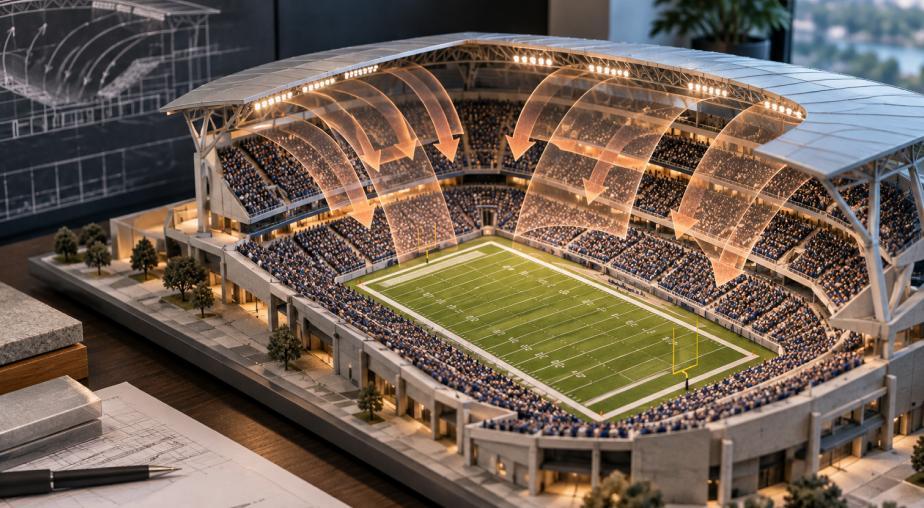
A 360-degree canopy covers approximately 64 percent of the seating bowl.
The roof does not fully enclose the building.
Highmark remains an open-air stadium.
But the canopy was designed to reduce the effect of Western New York’s wind while protecting a substantial portion of spectators from precipitation.
Its shape could also affect sound.
In an open bowl, crowd noise can escape vertically and outward.
A large canopy creates another surface from which sound can reflect back toward the seating bowl and field.
That does not guarantee a louder stadium.
Crowd behavior still matters more than architecture.
But design can amplify what supporters create.
For Buffalo, that is potentially important.
The franchise did not want modernization to make the home environment feel sanitized.
Fans Are Much Closer to the Field
Another architectural change may be even more significant.
The Bills said during the design process that the final row on the west sideline would be approximately 54 feet closer to the field than the corresponding seating at the previous stadium.
That difference changes visual intimacy.
It can also affect how players perceive the crowd.
A stadium does not need 80,000 spectators to feel hostile if supporters are positioned tightly around the playing surface.
Soccer-specific stadiums have demonstrated that principle for decades.
College basketball arenas demonstrate it differently.
Football stadiums can use similar geometry.
Buffalo’s new venue is therefore attempting to trade some raw capacity for concentration.
The crowd becomes slightly smaller but potentially more immediate.
Buffalo Chose Open Air Instead of a Dome
The decision not to build a fully enclosed stadium may ultimately prove central to preserving home-field identity.
Buffalo could have pursued a dome.
Instead, the Bills remained outdoors.
That keeps Western New York weather inside the football equation.
Snow can still fall.
Cold can still affect players.
Wind has not disappeared, even if the stadium is designed to mitigate it.
Late-season football can still look and feel distinctly different from games played inside climate-controlled buildings.
That was a deliberate choice.
The new stadium includes modern weather-management systems without eliminating weather itself.
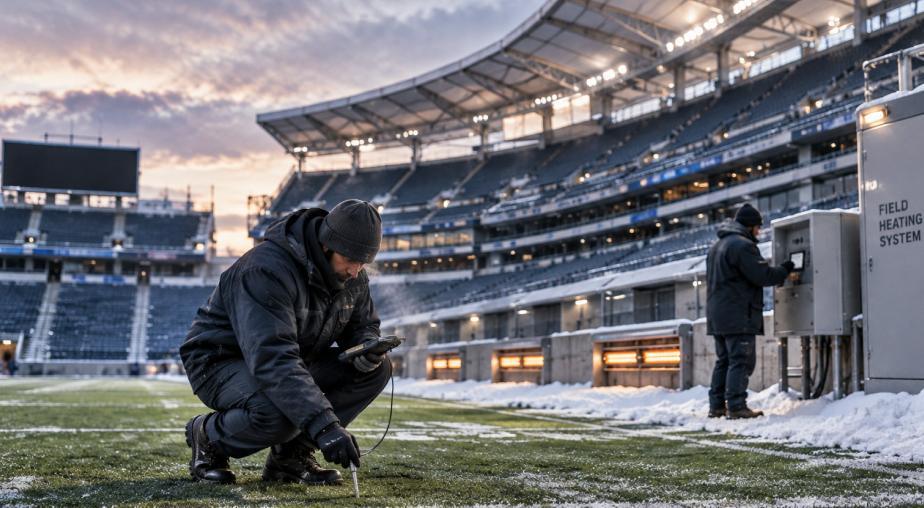
According to New York State’s stadium completion announcement, the building includes heated concourses, radiant heating above selected seating areas and a major snow-melt system using roof sensors.
The playing surface also includes underground heating coils.
The objective is not to pretend Buffalo has a different climate.
It is to make that climate more manageable.
Natural Grass Creates Another Major Change
The Bills are also moving from artificial turf to natural grass.
The old stadium used artificial surfaces throughout its later decades.
The new Highmark Stadium was designed around Kentucky bluegrass.
That required a much more sophisticated field-management system because maintaining natural grass through a Western New York winter is difficult.
The pitch includes underground heating, sub-air ventilation and grow lights.
Even before the first regular-season game, the system faced a practical test.
In early September, the Bills replaced the playing surface after determining that the original grass did not meet their standards.
A new field was installed before the Detroit game.
That episode illustrates an important point about stadium infrastructure.
A modern building can be completed on schedule while individual sporting systems still require adjustment.
The field is not decoration.
For players, it is the most important part of the building.
Home-Field Advantage Is Not Created by Amenities
The new stadium offers significantly more comfort than its predecessor.
There are 360-degree concourses.
Food and beverage areas use frictionless technology.
Premium spaces are more extensive.
Audio and video systems are substantially more advanced.
Players have expanded recovery, dining and preparation areas.
Those upgrades improve the experience.
They do not automatically make Buffalo harder to beat.
Home-field advantage comes from a combination of factors.
Travel matters.
Crowd noise matters.
Familiarity matters.
Weather can matter.
Playing-surface knowledge matters.
Quarterback communication matters.
Most importantly, team quality matters.
A bad team does not become dominant because its stadium is loud.
Buffalo’s advantage during the Josh Allen era has existed partly because the Bills have been very good.
The building can strengthen that advantage.
It cannot manufacture it.
Bills Mafia Is the Variable Architects Cannot Design
The most important feature of the new stadium may be the one that did not cost $2.1 billion.
The supporters.
Buffalo’s fan culture has become nationally recognizable under the “Bills Mafia” identity.
Tailgating is central to it.
Cold-weather games are central to it.
The emotional relationship between the franchise and Western New York is central to it.
That culture developed long before the new building existed.
The challenge for stadium designers was therefore unusual.
They were not being asked to create atmosphere from nothing.
They were being asked not to damage an atmosphere that already existed.
The new stadium remains in Orchard Park, directly across Abbott Road from the old venue.
That geographic continuity matters.
Buffalo did not move downtown.
It did not relocate its football culture to a completely different district.
Supporters will still travel to Orchard Park.
Tailgating remains part of game day.
The setting changes, but the ritual does not have to disappear.
Bruce Smith Connects the First Game to the Old Era
The Bills are deliberately connecting the new stadium’s opening night to franchise history.
Hall of Fame defensive end Bruce Smith will serve as Legend of the Game.
Smith is one of the defining figures of Buffalo’s Super Bowl-era teams and remains the NFL’s official career sacks leader with 200.
His presence creates a direct connection between generations.
The first regular-season game is not being presented as a rejection of the old stadium.
It is being framed as a continuation.
Players will also wear an inaugural-season patch during the home opener.
The symbolism is obvious.
Buffalo wants the stadium to feel new without making the franchise feel new.
The Public Investment Makes Performance Part of a Larger Debate
The stadium’s cost also ensures that discussions about it will extend beyond football.
New York State and Erie County committed a combined $850 million under the original agreement.
That level of public participation made the project one of the most closely scrutinized stadium deals in American sports.
Supporters of the agreement emphasized keeping the Bills in Western New York, construction employment, long-term economic activity and the cultural importance of the franchise.
Critics of publicly supported sports venues have long questioned whether economic benefits justify large taxpayer commitments.
Those arguments will not be settled by the result of Bills-Lions.
Nor should they be.
Economic impact and football atmosphere are different questions.
But the scale of investment raises expectations.
The building is supposed to function as more than a place where eight or nine regular-season NFL games happen each year.
Its success will also be evaluated through major events, year-round activity, community commitments and its economic relationship with Western New York.
The Stadium Was Built Around Buffalo’s Climate
Many new American stadiums emphasize insulation from the surrounding environment.
Buffalo took a different approach.
The stadium attempts to work with its location.
The canopy reduces wind.
Heating systems reduce the harshest effects of winter.
Snow-melt technology addresses accumulation.
The field-management system protects natural grass.
But the venue remains open.
Spectators can still see the Western New York landscape.
Weather can still become part of a December game.
That distinction is important because the old stadium’s identity was inseparable from place.
Moving the Bills into a generic indoor environment could have produced greater comfort while weakening one of the franchise’s distinguishing characteristics.
The new design tries to modernize Buffalo without removing Buffalo.
The First Real Test Comes Against Detroit
Thursday night will provide only one data point.
It will still reveal things that architectural renderings cannot.
How loud does the stadium become on third down?
How does the canopy affect crowd noise?
How efficiently do 60,000 people move through the concourses?
How does the natural-grass field perform under regular-season conditions?
Does the seating bowl feel more intimate?
Does the new environment feel distinctly Buffalo?
And can the Bills use any of it competitively?
Detroit is a useful first opponent because the Lions are not arriving simply to participate in a ceremony.
They are 1-0.
Buffalo is 1-0.
The game matters to both teams.
Once the ball is kicked, the stadium becomes a football venue rather than an infrastructure project.
The Real Test Will Come in December and January
A September night cannot fully answer the home-field question.
Buffalo’s identity has traditionally become most visible later in the season.
December will matter more.
January could matter most of all.
That is when wind, snow and cold become strategic variables.
That is when playoff games expose whether a crowd can genuinely disrupt an opponent.
The old stadium built much of its reputation during those moments.
Its playoff record was 16-3.
The new Highmark Stadium begins at 0-0.
Every statistic has to be built again.
Its first sellout.
Its first snow game.
Its first comeback.
Its first playoff game.
Its first postseason victory.
Its first unforgettable crowd moment.
Architecture provides the stage.
History requires time.
Buffalo Is Trying to Modernize Without Becoming Generic
That may ultimately be the most interesting part of the new Highmark Stadium.
Modern NFL buildings can begin to resemble one another.
Premium hospitality.
Large video boards.
Advanced concessions.
Club spaces.
Connected technology.
Buffalo has all of those things now.
But the franchise also needed something less measurable.
It needed the building to remain recognizably connected to Western New York.
Keeping the stadium in Orchard Park helps.
Remaining outdoors helps.
Designing around snow and wind helps.
Maintaining the tailgating culture helps.
Bringing franchise legends into the opening night helps.
None guarantees home-field advantage.
Together, they provide a foundation for it.
A New Building Has to Earn an Old Reputation
The first Highmark Stadium did not become intimidating because somebody described it that way when it opened in 1973.
Its reputation accumulated.
Jim Kelly played there.
Thurman Thomas ran there.
Bruce Smith terrorized quarterbacks there.
Four consecutive AFC championship teams called it home.
Later generations created their own memories.
Josh Allen helped turn playoff football in Orchard Park into a regular event again.
Snowstorms became part of NFL imagery.
Bills Mafia transformed tailgating culture into an extension of the team’s identity.
The new stadium inherits all of that history without inheriting any of its results.
That is what makes September 17 interesting.
Buffalo has spent $2.1 billion building a more comfortable, technologically advanced and carefully engineered football stadium.
It has 60,108 seats.
A canopy covers nearly two-thirds of them.
The crowd is closer to the field.
Natural grass replaces artificial turf.
Western New York’s weather remains part of the experience.
But home-field advantage is not included in a construction budget.
Supporters have to create it.
Players have to reinforce it.
Opponents have to begin feeling it.
Tonight against Detroit, Buffalo gets its first opportunity.
The building is finished.
Its reputation starts now.