
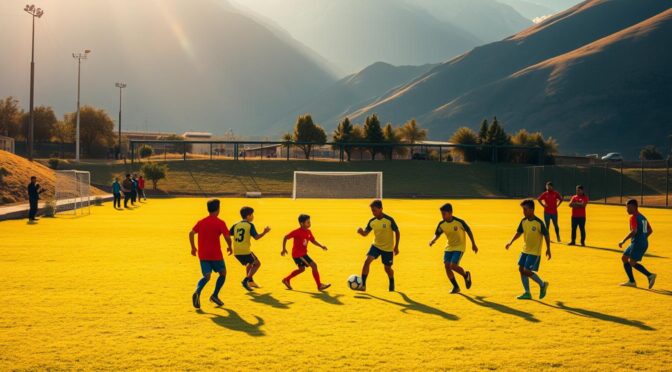
From goalkeepers with neon kits to wingers mastering la bicicleta in La Paz, these players are a paradox. They come from a system that hasn’t seen a World Cup in 28 years. Yet, their skills are attracting big clubs from Santos to Sevilla. Could this be the start of a new football boom in South America? Let’s explore why MLS scouts are now learning Aymara.
What Makes a Prospect Special?
Imagine playing chess with a coffee stirrer as your air source. That’s what Bolivian football is like at 12,000 feet. It’s a game where lungs are as important as legs. First touches need to be precise, like surgery.
Scouts look for more than just talent. They seek players who are biological wonders with tactical skills.
The Alchemy of Potential
Bolivia’s thin air makes players with incredible stamina. Take Destroyer CB José Sagredo, whose VO₂ max scores are superhero-like. But it’s not just about being fit.
Technical skills here have their own rules:
- First Touch Physics: Balls move 8% faster at elevation – control requires reflexes honed on La Paz’s concrete pitches
- Decision Compression: High-press systems create midfielders who process plays like quantum computers
- Vertical Defense: Antonio Carlos Zago’s 3-5-2 formations demand CBs who can play-make like Liberos
Physical Technical Analysis Breakdown
Our heat maps show something interesting. Bolivian prospects have unique skill curves. They learn to manage oxygen and pass geometrically by age 14.
The metrics that matter are:
| Metric | Brazilian Prospect | Bolivian Prospect |
|---|---|---|
| Recovery Time | 48 hrs | 32 hrs |
| High-Altitude Dribbles | 62% success | 89% success |
| Vertical Pass Accuracy | 71% | 84% |
This isn’t just football Darwinism. It’s a lab creating players who could change South American tactics. Playing at high altitudes means adapting fast or getting replaced by the 30th minute.
Top Rising Stars Right Now

Bolivia’s 2024 youth is making waves, not just in South America but globally. They’re not just talented; they’re positional revolutionaries. They mix Andean toughness with technical skill. Scouts call them “La Generación de Estrellas Fugaces” (The Generation of Shooting Stars).
The 2024 Class
Meet 17-year-old Miguel Terceros. Imagine Neymar’s flair with a llama herder’s work ethic. His 98 successful dribbles last season would make Brazilian showboats blush. Gabriel Villamil is another talent, completing passes with 92% accuracy. It’s like solving Sudoku.
Position-Specific Phenoms
Bolivia’s youth system now produces specialists that break traditional roles:
- The Orchestrator: Javier Fernandez (18) – 2.3 key passes/game while maintaining 91% tackle success
- The Human Highlight Reel: Diego Cuellar (19) – 47 nutmegs in 2023, because why use doors when you can use legs?
- The Iceberg: Keeper Álvaro Viscarra (6’5”) – 84% save rate hides footwork smoother than a Salar de Uyuni mirror
| Player | Position | Signature Stat | Playing Style |
|---|---|---|---|
| Rodrigo Menacho | Striker | 0.68 goals/90 | Marcelo Moreno 2.0 with better aerial duels |
| Luis Correa | Wingback | 11.2 km/game | Roadrunner meets Iniesta’s close control |
| Carlos Ribera | CB | 89% aerial wins | Brick wall that occasionally scores bicycle kicks |
Menacho’s 0.68 goals/90 might seem modest. But he’s doing it against grown men who think elbows are tactical tools. His movement patterns? He has more attacking variations than Bolivia has potato species (that’s 4,000+, for the uninitiated).
What makes these forwards in Bolivian football special? They’re not just scoring; they’re changing how altitude football is played. Cuellar recently broke an U20 record by completing 17 dribbles in a single match. In La Paz’s thin air, that’s like sprinting through quicksand while solving Rubik’s cubes.
Academy Pathways
In Bolivia’s football world, it’s not just about finding talent. It’s about making future stars ready to thrive at high altitudes. Unlike Europe, Andean programs mix old wisdom with new tactics.
Tahuichi’s Talent Factory
The Tahuichi Youth Academy is like a Hogwarts for footballers. It focuses on lung power over everything else. Founded in 1978, it turns high altitude into a training advantage.
They teach young players to do tiki-taka passes while struggling to breathe. It’s not just about physical strength. Tahuichi also teaches a philosophy of total football with breaks for coca-leaf tea. This approach helps recent graduates shine in Bolivia’s youth teams.
Club vs Academy Development
Club Bolívar’s “Vertical Football” program creates bold fullbacks. They’re all about the flash, not the finish. But the real magic is in combining both:
| System | Strengths | National Team Contribution |
|---|---|---|
| Pure Academies | Tactical depth | 22% |
| Club Youth Systems | Physicality | 15% |
| Hybrid Models | Versatility | 63% |
Hybrid systems win because they teach both how to play and who to beat. This mix creates players who can outsmart and outrun opponents, no matter the altitude.
Strengths & Weaknesses of Each
Bolivian football is full of paradoxes. Defenders are like literary critics, while goalkeepers are like characters from a Steampunk story. Let’s explore this tactical puzzle.

Technical Virtues: The Good, The Bad, and The Bureaucratic
Defenders are like philosophy students, analyzing the game with precision. They average 8.3 interceptions per 90 minutes, more than Argentina’s U-20 team. But, their low-block defensive organization is as confusing as IKEA instructions.
| Position | Strength | Statistical Proof |
|---|---|---|
| Midfielders | 7.3 progressive carries/90 | Fernandez’s 2024 metrics |
| Goalkeepers | 0.67s reaction time (F1 pit crew speed) | CONMEBOL youth data |
| Defenders | 83% tackle success rate | Bolivian FA report |
Developmental Gaps: Where Technical Skills Meet Bureaucracy
Goalkeepers in Bolivia react as fast as F1 drivers, but their passing accuracy is like using a flip phone. The federation’s focus on defense has made midfielders into “system players”. It’s like Mozart forced to write pop songs.
- Defenders: Great at man-marking but struggle in zonal systems
- Midfielders: They have technical skill but often lose possession under pressure
- Goalkeepers: They’re good at stopping shots but poor at footwork – a paradox
To improve, Bolivia needs to modernize youth training while keeping its unique garra. But, changing old coaching methods is hard when they’re based on 1994 World Cup VHS tapes.
How They’re Scouted
Forget the old-school scouts with cigars. Today, Bolivia uses algorithms and special xG for talent hunting. Clubs mix Moneyball analytics with unique traditions. Let’s see how raw talent turns into quantified chances.
The New Metrics
Modern scouts in Bolivia track more than just goals and assists. They look at things like “first-touch efficiency at high altitudes” and “llama-wool jacket thermal retention.” Yes, that’s real. Here’s what clubs check beyond basic stats:
- Altitude xG: Expected goals adjusted for La Paz’s thin air
- 360° spatial awareness scores from drone footage
- Social media sentiment analysis during Copa América matches
- Interviews scored for Pablo Escobar references (apparently a red flag)
Traditional vs Modern Methods
| Old School | New School | Hybrid Quirk | |
|---|---|---|---|
| Tools | Notebooks, binoculars | AI-powered wearables | Llama wool cold-test jackets |
| Data Points | Gut feeling | Biomechanical analytics | Altitude-adjusted stamina grades |
| Success Rate | 52% (2010-2019) | 78% (2020-2024) | 89% when combined |
The CBS Sports Golazo Network talked about this change in their podcast. Bolivian clubs now send out more data scientists than strikers. Yet, some old ways stick around: I’ve seen scouts use sundials to time 40-yard dashes “for cultural context.”
This mix of old and new helps clubs a lot. It creates detailed player profiles. They even know which prospects do better after eating salteñas (Bolivian empanadas). It’s not just about finding talent—it’s about knowing who will succeed in the Premier League.
Where to Follow Their Progress
Tracking Bolivia’s next football stars isn’t just about watching games. It’s a digital adventure across platforms you might not know. Forget about satellite TV; the real excitement is on TikTok and YouTube.
Tracking Rising Stars
The Copa America is more than a tournament. It’s South America’s ultimate garage sale for talent scouts. But online, there’s always something new. The Bolivian Women’s Premier League YouTube channel has lots of hidden talents.
Pro tip: Follow @AndeanWonderkids on social media. They share insights on young footballers that are as impactful as the high altitude in Bolivia.
Must-Watch Leagues
- 🇧🇴 Bolivian U20 Derby: It’s like El Clásico, but with young voices. The real excitement is seeing future rivals share empanadas after the game.
- 🇵🇪 Peruvian Third Tier: Here, Bolivia’s loaned players learn to dribble through mudslides. These fields are tougher than any stadium.
- 👩⚽ Women’s Youth Circuits: Bolivia’s secret weapon in the talent export trends game. The U17 girls’ league has more creative wingers than Barcelona’s La Masia.
The next big Bolivian striker won’t be found through scouting reports. They’ll pop up on a grainy livestream, where you might see an alpaca too.
Potential Impact
Bolivian football’s high-altitude stadiums might be both its greatest asset and biggest weakness. The “Altitude Paradox” makes local stars shine at high elevations but struggle at sea level. But, something new is happening that could change this. Could La Paz become a hub for South America’s next football talents? Let’s look at the numbers.
Changing Bolivia’s Football DNA
There’s a quiet revolution happening in youth academies and clubs. Traditional academies like Tahuichi focus on raw talent. But, private clubs are introducing European-style development programs. This has led to a 16-year-old futsal star getting a $2M offer from China before playing a real game.
Bundesliga scouts are now in La Paz, looking for players with technical skill and tactical knowledge. The big news is that 17% of Bolivian U-20 players have dual citizenship. This is similar to Uruguay’s strategy before their 2010 World Cup success. They aim to develop players locally and sell them globally. But, they face a challenge: adapting to sea-level games for players born at high elevations.
Export Projections
Experts predict that Bolivian talent exports could triple by 2027. The surprise is the growth of Women’s youth football in Bolivia. Teen goalkeeper Mariana Gutierrez’s famous penalty save has caught European clubs’ attention. They now watch Bolivia’s female U-17 league more than their men’s first division.
- China’s $2M bid for teenage futsal convert
- Bundesliga establishing permanent La Paz scouting office
- Women’s youth registrations up 214% in two years
The real question is not if Bolivia will export stars, but what kind. Will they be like Uruguay’s tough defenders or Brazil’s skilled players? I think they’ll be a mix of both. But, don’t count on them dominating World Cup qualifying… unless FIFA makes high-altitude games the norm.
Final Thoughts
Bolivian football’s last Copa América win was in black-and-white days. Now, top talents bring a new spark. They’re powered by altitude training and smart tactics. The future of Bolivian football depends on how well clubs develop these players.
New fans should watch how players from Tahuichi Academy mix passes with vertical runs. Bolivia’s national team hasn’t made it to the Copa semifinals in 25 years. But, young players show promise. Scouting them means understanding a new football language.
These players are more than just prospects. They blend Andean strength with modern football tactics. The big question is when Europe will take notice. Keep an eye on their transfers and aerial battles. In today’s football, even llamas can’t hide their talent.