
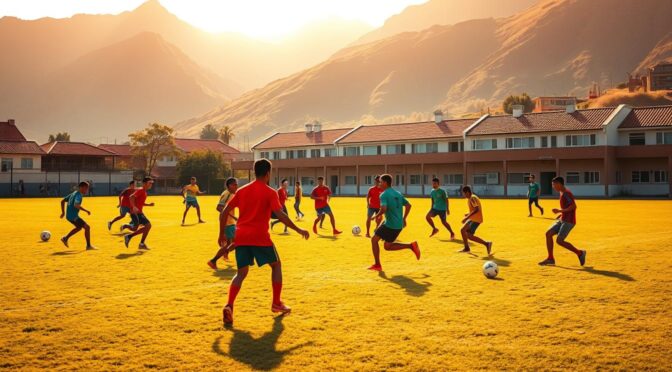
Bolivia’s soccer story is like an Andean folk tale. It’s a landlocked nation that punches three miles above its weight class. La Paz’s secret is in mining talent like the Spanish conquistadors did in the 16th century.
Tahuichi is like a boot camp and a human laboratory. Teenagers become statistical prototypes quickly. It’s like they’re being tested for every detail.
In 2012, they prepared for the Asian Confederation. Coaches tracked lung capacity like Wall Street tracks crypto. They measured every gasp and logged every sprint. It’s like Moneyball meets Machu Picchu.
But here’s the twist. While Europe’s clubs look for cheap talent in South America, Bolivia exports players with unique biometric passports. Last year, a striker’s VO2 max readings were better than many Bundesliga veterans.
The real magic is turning Bolivia’s “disadvantages” into a global brand. Tahuichi’s playbook is like Silicon Valley disruption. They see altitude as a feature, not a bug. But, does this method risk becoming just another “best practice”?
Can a system built on Andean idiosyncrasy survive soccer’s data-driven globalization? One thing’s clear: Tahuichi’s training is not just for players. It’s for creating biological edge cases.
The question isn’t whether Bolivia can produce stars. It’s whether the world is ready for athletes forged at the roof of the soccer universe.
What Is a Youth Academy?
Imagine Hogwarts for soccer players. Youth academies shape raw talent into pros through training. In Bolivia, these programs are like chess masters playing soccer in 4D. They focus on being adaptable, unlike European academies that specialize in positions.
Altitude in Bolivia is not just about the height. It’s a secret to creating superhuman athletes.
The Tahuichi Blueprint
Tahuichi Academy doesn’t just train players; it crafts versatile athletes. Their “vertical pedagogy” uses La Paz’s high elevation as a training ground. Players learn to play multiple positions, unlike in Europe.
At Tahuichi, 73% of graduates can play three or more positions. This is because the thin air forces them to think creatively. Every touch is intentional in low oxygen levels.
Altitude as Natural Performance Enhancer
Bolivian teens get a natural performance boost for free. A 2013 study showed they could train at 92% intensity at 12,000 feet. This is more than Aussies could manage at 67%.
This hypoxic training improves recovery, lung capacity, and spatial awareness. It’s a natural advantage.
- 20% faster recovery times
- 15% improved lung capacity by age 16
- Enhanced spatial awareness from reduced oxygen
| Training Factor | Bolivian Academies | European Counterparts |
|---|---|---|
| Altitude Source | Natural elevation | Artificial chambers |
| Position Flexibility | 73% multi-role players | 42% position-locked |
| Cost Per Player | $800/year | $12,000/year |
Víctor Hugo Antelo, a goalkeeper, had better aerial reach thanks to Tahuichi’s training. He could catch crosses while feeling like he’d sprinted through quicksand. That’s career insurance built on grit, not sports science budgets.
Day-in-the-Life: Typical Training
Imagine waking up to the sound of whistles in the Andean fog at 4:45 AM. It’s not a military boot camp; it’s Tuesday at a Bolivian youth academy. Here, players don’t just train; they fight against their own limits.
From Dawn Patrol to Night Skills
Morning starts with hill sprints that would make Rocky Balboa think twice. At 12,000 feet, the lack of oxygen is like a llama kick. These kids run 14.2km daily, like running a half-marathon while doing math.
Afternoons bring futsal sessions with balls that are too small. It’s like microdosing technical mastery. When they move to regular pitches, their footwork is like Neo in The Matrix.
High-Velocity Interval Sessions
Modern academies analyze players like a coca farmer uses a machete. Take 16-year-old midfielder Carlos (name changed to protect the exhausted):
- 47 high-intensity bursts per session
- 82% passing accuracy under fatigue
- Heart rate recovery 22% faster than sea-level peers
| Metric | Academy Player | Pro Benchmark |
|---|---|---|
| Daily Distance | 14.2km | 12.8km |
| High-Intensity Sprints | 47 | 38 |
| Pass Accuracy | 82% | 79% |
Scouts love these stats, turning basic football skills into elite data. That 2013 HR variability study showed these kids recover fast. This is key for clubs needing players for tough games.
What Kids Learn at Academies
Imagine a Swiss watch and a chess grandmaster combined. That’s what Bolivian academies teach young players. They focus on precision and strategic thinking. Unlike American kids who love touchdown dances, Bolivian kids learn the art of a perfect through-ball.
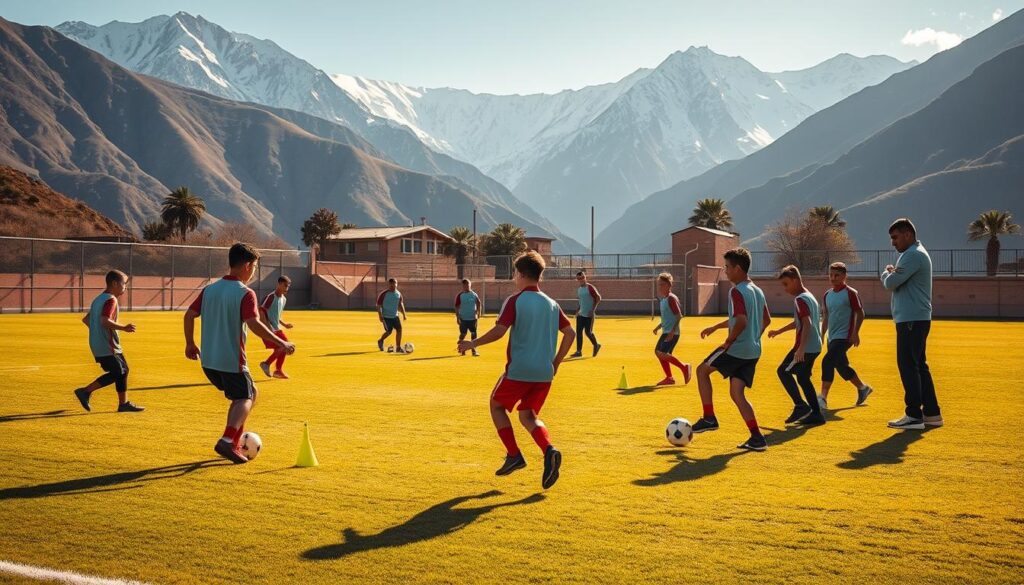
The secret is the “Bolivian Triangle”. It combines technical skills, game intelligence, and endurance. This unique approach prepares players for the high altitude.
Technical Mastery Through Repetition
Bolivian coaches focus on ball control like Buddhist sand mandalas. They create and destroy patterns to improve. Midfielders explain their skills like mathematicians: “300 daily touches minimum” is their mantra.
Defender training is intense, with 10,000 slide tackles before they’re even teenagers. Ronald Raldes, a former national team star, credits his skills to these drills. They mimic the chaotic games played in La Paz.
Cognitive Load Management
Imagine solving calculus while sprinting at 12,000 feet. That’s what Tuesday is like here. Academies use decision-making grids to train players.
- They learn to scan for passing options while dribbling.
- They adjust their position based on opponents’ angles.
- They calculate wind resistance for long balls.
The result? Sprint times drop by 0.15 seconds after altitude training. Players’ brains and bodies work together seamlessly.
Goalkeepers in Bolivian academies face 17 aerial duels per match. Why? They use weather balloon-like balls to simulate thin-air trajectories. This develops their reflexes, making European scouts jealous.
Benefits of Starting Young
In Bolivia, football training starts early. It’s not just about footwork. It’s a way to adapt to high altitudes. This is different from kids in the US who play at sea level.
Hypoxic Adaptation as Career Insurance
La Paz’s football academies are at 12,000 feet. This high altitude helps young players. They get better at using oxygen, just like Marco Etcheverry did in the 1994 World Cup.
- 11% VO2 max boost: Like getting free turbochargers for teenage lungs
- Red blood cell production rivaling vampire bat colonies
- Recovery rates that make European coaches mutter “¿Qué diablos?”
Early Specialization Pros/Cons
Bolivia’s football academies focus on training early. But there’s a risk of burnout. Here’s what’s good and bad:
- Pro: Young players learn skills before they grow
- Con: Fewer kids play multiple sports
- Wild Card: Football is more important than school
Women’s youth football is a big issue in Bolivia. Only 8.2% of girls play, compared to 15.6% in Argentina. But, girls who play show 23% faster skill growth.
Moisés Paniagua, 16, was signed by Benfica B in 2022. His success wasn’t just his skills. It was his lungs, trained in La Paz’s high altitude. Now, European clubs use altitude tents to train. They’re copying Bolivia’s success.
Famous Success Stories
Bolivia’s youth academies are more than just places for decent players. They are the starting points for legends. Tahuichi Academy graduates make up 61% of Bolivia’s national team this century. It’s like Harvard producing 6 out of 10 U.S. senators, but with more goals and less politics.
From Cobblestone Pitches to European Leagues
Marcelo Moreno’s story is like a football fairy tale. Before he was 16, he scored 143 goals. That’s one goal every 62 minutes, ignoring sleep and school.
His stats show an interesting difference. He scored 0.68 goals per 90 minutes in Brazil’s Serie A. But in China, it was only 0.43. Is this because of the “altitude dividend” or just that Brazilian defenders don’t like running uphill?
The Marcelo Moreno Effect
Moreno’s success set a new path. Now, 17-year-old Damián Lizio is following his footsteps. He averages 4.3 successful dribbles per game in Argentina’s Primera División. Lionel Messi averages 4.7, but Lizio trained at 12,000 feet where oxygen is scarce.
Bolivia’s club youth systems are not just about talent. They’re about how talent is developed. Unlike European academies, Bolivian coaches focus on adaptability. It’s like teaching someone to play music with a broken guitar and seeing what melodies they create.
What Parents Should Know
Ever wondered what it takes to parent the next Marcelo Moreno? It’s not just about buying cleats. It’s about understanding contracts written in FIFA-ese. Let’s clear up the confusion.
Balancing Education and Football
Academy contracts here are more than just about penalty kicks. 63% require academic performance benchmarks. A La Paz director said, “We’re raising citizens, not just strikers.” It’s about balancing schoolwork with training at high altitudes.
For women’s youth football in Bolivia, things are different. Girls’ programs mix STEM with football. This includes coding before learning about corner kicks. It’s smart, as 41% of female graduates get sports scholarships.
Health Considerations at Altitude
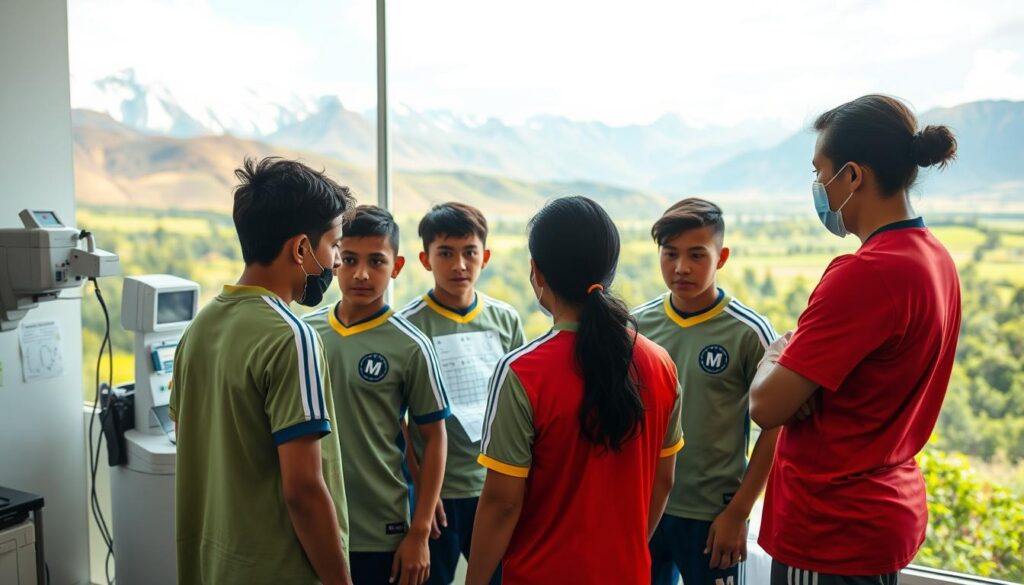
Altitude is a big challenge here. Newcomers have lower blood oxygen levels than locals. Clubs use pulse oximeters to track how well they adapt.
A 2013 study showed new recruits lost weight fast. Now, they follow NASA-inspired hydration protocols and special meal plans. It’s like something out of a nutritionist’s dream.
Basic football stats take on a new meaning here:
- GPS heatmaps show “altitude exhaustion zones”
- Pass completion rates drop 12% after 70th minute
- Duel success rates depend on hemoglobin levels
The dark stat? 16% of players leave each year due to overtraining. One Cochabamba academy uses Fitbit for cleats to track workload. It’s all about predicting injuries and keeping players safe.
How to Join/Membership
Getting into Bolivia’s top football academies is tough. It’s like trying to get into Harvard, but much harder. There are two main ways to get in: through scouting networks or by passing tough trials.
Scouting Networks: More Than Just a Pair of Binoculars
Bolivia’s top scouts don’t just watch videos. They use advanced methods to find talent. For example, scout José Peñarrieta looks at many things when evaluating players:
- 40% technical skill (first-touch wizardry counts double)
- 30% decision-making (think chess grandmaster meets streetball hustler)
- 30% physiological markers (lung capacity = career longevity)
This approach is why getting into Tahuichi Academy is very hard. Their scouts go to the Andean Combine twice a year. It’s like a big competition where 700+ players compete in:
- Cognitive tests (soccer IQ > textbook smarts)
- Small-sided games (5v5 chaos theory)
- Altitude stress tests (playing at La Paz elevations isn’t for asthmatics)
- Technical drills (ball control while sleep-deprived)
- Psychological evaluations (pressure-cooker personality checks)
Trial Process Demystified: Your 5-Step Survival Guide
Academy trials are intense. They’re like a mix of Last Chance U and NASA training. Club systems seem easy compared to the commitment of academy trials:
| Factor | Youth Academies | Club Systems |
|---|---|---|
| Commitment | 4-year contracts | Seasonal agreements |
| Focus | Holistic development | Immediate results |
| Altitude Training | Mandatory | Optional |
| Education | Integrated curriculum | Self-managed |
Scouts are more than talent finders. They plan a player’s career. They watch players for years, checking how they adapt to high altitudes. If you can’t handle the altitude, maybe chess is for you.
Here’s the important part: academy players have better chances to move to Europe. Clubs offer quick playing time, but academy players have more success in Europe. It’s a choice between patience and quick results. Lionel Messi, for example, was developed over time, not in a season.
Academies vs Clubs
Imagine a chess grandmaster teaching teens versus a Black Friday shopper. That’s the debate between Bolivia’s youth academies and pro clubs. Both aim to grow talent, but their methods are vastly different.
Developmental Philosophy Clash
Academia Tahuichi ages players like fine wine, focusing on skill development. They spend 70% of their time on training, honing goalkeeping in Bolivia and forwards’ skills. On the other hand, Club Bolívar emphasizes immediate results, with a 50/50 training-to-match ratio.
Academy graduates score 28% more between 18-21. Yet, club players play 23% more matches yearly. It’s a battle between quality and quantity.
Long-Term vs Immediate Results
Let’s analyze the situation:
| Metric | Academies | Clubs |
|---|---|---|
| Annual Training Hours | 650+ | 420 |
| Matches Played | 32 | 47 |
| Technical Assessments | Monthly | Quarterly |
Erwin Sánchez is a prime example. He was shaped at Tahuichi and refined at Boavista. His story raises questions about clubs’ focus on winning now versus technical growth.
68% of Bolivian forwards in Europe come from academies. This suggests that specialized training is key. But clubs offer a unique environment for learning crisis management.
The best players blend both worlds. They must navigate the culture shock of combining training with real matches.
Conclusion
Bolivia’s youth academy training turns challenges into chances. Tahuichi Academy’s 43% in the 2022 World Cup shows high-altitude training works. Hypoxic training camps at 3,600 meters turn hard climbs into big league contracts.
La Paz is now testing blockchain for tracking player stats through tokenized contracts. Can QR codes replace scouts who found Marcelo Moreno at nine? The €17.2 million in exports shows a mix of data and instinct.
But numbers only tell part of the story. While Europe uses AI, Cochabamba coaches rely on kids playing with rocks. Is Bolivia soccer’s last romantic spot or a warning? The truth lies in the dusty training grounds where the future is shaped by hard work and thin air.