

Brazil’s preparation for the next South American U-20 Championship is happening well before players arrive at the national-team training center.
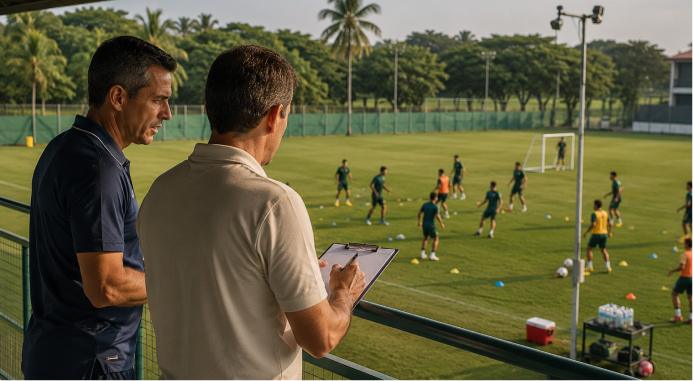
During late June and July 2026, Brazil U-20 coach Paulo Victor and members of his technical staff visited Palmeiras, Corinthians, Cruzeiro, Atlético Mineiro, Vasco da Gama and Botafogo. They spoke with professional and academy coaches, studied development environments and watched Brasileiro U-20 matches before deciding which players deserved places in the next national-team camp.
That work directly preceded Brazil’s August friendlies against Bolivia at Granja Comary in Teresópolis.
The sequence matters.
Brazil did not begin by publishing a list of 24 players and then attempting to understand them during a short camp. The technical staff first went into the clubs, watched players in their normal competitive environments and established relationships with the people responsible for their daily development.
The Brazil U-20 scouting visits offer Bolivia a useful model at exactly the right moment.
Bolivian football is also trying to reorganize its youth structure. The FBF has launched national U-15, U-17 and U-19 leagues, appointed Spanish specialist Hugo Blanco as Director of Football and Methodology, and continues preparing the generation that will contest the 2027 South American U-20 Championship.
The opportunity is to combine two different ideas.
Brazil shows the value of direct club relationships and in-person observation.
The United States demonstrates how a federation can add systematic player tracking, regional identification events and continuous monitoring across a huge player pool.
Bolivia does not need to copy either system completely. It needs to build a smaller version appropriate to its geography and resources. Bolivia’s U-20s Face Brazil as the USA Qualifies for Another U-20 World Cup: Which System Is Better Preparing the 2030 Generation?
Brazil Is Scouting The Environment, Not Just The Player
Paulo Victor’s July work was notable because his staff was not simply appearing at major matches looking for the most obvious prospects.
The Brazilian delegation visited training centers.
It spoke with coaches.
It watched several Brasileiro U-20 knockout matches.
Among the games observed were Cruzeiro against Vasco, Botafogo against Santos and Palmeiras against Corinthians.
The objective was to understand more than a player’s performance during 90 minutes.
A national-team staff benefits from knowing how a prospect trains, what position he normally plays, how his club manages his physical development and whether his recent performance represents a temporary run of form or longer-term progression.
This kind of communication can prevent mistakes during selection.
A federation scout may see an attacking midfielder play as a winger in one match without knowing that the player has spent most of the season developing centrally.
A young defender may appear to have lost his starting position when he is actually returning gradually from injury.
A physically dominant 18-year-old may look impressive against youth opposition while struggling every time he trains with the senior squad.
Club coaches possess that context.
National-team coaches need access to it.
Brazil Used The Bolivia Friendlies As The Next Evaluation Stage
After the club visits came the national-team camp.
Paulo Victor called 24 players for two matches against Bolivia on August 9 and August 12 at Granja Comary.
Brazil described the games as preparation for the January 2027 South American U-20 Championship. The staff planned to use them to evaluate players, test alternatives and apply tactical concepts developed in training.
The official Brazil U-20 call-up included both returning players and new faces.
That is exactly how scouting should connect with competition.
Watching players at their clubs produces the first layer of information.
Bringing them together produces another.
International matches add a third.
A player may dominate at club level but struggle with the speed of international football. Another may look less spectacular for his club but fit a national-team role perfectly.
The job of the federation is to connect those pieces.
Bolivia Now Has More Youth Matches To Scout
Bolivia’s biggest problem in previous cycles was not always identifying talented individuals.
It was that many young players lacked enough high-level competition for meaningful comparisons to be made.
That situation is beginning to change.
In 2026, the FBF is simultaneously operating national U-15, U-17 and U-19 competitions for professional clubs. The federation says those three leagues will generate 471 official matches and involve approximately 2,000 young players across more than five months.
The FBF youth-league structure creates something Bolivia badly needs: a recurring database of competitive performances.
That should transform scouting.
Instead of evaluating a young player primarily through short camps or recommendations, national-team staff can compare him across months of league competition.
A midfielder can be watched against Bolívar one week and Blooming the next.
A defender can be evaluated at altitude and at lower elevations.
Goalkeepers can be judged across dozens of situations rather than one tournament.
The leagues create the raw material.
Bolivia now needs the scouting structure capable of using it.
The United States Adds Another Layer: Continuous Talent Identification
The United States operates in a completely different environment, but one part of its system is particularly relevant.
U.S. Soccer has a dedicated Talent Identification department whose purpose is to identify and monitor players for youth national teams while expanding the national player pool.
The U.S. Soccer Talent Identification system works with youth national teams, sporting analytics, coaching education and high-performance staff.
The important word is monitor.
Scouting is not treated as one decision.
A 14-year-old player can be identified, watched again several months later, evaluated against stronger opposition and remain inside the national database even if he is not immediately selected.
U.S. Soccer also runs Talent Identification Centers in different regions.
More than 4,000 boys and girls aged 13 to 15 participated during the 2025-26 cycle.
Those events are free for selected players and designed to resemble youth national-team camps. Players are identified through federation scouting or recommendations from coaches and club directors.
Bolivia obviously does not have the same geographic scale or player population.
That may actually make a national tracking system easier to implement.
Bolivia Needs A Permanent National Prospect Database
A Bolivian version does not need expensive software at the beginning.
It needs consistent information.
Every serious youth prospect should have a federation profile that follows him through multiple age groups.
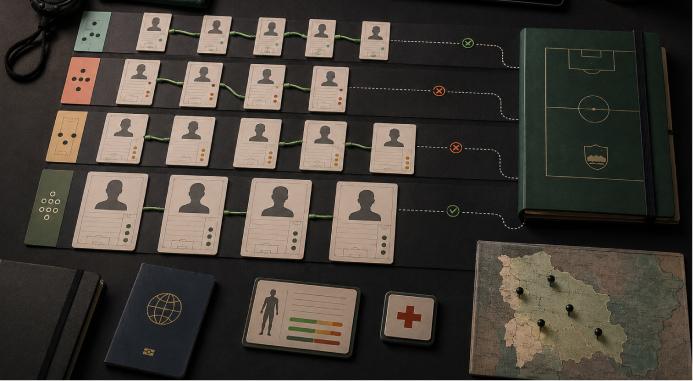
That profile could include basic fields such as:
- primary and secondary positions;
- club and competition level;
- total minutes played;
- age-group national-team history;
- physical-development notes;
- injury history relevant to availability;
- international eligibility;
- match evaluations from federation scouts;
- and technical priorities identified by coaches.
The value comes from updating the information.
A database created once and ignored would solve nothing.
The federation should be able to open a player’s file in December 2026 and understand how his situation changed since June.
Did he become a starter?
Did he move from U-17 to U-19 competition?
Did he begin training with the professional team?
Did his position change?
Was he injured?
Did another player in the same position develop faster?
Those are the questions that turn scouting into talent management.
Hugo Blanco’s New Role Creates An Opening
Bolivia has recently made an institutional change that could help connect these ideas.
Spanish coach and methodology specialist Hugo Blanco was appointed Director of Football and Methodology for the FBF in August.
His remit includes building greater continuity among national teams, coordinating development processes and working with professional clubs.
Public comments surrounding his appointment have emphasized common methodologies, coach development and creating clearer player-development pathways.
That matters because scouting cannot operate separately from methodology.
A scout must understand what type of player the federation is trying to develop.
If Bolivia wants center backs comfortable building possession, scouts need to evaluate those characteristics.
If the national methodology expects fullbacks to defend large spaces and contribute in buildup, those qualities must appear in player reports.
Selection becomes more coherent when scouts and coaches use common criteria.
Bolivia Should Create Regional Scout Responsibilities
Brazil can send its U-20 coach directly to major clubs because many of the country’s strongest academies operate within a highly visible professional structure.
Bolivia needs a broader geographic plan.
A practical national network could divide responsibility by region.
One scout might regularly cover Santa Cruz and Beni.
Another could focus on La Paz, El Alto and Oruro.
Cochabamba could form another central observation area.
Southern regions could include Tarija, Chuquisaca and Potosí.
The purpose would not be bureaucracy.
It would be accountability.
Every important youth competition would have someone responsible for monitoring it.
Every professional academy would know who its federation contact is.
A player would be less likely to disappear simply because he developed outside one of the most visible clubs.
Club Coaches Should Become Part Of The Information Network
Brazil’s recent approach demonstrates how valuable club relationships can be.
Bolivia should formalize those relationships.
National-team scouts could meet academy directors periodically and discuss prospects by age group.
Professional clubs could provide information about players promoted into higher categories.
The federation could also ask clubs to nominate players they believe deserve monitoring without guaranteeing a national-team call-up.
That distinction matters.
Recommendations should create observation opportunities, not automatic selections.
A club coach may understand a player better than anyone else. The federation scout must still make an independent assessment.
Healthy cooperation requires both.
The System Must Include Bolivians Developing Abroad
A modern Bolivian scouting network cannot stop at the national border.
The senior national team already demonstrates why.
Players such as Efraín Morales developed in the United States, while other Bolivian internationals or prospects have developed in Brazil, Spain, Argentina and elsewhere.
That trend is likely to continue.
A player eligible for Bolivia may spend his entire academy career outside the country.
If the FBF learns about him only after he reaches a professional first team, the federation has already lost years of potential relationship-building.
The United States provides a useful example because its talent-identification structure includes attention to dual and multiple nationals.
Bolivia should maintain a similar international eligibility list.
The goal should not be aggressive recruitment of every teenager with a Bolivian parent.
It should be awareness.
Who is developing abroad?
At what level?
Which national teams can the player represent?
Has he shown interest in Bolivia?
Has a federation scout watched him?
Those questions should have answers before a player becomes a headline.
Data Should Support Scouts, Not Replace Them
Modern football increasingly uses data to identify players.
At youth level, that can be useful but dangerous.
Physical statistics can favor early developers.
Goals and assists can exaggerate the value of attacking players while hiding midfielders who make strong decisions without producing obvious numbers.
A 16-year-old center back playing for a dominant club may face very little defensive pressure.
That is why Brazil’s direct observation remains important.
Data can tell the federation where to look.
Scouts must still understand what they are watching.
Bolivia should combine both approaches.
Match minutes, age, position and competition level can narrow the player pool.
Video can provide another layer.
Live observation provides context.
Conversations with club staff fill in development information.
The final judgment should combine all four.
Scouting Must Extend Beyond The Current U-20 Team
The immediate focus is the 2027 South American U-20 Championship, but Bolivia should resist building the system only for that competition.
The same database should connect U-15, U-17, U-19, U-20 and senior-team monitoring.
A player identified at 15 should not disappear because he misses one national-team camp at 17.
Another player who was outside the system at 15 should still be able to enter at 18 if his development accelerates.
Youth development is not linear.
That is precisely why continuous tracking matters.
The U-19 League Could Become Bolivia’s Most Important Scouting Competition
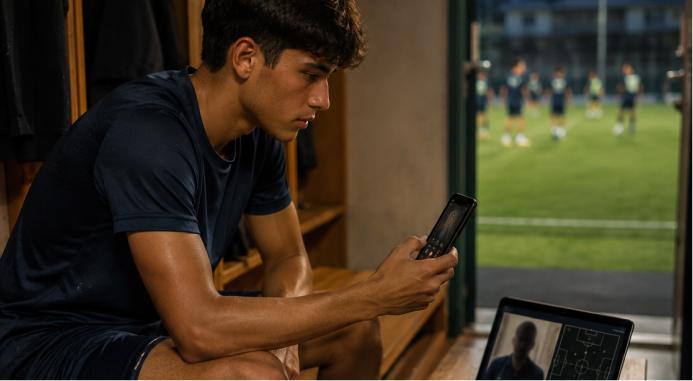
The new national U-19 league has particular value because its players are close to the transition into senior professional football.
The competition is mandatory for Bolivia’s 16 Division Profesional clubs and offers qualification to the 2027 Copa Libertadores U-20.
That provides both national and international incentives.
But the league should also become a permanent scouting environment.
National-team coaches should know which U-19 players are performing consistently.
Senior clubs should know which opponents have prospects worth following.
Federation scouts should be producing comparative positional lists throughout the season.
Instead of waiting for a U-20 camp to determine the best available right backs, the coaching staff should already have months of reports.
The Best Model For Bolivia Is A Hybrid
Brazil’s current approach and the U.S. system solve different problems.
Brazil emphasizes relationships with elite clubs, direct observation and integration between professional academies and national-team staff.
The United States emphasizes scale, regional coverage, structured identification events and continuous monitoring.
Bolivia needs elements of both.
It needs scouts who visit clubs.
It needs regular communication with academy directors.
It needs youth leagues that produce enough matches to evaluate players properly.
It needs a database connecting those observations.
It needs regional coverage.
And it needs an international list for Bolivians developing abroad.
None of those pieces is revolutionary on its own.
Their value comes from being connected.
Bolivia Finally Has Enough Structure To Make Tracking Worthwhile
This is why 2026 represents an important opportunity.
Bolivia now has national youth leagues producing hundreds of official matches.
It has a new Director of Football and Methodology.
It has a U-20 generation preparing for South American competition.
It has a senior national-team project increasingly dependent on younger players.
The next step is to connect those structures through scouting.
Brazil’s staff visiting six clubs before choosing its U-20 squad demonstrates the importance of understanding players inside their daily development environments.
U.S. Soccer shows what happens when those observations become part of a broader monitoring system.
Bolivia does not need six months of seminars to decide which model is superior.
The answer is to combine them.
Watch players where they develop.
Talk to their coaches.
Track them over time.
Compare them against players from other regions.
Keep monitoring those based abroad.
Then use national-team camps as the final stage of evaluation rather than the beginning.
If Bolivia can create that cycle, the benefits will extend far beyond the 2027 South American U-20 Championship.
The federation will begin building something much more valuable: a national talent map capable of following players from youth football toward the senior La Verde that will need them in the 2030 World Cup cycle.