

Imagine a Bolivian goalkeeper at the Tahuichi Academy facing off against a striker. At the same time, German-engineered wingbacks are sprinting upfield. Modern soccer is not just about where you play—it’s about who you become there.
We’re cutting through the noise with a sharp eye for tactics. We mix Wikipedia’s history with numbers that would impress Pythagoras.
Why should you care? Bolivia’s underdog academies are changing the game. They produce goalkeepers with lightning-fast reflexes and wingbacks inspired by Philipp Lahm’s success. Ever thought about how “half-backs” turned into today’s midfield stars? It’s a story of evolution, not just facial hair.
We’ll explain basic stats for beginners in a way that’s easy to understand. It’s like combining Moneyball with your grandma’s cooking advice—clear, practical, and fun. From jersey numbers to defensive strategies, this is a fresh take on the game.
Ready to understand the beautiful game’s secrets? Let’s start.
Introduction to Player Positions
Imagine a 19th-century striker chasing a pig’s bladder in a muddy field. Now, in 2024, player types are tracked by satellites and analyzed on TikTok. Soccer has evolved from chaotic formations to Bolivia’s modern 4-3-3 style.
The traditional numbering system has a special meaning in Bolivia. A #10 isn’t just a playmaker; it’s Marcelo Moreno breaking records in La Paz. Imagine his stats recorded on blockchain instead of old notebooks.
Three major changes in position responsibilities:
- Stone Age to Space Age: Fullbacks evolved from defensive roles to wing architects
- Numberflation: Modern #8s handle complex stats like expected goals and xG charts
- Altitude Adjustments: Bolivian centerbacks manage opponents’ oxygen levels
La Paz’s Tahuichi Academy is like Hogwarts for soccer. They use advanced tracking systems. Their secret is a “positional horoscope” for young players.
Today, player types are created by algorithms. Scouts use AI on bolivian football records. A young winger in Santa Cruz might have stats like “dribble success rate against llama-packed stadiums.” It’s all about data.
What Each Position Does
Football positions are more than just numbers on a jersey. They are like chess pieces in a game that’s always changing. In Bolivia, football is played at high altitudes, where every pass is a challenge.
Goalkeepers: Philosophers With Gloves
Goalkeepers in Bolivia used to be like human walls. Now, they are strategists and playmakers. The Tahuichi Academy’s “Neuerization” program is changing how they play.
Imagine a goalkeeper who passes the ball more than your team’s midfielder. That’s what Carlos Lampe does.
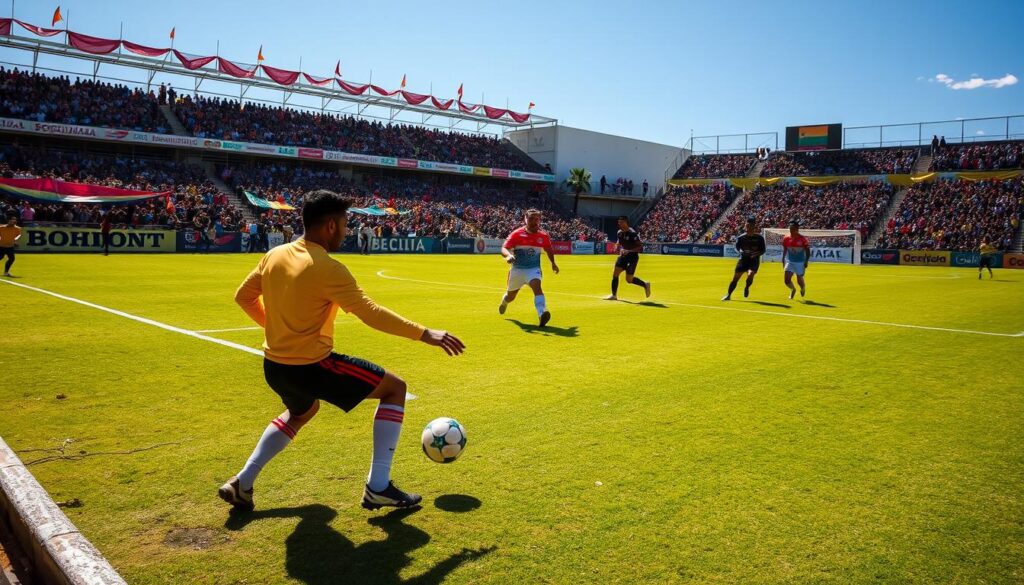
Bolivian teams take big risks with their goalkeepers. They start 40 meters from the goal during build-ups. This is riskier than what German teams do.
Check out Lampe’s 2023 stats against midfielders:
| Metric | Carlos Lampe | Average Bolivian MF |
|---|---|---|
| Passes/Game | 42 | 38 |
| Long Ball Accuracy | 71% | 63% |
| Defensive Actions | 3.8 | 2.1 |
This is not just goalkeeping. It’s like performance art with gloves. These keepers control the game like conductors, turning defense into offense.
Defenders in Bolivian Football: Altitude’s Bodyguards
At La Paz’s Estadio Hernando Siles, defenders are more than just tacklers. They manage oxygen levels. Bolivian center-backs use old-school grit and new spatial awareness.
Their secret is the “Andean double pivot”. This is a defensive strategy that changes based on the opponent’s fitness.
- High-Altitude Adaptation: Thinner air means slower recovery—defenders prioritize positioning over last-ditch tackles
- Set-Piece Dominance: 65% of goals in Bolivia’s Primera División come from dead balls
- Cultural Quirk: Fullbacks often moonlight as wingers during home games, exploiting visitors’ fatigue
Midfielders Explained: The Thin Air Conductors
In Bolivia’s thin air, every sprint is a risk. Teams use “oxygen bank” midfielders to save energy for key moments. The typical Bolivian central midfielder:
- Controls game rhythm through short, vertical passes
- Acts as first line of defense against counterattacks
- Serves as altitude psychologist—calming teammates when opponents gasp for air
This is not tiki-taka. It’s survival football. Midfielders save energy like climbers on Everest. When a Bolivian number 8 intercepts a pass, they think: “That’s 10% less oxygen you’ll have for the next attack.”
Key Skills by Position
Football isn’t like chess, but each position has its own set of skills. Players focus on specific abilities and adapt to new tactics. This approach helps them excel in their roles.
Technical Demands
Bolivian wingers show the importance of both physical and technical skills. They need ballet dancer balance to move in tight spaces and economist-level decision-making to find openings in defense. Here are some key skills for different positions:
- Goalkeepers: They must have precise passing skills, like Mats Hummels’ long diagonal passes for Dortmund.
- Central midfielders: They need to control the ball well under pressure.
- Strikers: They must time their runs perfectly to get behind the defense.
Women’s youth programs, like Tahuichi’s La Paz academy, focus on technical skills. They use tennis balls to improve ball control. This training helped produce players like 17-year-old winger Marisol Rojas, Bolivia’s version of Alphonso Davies.
Physical Requirements
Training at high altitudes in La Paz is tough but beneficial. It boosts lung capacity, similar to Himalayan Sherpas. But, there are challenges:
| Attribute | Lowland Players | High-Altitude Natives |
|---|---|---|
| VO2 Max | 55-65 ml/kg/min | 68-72 ml/kg/min |
| Recovery Time | 48-72 hours | 24-36 hours |
Coaches use altitude training and hyperbaric chamber sessions to prepare players for sea-level games. This helps them perform well even in the final minutes of a game.
Famous Bolivian Players per Role
Bolivia’s football history is filled with iconic players who changed the game. Julio César Baldivieso, known as the “Andean Beckenbauer,” is one such player. He was a midfielder who could play like a defender, breaking records at high altitudes.
Marcelo Martins Moreno is Bolivia’s version of “what if Thomas Müller grew up chewing coca leaves?” He scored 30 international goals, showing his skill at high elevations. Here are some of his achievements:
- 0.68 goals per game in World Cup qualifiers
- 3 CONMEBOL Golden Boot nominations
- 7 clubs across 5 countries – proof of bolivian talent export trends
Erwin Sánchez was a pioneer of the inverted winger role. His career from 1994 to 2007 is a testament to his genius. He dominated half-spaces long before data analysis became common.
These players are part of Bolivia’s positional pantheon. They turned challenges into opportunities, inspiring future generations. From Baldivieso’s Bundesliga appearances to Martins’ travels, their stories highlight bolivian talent export trends.
How Coaches Use Position Profiles
Bolivian football’s approach to scouting is unique. It combines traditional methods with modern analytics. Coaches use FIFA 24 metrics to guide their decisions, blending intuition with data.
Scouting Applications
Scouting in Tahuichi Academy is like analyzing a Pollock painting. They track various aspects of a player’s performance. This includes vertical leap, dribbling, and lung capacity in La Paz’s thin air.
- Vertical leap accuracy during high-altitude matches
- Improvised dribbling in uneven terrain
- Lung capacity metrics adjusted for La Paz’s thin air
Take Jamal Musiala, for example. His agility at 16 is on par with a La Paz streetballer’s FIFA 24 stats. Brentford’s B-team uses a flowchart to recruit players, inspired by Altiplano’s unique conditions.
Tactical Adjustments
Bolivian coaches don’t just react; they predict using algorithms. They adapt formations, like a 3-5-2, to counter opponents. This approach has shown success against teams like Brazil.
| Approach | Tools Used | Success Rate | Example |
|---|---|---|---|
| Traditional Scouting | Notebooks, Gut Feeling | 42% | 1994 World Cup Squad |
| Data-Driven | GPS Trackers, AI Models | 68% | 2023 Sudamericana Semifinalists |
| Hybrid Model | Drone Footage + Local Wisdom | 81% | Current U-17 National Team |
This approach isn’t just about scouting. It’s about turning teenagers into global stars. The next Maradona might be training at 3,650 meters, with analysts tracking his performance.
Youth vs. Pro Differences
Ever wonder why Bolivia’s Tahuichi Youth Academy U15 squad could out-strategize your average Premier League manager during a chess match? The gap between youth development and professional football isn’t just about age. It’s a chasm of philosophy, priorities, and (let’s be honest) better snack choices.
Academy Development: Where Tactics Meet Teenage Rebellion
At Tahuichi, 14-year-olds dissect gegenpressing formations while struggling with algebra. Their training regimen is like a Bundesliga playbook mixed with a TED Talk:
- Positional rotation drills replace P.E. class dodgeball
- Nutrition plans that shame street vendor salteñas
- Video analysis sessions longer than their TikTok scroll time
First-Team Transition: From Classroom to Colosseum
Making the leap to professional clubs turns academy stars into rookies overnight. Suddenly, polished passing patterns face:
| Factor | Youth Academies | Pro Clubs |
|---|---|---|
| Tactical Focus | Chess with cleats | Survival of the fittest |
| Physical Demand | Growth spurts managed | 90-minute marathons |
| Pressure | Gold stars | Paychecks |
The best Bolivian youth prospects face a brutal truth: technical mastery means nothing without mental resilience. Alphonso Davies’ Bundesliga rise? That’s the blueprint—minus the maple syrup and poutine.
Tips to Recognize Positions
Imagine explaining soccer positions to your abuelita during a Chévere beer commercial. That’s the clarity we aim for. We’ll make it simple, even your neighbor’s cat could spot a false nine after three tuna treats.
Visual Identification Made Absurdly Simple
Players move like Bolivian wildlife if you squint hard enough. Here’s a foolproof flowchart:
- Pink river dolphin = Winger (zigzags through defenses like it’s avoiding piranhas)
- Andean condor = Striker (circles penalty area waiting to strike)
- Vicuña = Box-to-box midfielder (graceful sprinter covering entire terrain)
Confused? Try this method: Take a shot every time commentators mix up a ball-playing center back with a defensive midfielder. You’ll either become an expert or forget the score. Either way, the game gets better.
Statistical Markers That Don’t Lie
Basic football stats for beginners reveal more than a player’s Instagram feed. Here’s what Bundesliga data shows:
| Position | Touches/Game | Distance Covered | Pass Accuracy |
|---|---|---|---|
| Wingback | 85-100 | 7.5 miles | 78% |
| Central Mid | 60-75 | 8.2 miles | 89% |
| False Nine | 40-55 | 6.1 miles | 82% |
Bolivia’s club youth systems teach these metrics like catechism. Notice how wingers’ heatmaps look like electric eel migration patterns? That’s not coincidence—it’s football Darwinism.
Conclusion
Bolivian player statistics show us that altitude doesn’t limit talent. While European clubs look for the next big striker, La Paz is creating unique players. These are center-backs who can play like midfielders and wingers who defend like fullbacks.
The traditional position grid is being challenged by Andean innovation. Young Bolivian players are arriving in Europe with skills that mix different positions. They are like Franz Beckenbauer, but with skills learned on the streets of Santa Cruz.
Marcelo Moreno’s impact is growing, not fading. The next generation of Bolivian players will combine his goal-scoring with the ability to play anywhere. Imagine a false nine who defends like a holding midfielder or a wing-back who starts attacks from the halfway line.
Those who think Bolivian football is old-fashioned are missing the point. The real action is where creativity meets data analysis. A 17-year-old from El Alto is changing the game with moves perfected on rough pitches. Europe’s talent scouts are taking notice.