
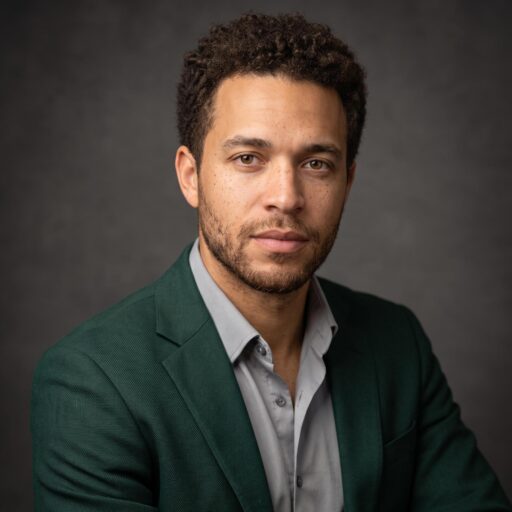
Mauricio Pochettino 2030 has reportedly agreed to remain head coach of the United States men’s national team.
His deal runs through the 2030 World Cup, providing a full four-year international cycle.
Reports published between August 3 and August 5, 2026, said Mauricio Pochettino 2030 would extend beyond his work with the senior national team. His expanded role includes input into youth development, coaching education, and technical coordination across the U.S. soccer system. The arrangement follows the United States’ elimination by Belgium in the Round of 16 of the 2026 World Cup.
For Bolivia, the significance is not that the Bolivian Football Federation should copy every U.S. decision.
The two countries operate with different budgets and player pools.
They also vary in domestic leagues and infrastructure.
The useful lesson is institutional.
A federation must decide whether its coach is managing the next match. This question ties into Mauricio Pochettino 2030.
Bolivia has already chosen continuity by backing Óscar Villegas after La Verde missed the 2026 World Cup in the intercontinental playoff. The challenge is now to turn that public support into a measurable national project extending toward 2030.
Mauricio Pochettino 2030: Evaluation
The Reported Extension Changes The USMNT Debate
Pochettino was appointed by U.S. Soccer on September 10, 2024. This came less than two years before the United States hosted the World Cup with Canada and Mexico. He arrived with experience at Espanyol, Southampton, Tottenham Hotspur, Paris Saint-Germain and Chelsea. That limited international windows prevented evaluating players and installing his methods. Mauricio Pochettino 2030 signals a long-term plan.
The United States produced measurable progress during the 2026 tournament. Pochettino’s team defeated Paraguay and Australia, finished first in Group D and beat Bosnia and Herzegovina 2-0 in the Round of 32. That result made Pochettino the winningest World Cup coach in USMNT history with three tournament victories.
The campaign ended with a 4-1 defeat against Belgium on July 6 at Seattle Stadium. Malik Tillman equalized temporarily with a direct free kick, but Charles De Ketelaere scored twice before Hans Vanaken and Romelu Lukaku completed the result. The announced attendance was 66,925.
According to reports surrounding the new agreement, Pochettino completed his first contract period with an 18-12-1 record. Those results included an appearance in the Concacaf Gold Cup final, a fourth-place finish in the 2025 Nations League and the World Cup Round of 16.
The extension therefore does not reward a perfect cycle. It reflects the federation’s belief that the work completed before and during the World Cup provides a stronger foundation than another coaching change would.
Continuity Is Not The Same As Satisfaction
Keeping a coach after a disappointing elimination can be interpreted as complacency. It can also represent a serious attempt to preserve tactical knowledge, player relationships and institutional progress.
The distinction depends on what happens next.
Continuity has value when a coach receives time to correct identifiable weaknesses. It becomes unproductive when the federation uses “process” as protection from scrutiny.
Belgium exposed several USMNT problems. The Americans conceded only two minutes after Tillman’s equalizer, struggled to protect space when their press was bypassed and generated only two shots on target. Retaining Pochettino means asking him to address those issues rather than pretending the 4-1 loss was irrelevant.
His reported expanded responsibilities also place greater expectations on the federation. If Pochettino influences youth development and coaching education, the success of the agreement cannot be judged only by senior-team results.
U.S. Soccer already operates a national talent-identification structure connecting youth national teams, sporting analytics, coaching education and high-performance departments. Its stated objective is to expand the player pool and give more players an opportunity to be scouted. (U.S. Soccer Talent Identification)

The federation has also developed “The U.S. Way,” a shared technical framework involving youth programming, coach development, infrastructure and talent identification. Pochettino’s longer tenure can now be connected to that broader structure rather than functioning as a separate senior-team project.
Bolivia Has Already Made Its Continuity Decision
Bolivia appointed Óscar Villegas on July 19, 2024, after a difficult beginning to the South American qualifying campaign. His arrival immediately shifted the national team toward a younger player base and produced three consecutive victories that returned La Verde to the qualification race.
Bolivia eventually collected 20 points and secured the intercontinental playoff position. The campaign included the emergence of Miguel Terceros, Moisés Paniagua, Robson Matheus, Diego Arroyo, Lucas Macazaga and other players expected to remain important through the next cycle. Villegas was initially contracted through 2028 with an option extending the project toward 2030.
La Verde defeated Suriname 2-1 on March 26, 2026, at Monterrey Stadium. Paniagua equalized in the 72nd minute before Terceros converted a penalty seven minutes later. Bolivia then lost the decisive playoff final 2-1 to Iraq on March 31, with Paniagua scoring La Verde’s goal. (FIFA playoff tournament review)
Two days after that defeat, FBF president Fernando Costa publicly backed Villegas and said Bolivia’s qualification campaign for 2030 had begun. The message was important because it prevented the playoff loss from producing an immediate emotional dismissal. (FBF support for Óscar Villegas)
| Area | United States | Bolivia |
|---|---|---|
| Head coach | Mauricio Pochettino | Óscar Villegas |
| Appointment | September 10, 2024 | July 19, 2024 |
| 2026 outcome | World Cup Round of 16 | Lost intercontinental playoff final |
| Main continuity argument | Full cycle and broader federation influence | Youth renewal and competitive recovery |
| Core challenge | Convert potential into deeper World Cup progress | Build a team that performs consistently away from altitude |
| 2030 priority | Integrate senior and youth structures | Preserve the young core while expanding national development |
Both federations are therefore making a similar strategic claim: the coach who managed the end of the 2026 cycle should lead the beginning of the next one.
The difference will be found in the resources and systems placed around them.
Bolivia Must Connect The Senior Team To Youth Development
Villegas’ strongest qualification for a long-term project is not simply that Bolivia reached the playoff. It is his previous work with young players.
Before taking charge of the senior national team, Villegas worked within Bolivia’s youth structure. He had also coached Paniagua at Always Ready and gave the midfielder his senior club debut in 2022. That relationship helped Villegas trust the 18-year-old during the playoff against Suriname, when Paniagua entered in the 59th minute and changed the match. (FIFA profile of Moisés Paniagua)
That example illustrates what continuity should produce. A national-team coach who understands the youth pool can introduce players because he knows their development, mentality and tactical education—not merely because public pressure demands
changes.
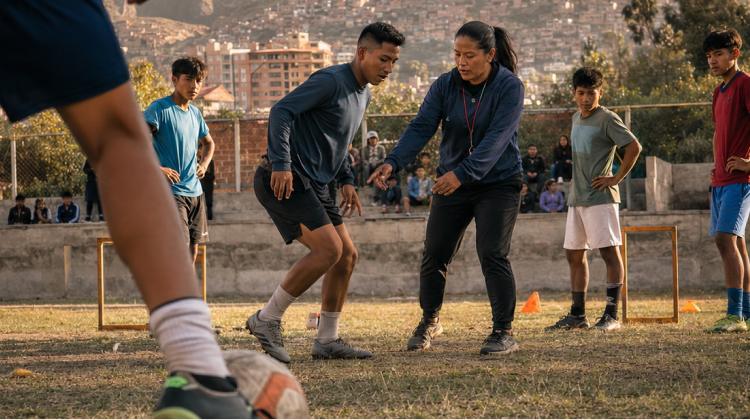
Bolivia now needs to extend that relationship beyond a small group of exceptional prospects.
The senior coach, youth coaches and domestic clubs should use a shared system for evaluating players. Physical data, club minutes, injuries, positional profiles and international performances should be recorded consistently. A player who performs for the under-17 or under-20 team should enter a visible pathway toward the senior squad.
The federation must also avoid reducing youth development to early senior debuts. Selecting an 18-year-old is useful only when that player receives appropriate coaching, physical preparation and competitive minutes afterward.
The Terceros And Paniagua Generation Needs A Stable Framework
Terceros finished South American qualification with seven goals, one fewer than Lionel Messi and level with Colombia’s Luis Díaz. He also scored the goal against Brazil that secured Bolivia’s playoff position and converted the winning penalty against Suriname. (Bolivia’s 2026 playoff squad)
Paniagua scored in both playoff matches at 18 years old. His emergence, combined with the development of Robson Matheus, Gabriel Villamil, Efraín Morales, Lucas Macazaga and Diego Arroyo, gives Bolivia a potentially stronger age profile than it carried into several previous qualification cycles.
Continuity can help those players because they do not need to restart tactically every year. They can learn consistent pressing triggers, buildup structures, defensive responsibilities and set-piece roles.
That stability must not create automatic selection.
Villegas should continue introducing competition around the established young core. A player’s importance during the 2026 campaign should not guarantee his position in 2028 or 2029. Club form, fitness and tactical suitability must remain decisive.
The goal is to build familiarity without creating comfort.
Bolivia Needs Clear Review Points Before 2030
Pochettino’s reported four-year extension does not mean the United States will ignore results until the next World Cup. The USMNT will pass through regional competitions, international windows and squad transitions that allow U.S. Soccer to measure progress. (Bolivian Player Statistics, Records & Rankings Explained)
Bolivia requires the same structure.
The FBF should define formal review periods rather than evaluating Villegas only after a major defeat. Those reviews should examine more than wins and losses.
Important indicators include:
- The number of under-23 players receiving meaningful senior minutes.
- Away results against South American and international opponents.
- Goals conceded during transitions, set pieces and the opening stages of each half.
- The percentage of selected players receiving regular club minutes.
- The number of national-team prospects competing outside Bolivia.
- Tactical consistency between youth teams and the senior side.
- The ability to create chances without depending entirely on Terceros or Ramiro Vaca.
These benchmarks would make continuity accountable. They would also protect the coach from decisions driven entirely by one poor result or a short period of public criticism.
A Shared Methodology Must Outlast The Coach
One of the most important elements of Pochettino’s reported agreement is his expected influence beyond the senior squad.
The United States is attempting to connect its national-team coach with coaching education, talent identification and the professional soccer system. That approach acknowledges that a World Cup team is the final product of decisions made years earlier.
Bolivia needs a methodology that functions even after Villegas eventually leaves.
Youth coaches should not change their entire playing model every time the senior team appoints a new manager. Clubs will always maintain their own identities, but the federation can still establish national principles for technical development, physical preparation and positional education.
The FBF should also expand coaching education beyond the country’s largest professional clubs. Players develop in Santa Cruz, Cochabamba, La Paz, El Alto, Sucre, Tarija, Oruro, Potosí and smaller communities that rarely receive the same scouting or training resources.
A national project must reach those areas consistently. Otherwise, the federation remains dependent on an unusually productive generation appearing by chance.
Continuity Must Improve Bolivia Away From Home
Bolivia’s home advantage will remain an important part of its qualification strategy. Matches in El Alto can place visiting opponents under physical and tactical pressure, and Villegas used that environment effectively during the previous cycle.
The 2030 project cannot be built entirely around altitude.
The loss to Iraq in Monterrey showed how narrow the margin becomes in neutral conditions. Bolivia competed, equalized and remained within one goal of qualification, but conceded near the beginning of both halves. Iraq’s Aymen Hussein scored the decisive goal after halftime.
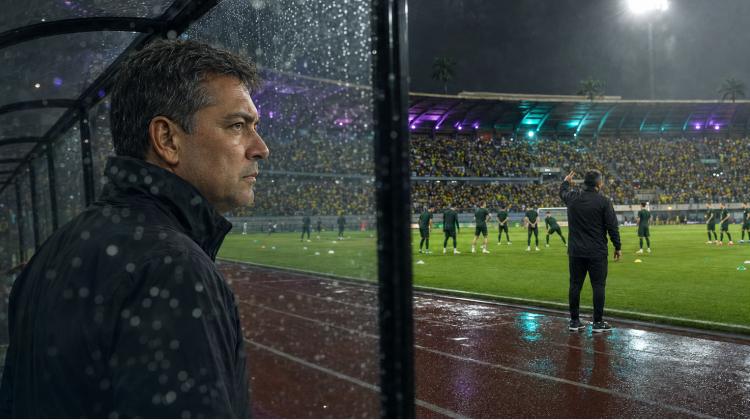
Continuity gives Villegas time to create a more reliable away identity. Bolivia must become comfortable defending in a compact block, slowing matches through possession and choosing when to press rather than attempting to reproduce the rhythm of El Alto in every stadium.
That development should be tested through demanding friendlies and regional competition. Easy victories may improve confidence, but they will not reveal whether Bolivia can control space against faster and more physical opponents.
The federation should therefore judge the next two years partly by the quality of Bolivia’s performances outside the country, even when the final result is unfavorable.
What Bolivia Can Take From The Pochettino Decision
The most useful lesson from the United States is not that every federation should renew a famous coach after a World Cup defeat.
It is that coaching continuity should form part of a larger football structure.
Pochettino reportedly received another cycle because U.S. Soccer believes his work can influence the senior team, youth development and coaching standards. The extension creates stability, but it also expands his responsibility.
Bolivia has already taken the first step by retaining Villegas. The next step is more difficult.
The FBF must provide a coherent calendar, stronger youth scouting, better coach education, meaningful international preparation and transparent evaluation. It must help young players move into competitive club environments while continuing to monitor those who remain in the domestic league.
Villegas should be given enough time to develop the Terceros–Paniagua generation. He should also be held to clear standards involving defensive improvement, away performance and squad depth.
The United States’ reported decision recognizes that two years were not enough for Pochettino to complete an international project. Bolivia should recognize the same reality without treating continuity as an excuse.
A four-year cycle matters only when every season within it produces visible progress.