

Imagine the most amazing sports comeback story, like the ’04 Red Sox. Now imagine it happening 13,000 feet up. That’s what Bolivia’s football squad is doing under Oscar Villegas.
They didn’t just get a new coach; they changed everything. Moving games to the Estadio de Villa Ingenio was a bold move. The thin air became their secret weapon, leading to three straight CONMEBOL wins.
This wasn’t just a streak for Bolivia. It was magic fueled by thin air.
But what happens when reality hits? The injury report is football’s oldest twist. Just as they were finding their footing, injuries started to pile up. Villegas’s plan was at risk.
This isn’t just about who’s not playing. It’s about if momentum can beat misfortune. Can a team built at high altitude keep going with a few injuries?
Positional depth issues
In La Paz, Bolivia doesn’t just play soccer. They use the high altitude and teamwork to make up for lack of star players. This makes their biggest strength also their biggest weakness when injuries happen.
Source 3 highlights the difference. Colombia relies on individual talent, but Bolivia can’t afford that. Their strength is their team system. Coach Villegas’s plan is to keep the pressure high and mentally tough in the thin air.
So, where does it hurt most when Bolivia squad injuries occur? It’s like losing a key player in an orchestra. Some roles in Bolivia’s team are critical, like the conductor.
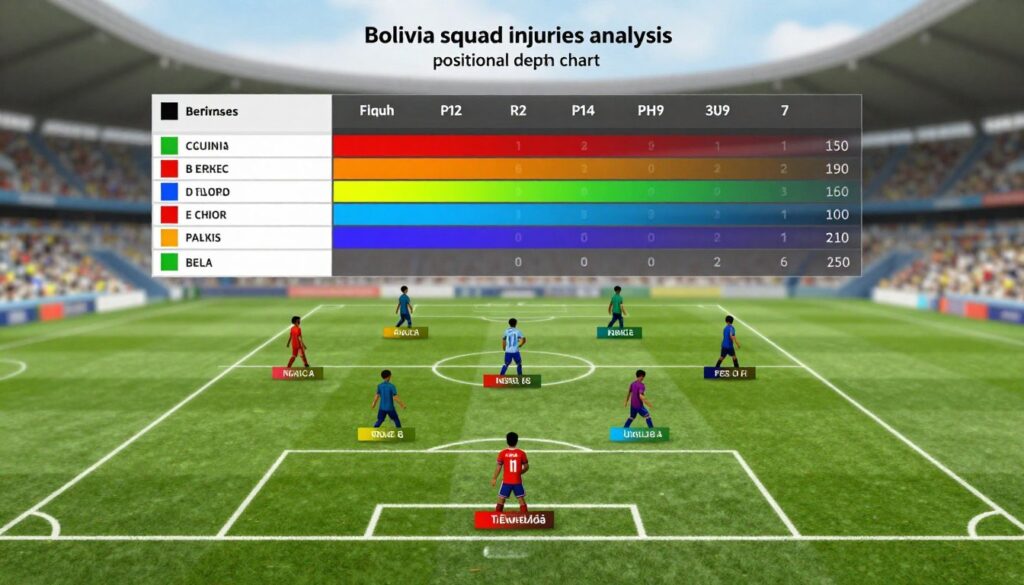
The defensive setup is a key part of Bolivia’s game. It relies on a few experienced center-backs. If they get injured, the team’s defense could be severely weakened.
The midfield is also a key area. Players need to be fit and tough to play at high altitudes. Losing the main midfielder can greatly affect the team’s performance.
Bolivia’s attack also faces challenges. They rely on using opponents’ tiredness to their advantage. If their top winger is out, they might struggle to create scoring chances.
With limited resources, each injury is a big deal. Losing a player can affect the whole team’s strategy. This can lead to a chain reaction of problems.
Are they just one injury away from losing their defensive strength? Yes, that’s possible. This analysis shows how delicate their situation is. Their strategy is to make the most of what they have. But without key players, it falls apart.
The result is clear. While Colombia can rely on individual brilliance, Bolivia needs everyone to perform well. Their injuries can turn into big problems. It’s the cost of building a team that depends on every part working together.
Tactical adjustments
Oscar Villegas is now coaching a team of backups. He changed stadiums to win a psychological battle. But now, he faces a new challenge with half his team.
Soccer, he said, “is made of details.” But what if the most important detail—who is on the field—is out of his control?
This is where coaching really matters. Will Villegas stick to his high-pressing tactics with less-fit players? Or will he adapt for the better of his team?
The “psychological and emotional aspect” he loves has changed. It’s now about inspiring his team to win, not just intimidating opponents.
He must make tough choices. It’s like a Michelin-star chef cooking with Sunday league ingredients. He might choose to sacrifice a forward for an extra midfielder.
Another option is to focus on counter-attacks. This means less intensity and more strategic strikes. It’s a tactical shift born of necessity, not choice.
Villegas wanted to control the details. But now, the details are controlling him. Each change opens up new weaknesses for opponents to exploit.
His chess match starts with many of his best pieces captured. The question is not just about formation but philosophy. Can he win when he’s lost control of the biggest detail?
The answer will define his legacy. Sticking to his plan with the wrong players looks principled. Adapting pragmatically looks smart if it works, cowardly if it fails. This is the harsh reality of the selection impact.
Villegas’s real test is not tactical but psychological. Can he convince himself to change his plan for a chance to save his team?
Selection consequences
So here we are. Sixth place. In the CONMEBOL table, it’s not just a number—it’s a ticket to somewhere. Manager Gustavo Villegas holds a pen over a roster sheet. It looks like a triage report.
Every name he circles is a 30-year dream. The selection impact here isn’t just for one game. It’s for history books.
Call up an untested kid from the reserves? That’s either visionary or risky. Choose a veteran nursing a knock? That’s either loyal trust or sentimental folly. There’s no middle ground.
The grind of South American qualifying forgives nothing. Each decision either builds a World Cup run or breaks it.
This pressure cooker makes every recovery a national event. The saga of a player’s return from a torn ACL at altitude isn’t just medical—it’s strategic. As detailed in reports on Bolivian soccer injury comebacks, the high-stakes rehab calculus directly feeds Villegas’s dilemma. A player rushed back could break again. One held too long might miss the window entirely.
The true selection impact unfolds in the manager’s office, not on the pitch. It’s a quiet drama of risk assessment with a nation’s hope as the stake. Get these calls right, and Villegas becomes the architect of a modern miracle. Get them wrong, and it’s another generation asking “what if?” The most important game isn’t played at 13,000 feet. It’s played in Villegas’s head, with a pen and a very short list of names.