

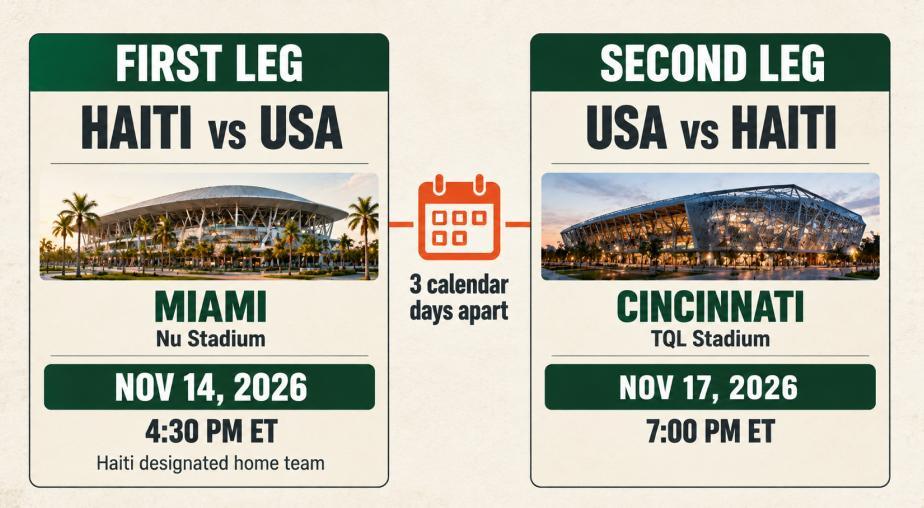
The USMNT–Haiti Nations League quarterfinal has a new setting, and the implications reach beyond travel arrangements. On October 22, 2026, Concacaf announced that Haiti’s first leg against the United States would move from Sabina Park in Kingston, Jamaica, to Nu Stadium in Miami, Florida. Kickoff is scheduled for November 14 at 4:30 p.m. ET.
For Mauricio Pochettino’s team, the relocation creates a series played entirely on American soil. Yet geography alone does not determine which side benefits. Haiti remains the designated home team for the opening match, and the atmosphere could present a different challenge from the one the Americans originally expected.
The key question is how each team uses the changed circumstances. The United States could gain a simpler transition between matches, while Haiti has an opportunity to make its relocated home fixture feel more meaningful to its supporters.
Why The USMNT–Haiti Match Moved To Miami
The decision followed a formal request from the Haitian Football Federation because of the ongoing security situation in Haiti. Under Concacaf’s exceptional hosting arrangement, Haitian teams may receive permission to stage designated home matches in an opponent’s territory.
The measure also extends to Haitian clubs. Each fixture still requires separate approval, the opposing federation’s agreement and a stadium that meets Concacaf requirements. The arrangement remains subject to review.
That distinction matters when assessing the sporting consequences. Miami is an approved solution to Haiti’s hosting difficulties. Its selection does not transfer the first leg’s home designation to the United States.
For Haiti, the immediate task is turning an alternative venue into a competitive base. Familiar routines, clear preparation and a connection with supporters can help a team settle into a stadium outside its own country. Those factors cannot erase the disruption of being unable to host normally, but they can influence how confidently a side approaches the opening minutes.
For the Americans, the sensible response is to prepare for a demanding away-designated fixture, regardless of the address.
Miami Could Give Haiti A Stronger Crowd Connection
The clearest reason to question an automatic American advantage is the potential atmosphere. Haiti’s June friendly against Peru at Nu Stadium drew a sellout crowd of 26,700, according to The Guardian’s reporting.
That precedent does not establish how tickets will be distributed for November’s quarterfinal. It does show why the stadium’s location should not be treated as a reliable forecast of crowd allegiance.
A strongly supportive crowd could help Haiti sustain pressure after a promising attack or recover emotionally after conceding. It could also make the United States work harder to quiet the game through possession and controlled decision-making.

Crowd influence is most useful when it reinforces a coherent approach. If Haiti begins aggressively, the players will still need to coordinate their pressing rather than chase the ball individually. If the team spends long periods defending, maintaining compact distances will matter more than responding to every surge of noise with a risky challenge.
The same principle applies to Pochettino’s players. A loud opening spell should not force hurried passes or unnecessary attempts to settle the contest immediately. Establishing control may require patient circulation, secure first touches and an ability to recognize when an attack should be reset.
Miami could offer Haiti emotional energy. Whether that becomes a sporting advantage will depend on how effectively the team channels it.
A Different Travel Plan, But Limited Recovery Time
U.S. Soccer’s venue announcement confirms that the return match remains at TQL Stadium in Cincinnati, Ohio, on November 17 at 7 p.m. ET. The revised series places the two fixtures three calendar days apart, with both taking place in the United States.
Replacing a Jamaica-to-Ohio journey with a Florida-to-Ohio trip could simplify movement between the legs. That is a practical possibility, rather than evidence of a confirmed training itinerary or a measurable fitness advantage.
The short turnaround still puts recovery near the center of the coaching decisions. Players who cover substantial ground in the first match may have limited time to recover before facing the same opponent again. Substitutions could influence both the immediate score and the condition of the team available in Cincinnati.
This creates a difficult balance. Saving a player for the second leg has little value if the first match becomes unnecessarily complicated. Keeping every starter on the field may also carry a cost if fatigue reduces the team’s ability to press, defend transitions or retain possession late on.
The coaching staff’s challenge is to recognize the demands of the game as they develop. The venue change offers different logistical options; it does not remove the need for careful workload management.
What Pochettino Needs From The First Leg
The most useful objective for the United States is a performance that leaves the team in control of its options for the return fixture.
That starts with the relationship between attacking ambition and defensive positioning. Sending players forward can create overloads, but the players behind the ball must remain close enough to stop an immediate counterattack. Losing possession with both wide defenders advanced would create an avoidable test of recovery speed.
Against a compact defense, the Americans would need to move opponents before forcing the final pass. Quick combinations, changes of direction and runs beyond the defensive line can create openings. Repeated deliveries into a crowded penalty area may produce activity without producing clear chances.
If Haiti presses higher, the problem changes. The United States would need passing options around the ball and attackers prepared to exploit the space behind that pressure. These are possible match scenarios, rather than confirmed tactical plans from either coach.
There is also a broader selection question. Noticiasbo’s examination of Justin Ellis and USMNT striker depth explored the competition developing in the American attack. A quarterfinal asks a different question from a friendly: which combination can create chances while also carrying out the defensive work required by the tie?
The November selections will determine who receives that responsibility. The venue announcement itself provides no basis for assuming a particular starting lineup.
Cincinnati Remains The Decisive Second Setting
When U.S. Soccer selected Cincinnati, it identified this quarterfinal as the USMNT’s first official competition of the 2030 World Cup cycle. Pochettino also emphasized the value of the support his team could receive there.
The order of the fixtures gives the opening match particular importance. A lead would allow the Americans greater choice over how aggressively to begin in Cincinnati. A deficit would increase the need to create chances while guarding against the spaces that open when a team pushes forward.
For Haiti, remaining competitive throughout the first leg would preserve several possible routes through the return match. That does not require a purely defensive approach. It requires judging when an attacking opportunity is worth the risk of losing the team’s shape.
The most revealing indicators in Miami will be the quality of chances created, the protection behind attacks and each side’s response to changes in the score. Possession totals alone will offer an incomplete picture.
The relocation changes the surroundings of USMNT–Haiti, but its competitive value remains available to both teams. The Americans can benefit from a series staged domestically. Haiti can seek a stronger connection with the stands. The side that converts those circumstances into disciplined decisions will be better placed when the quarterfinal reaches Cincinnati.