

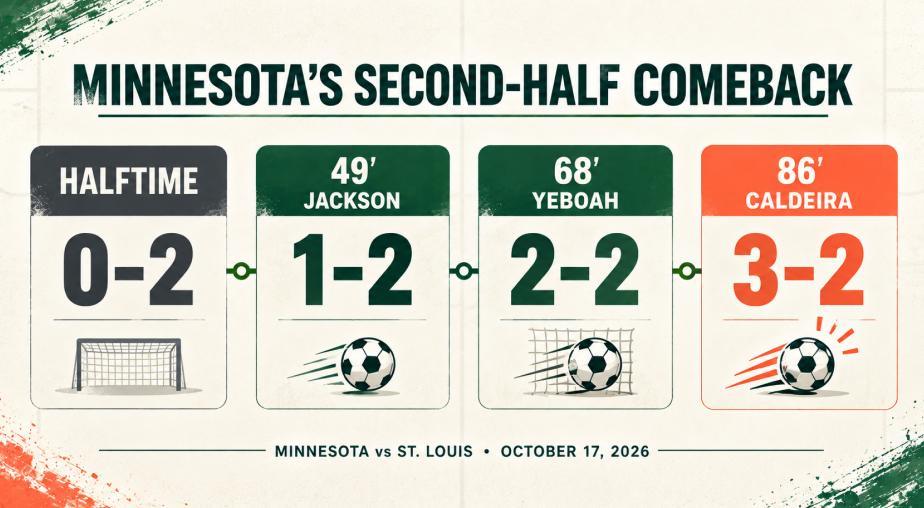
Marcus Caldeira gave Minnesota United a result that changed the mood around its season. His 86th-minute winner completed a 3–2 comeback against St. Louis CITY at Allianz Field in St. Paul on October 17, 2026, ending the visitors’ 19-match unbeaten MLS run. Minnesota had trailed by two goals after just 10 minutes.
The victory restored a possibility that had been slipping away. Minnesota reached 34 points with four regular-season matches remaining, keeping its playoff pursuit alive. It also delivered the club’s first home league win since April 18.
Yet the significance extends beyond one dramatic finish. The Loons received goals from three players, attacking contributions from substitutes and important interventions from their goalkeeper. Turning that combination into a playoff push will require repeating the productive parts of the performance without repeating its disastrous opening.
A Two-Goal Deficit Became A Test Of Minnesota’s Response
Rafael Navarro opened the scoring in the fourth minute, and Sangbin Jeong doubled St. Louis’ advantage in the 10th. Minnesota eventually answered through Aziel Jackson in the 49th minute, Kelvin Yeboah in the 68th and Caldeira in the 86th. The official scoring summary records a comeback built across almost the entire second half.
The timing of Jackson’s goal mattered. Scoring shortly after halftime reduced the deficit with enough time remaining to pursue an equalizer through sustained play. Minnesota did not have to make every possession an immediate attempt at goal.
That distinction is useful when judging the performance. A team chasing two goals can become stretched, leaving too many players ahead of the ball and making the next concession more likely. Recovering one goal early changes the decisions available to the players.
Minnesota’s response demonstrated that it could continue creating opportunities after a severe setback. The more demanding question is whether it can produce that attacking commitment from the opening whistle, when the score is level and the match has not yet become an emergency.
Caldeira’s Winner Adds Weight To His Emerging Role
Caldeira’s decisive contribution came from the bench. He replaced Mauricio González in the second half, then benefited from Joaquín Pereyra’s forward pass to launch the counterattack that produced the winning goal. Minnesota’s match recap describes a run that carried him past converging defenders before he finished from inside the penalty area.
It was another meaningful step for the 22-year-old Canadian forward. MLS reported that the winner was his seventh goal in 12 appearances during the season, following his first Canada call-up in the September–October international window.
Those numbers strengthen the case for giving him responsibility in important moments. They do not settle every selection question. Starting a match against an organized defense presents different demands from entering when opponents are tiring and the game has opened up.
For Minnesota, that distinction can be an advantage. A forward capable of threatening space late in a match gives the coaching staff another way to change the contest. The next assessment should consider his movement, ability to retain possession and combinations with teammates alongside his finishing.
The goal is evidence of growing usefulness. It should be the starting point for evaluating his role, rather than the only measure of it.
The Comeback Had More Than One Attacking Source
Caldeira supplied the final touch, but Minnesota’s recovery depended on several relationships. Yeboah assisted Jackson’s goal before scoring himself from González’s service. Pereyra then provided the direct assist for the winner, with Bongokuhle Hlongwane credited with a secondary assist.
That distribution matters for a team trying to sustain an improvement. An attack becomes easier to defend when every promising possession depends on the same player receiving in the same area. Different creators and finishers force opponents to make more decisions.
The practical task is preserving those connections. The player carrying the ball needs an option nearby, a runner beyond the defense and teammates positioned to contest possession if the move breaks down. Attacking ambition becomes more useful when those movements support each other.
There is also a selection benefit. Contributions from substitutes allow a coach to alter the match without relying entirely on the starting group to solve every problem.
Minnesota should take confidence from the number of players involved. It should then examine which combinations can be reproduced against opponents who defend deeper or offer less space than St. Louis did during the decisive counterattack.

The Shot Totals Support The Recovery, With Limits
Minnesota finished with 26 shots and nine attempts on target. St. Louis recorded 15 shots and six on target. Those figures show that the Loons generated substantial attacking activity rather than relying solely on three isolated finishes.
Shot volume still needs context. A total does not reveal how difficult each attempt was, whether it came under pressure or how frequently a team reached genuinely favorable positions. It cannot establish the quality of an entire performance by itself.
The useful inference is narrower: Minnesota kept asking questions of the visiting defense. Its players continued finding shooting opportunities, giving the comeback more substance than a scoreline alone would reveal.
For the next match, the objective should be to preserve that pressure without assuming that more shots automatically produce more goals. Better positioning before the final pass can be more valuable than an additional attempt from distance.
An attacking review should therefore examine how chances developed. Were receivers facing goal? Did the ball arrive early enough? Were supporting runners available? Those details offer a clearer route to improvement than simply targeting another high shot count.
Drake Callender Helped Keep The Winning Goal Possible
The comeback also depended on preventing St. Louis from restoring its advantage. Minnesota’s report highlights Drake Callender’s double save in the 75th minute, denying Navarro and Mykhi Joyner with the match level. He later dealt with a Rafael Santos free kick as the visitors pursued an equalizer.
Those interventions deserve a place beside the attacking story. A late winner remains possible only if the team survives the dangerous moments that come before it.
There is a warning within that praise. Minnesota cannot build its remaining campaign around repeated emergency saves. The two early concessions left it needing an unusually strong response, and St. Louis still created opportunities after the equalizer.
The first defensive action, the reaction to a loose ball and the tracking of the next runner all require attention. A successful tackle or save does not finish the phase if an opponent remains free nearby.
For head coach Cameron Knowles, the target should be a more stable starting point. Keeping matches level for longer would allow Minnesota’s attackers to pursue a lead rather than spend much of the afternoon repairing damage.
Four Matches Leave Little Room For Another Stall
The later MLS assessment of Caldeira’s winner placed Minnesota five points behind the Western Conference’s ninth and final playoff position, with four matches remaining. That left 12 points available to the Loons.
The arithmetic keeps qualification possible, but Minnesota must gain ground on other clubs. Its own improvement is only part of the equation.
That makes the difference between draws and victories particularly important. A point can preserve a chance, yet a team chasing a substantial deficit needs results that meaningfully close it. Caldeira’s goal changed Minnesota’s return from one point to three, adding two points that could matter in the final table.
The performance should therefore be treated as an opening rather than proof of a completed turnaround. Momentum becomes useful when it changes preparation, decisions and execution in the following game.
Houston Will Test Whether The Improvement Travels
Minnesota’s next league fixture is scheduled at Houston Dynamo FC on October 24, with kickoff at 8:30 p.m. Eastern Time. The MLS match reaction identifies that trip as the next step in the Loons’ postseason pursuit.
The matchup raises a familiar question about balancing attacking quality with defensive control. NoticiasBo’s analysis of Houston’s defensive problems examined how productive forwards still need collective support to turn goals into victories.
Minnesota faces the same requirement. Caldeira gives it a threatening finishing option, and the St. Louis comeback showed that several teammates can contribute. Protecting those contributions requires a better opening phase, coordinated reactions when possession changes and useful outlets when the team comes under pressure.
The victory at Allianz Field preserved Minnesota’s opportunity. The next test is whether the Loons can carry their attacking purpose into an away match while giving themselves less damage to repair.