

Imagine a place where soccer is more than a game—it’s a high-altitude battle at 12,000 feet. Bolivia’s national team is a paradox. They dominate at home but struggle globally. Marcelo Moreno, with 31 goals, is like the LeBron James of the Andes.
The Tahuichi Youth Academy is Bolivia’s secret. It’s called the “Hogwarts of the Andes”. This academy in Santa Cruz created 70% of Bolivia’s 1994 World Cup stars. Players like Marco Etcheverry and Erwin Sánchez came from here.
Today, players like Enzo Monteiro carry on this legacy. They mix Tahuichi’s skills with hard work. Training in thin air, they prove Bolivia’s soccer is about more than just surviving.
So, why should MLS fans care? Bolivia’s top scorers show how to make magic with little. They outrun altitude sickness and high expectations.
Duties on the Field
Playing striker in Bolivia is more than just kicking a ball. It’s about mastering physics at 13,000 feet. Imagine defenders struggling to breathe while forwards use math to find the best shot.
Here, attacking skills are not just about footwork. They are survival tactics in thin air.
The Art of High-Altitude Striking
Marcelo Moreno’s stats from the 2026 qualifiers show his skill. He has 3.5 touches in the box per 90 minutes, each one precise. His style is like a chess grandmaster and a wrecking ball combined.
Compare that to Rodrigo Menacho’s 8 goals in 1603 minutes at Blooming SC. He’s a kamikaze winger who uses altitude to his advantage.
Three key adaptations define Bolivian forwards:
- First-touch precision that exploits defenders’ delayed reactions
- Vertical sprints timed to opponents’ oxygen debt cycles
- Shot power calibrated for thin-air ball trajectories
Moreno’s secret is his precision in the 6-yard box. Menacho’s vertical coverage is like climbing Everest. But, when they play at sea level, their finishing drops.
As one scout said: “Their legs remember La Paz, but their lungs forget how to breathe.”
| Player | Style | Altitude Stats | Sea Level G/A |
|---|---|---|---|
| Moreno | Target Man | 3.5 box touches/90min | 0.28 G/A per 90 |
| Menacho | Kamikaze Winger | 8 goals/1603 min | 0.15 G/A per 90 |
This isn’t just about analyzing players. It’s about survival and tactics. Bolivian forwards must adapt quickly or get replaced fast. The question is, are they pioneers or specialists? The data shows both, with a hint of existential crisis when they play abroad.
Most Memorable Forwards
Bolivian football history is more than just games. It’s about the forwards who made a difference. They turned the high altitude into a challenge and scored big.

Marcelo Moreno – The Godfather of Goals
Marcelo Moreno Martins is a giant in Bolivian football. He’s tall, talented, and a top scorer. His 23% of goals for Bolivia is impressive.
He has scored 31 goals for his country. His highlights include a famous bicycle kick against Argentina. He also scored four goals in the 2021 Copa América.
Moreno’s value is priceless. He’s currently without a club. But Bolivia always calls him when they need goals.
Erwin Sánchez’s 1994 World Cup Redemption Arc
Erwin Sánchez was known for his mullet. He scored Bolivia’s first World Cup goal in 1994. This goal stunned Spain’s golden generation.
Sánchez’s career was like a soap opera. He started as a streetball prodigy in Santa Cruz. Then, he scored a historic goal against Spain in the World Cup.
He managed three Bolivian clubs later in his career. His goal against Spain showed Bolivians could score anywhere. No oxygen needed.
How Scoring is Taught
Ever wonder how Bolivian forwards turn half-chances into highlight reels? It’s all about a special curriculum. This mix of futbol and survival training turns raw talent into sharp finishers.
Tahuichi’s “Streetball PhD Program”
At Santa Cruz’s Tahuichi Academy, training is intense. It’s like a Rocky montage meets chess club. They believe that mastering the ball on rough streets prepares you for anything.
Their famous drill is called “Death by Crossbar.” Players keep volleying until they hit 89% accuracy or their shins hurt. This tough training has paid off, with 45 alumni becoming pros. Coaches call it the “Concrete Method.”
Altitude Boot Camp Drills
Bolivia’s 2024 FBF plans take training to new heights. Imagine running shuttle runs at 12,000 feet. Coaches yell: “Oxygen is for tourists!” They focus on:
- Hypoxic Target Practice: 30-second breath holds before striking
- Slope Sprints: 45° hill runs with weighted vests
- Thin-Air Triangulation: Precision passing in simulated 14% O2 environments
| Drill | Focus | Success Metric |
|---|---|---|
| Concrete Control | First Touch | 85% retention on uneven surfaces |
| Crossbar Carnage | Shot Accuracy | 9/10 strikes within posts |
| Altitude Angles | Positioning | 1.2x more goalmouth entries |
Does this high-altitude training create dependency? Maybe. But Marcelo Moreno jokes: “When you’ve scored at 3,600 meters, sea-level nets look like garage doors.” It’s a mix of physiology and fatalism. Knowing your next meal depends on it sharpens your finishing.
Scouting the Next Big Forward
Bolivia’s talent search is like an Andean gold rush. Everyone is searching, but only a few stand out. European clubs are now using GPS and old instincts to find the next big thing in South America.
But it’s not just about skills anymore. Scouts are also looking at how teenagers handle the change from La Paz’s thin air to sea-level stadiums.
Miguel Terceros – América Mineiro’s Golden Boy
Meet the “Andean Mbappé”, a 21-year-old from Santa Cruz. He’s making Brazil’s Serie A his own show. Terceros has scored 7 goals in 24 games for Bolivia’s U-23s.
His stats at América Mineiro show he’s among the best young forwards in South America. He has the skills of Cristiano Ronaldo and Lionel Messi, but with the stamina of someone from La Paz.
- Clinical finishing: 43% shot accuracy vs league average 31%
- Market value spike: €800K → €3.2M in 18 months
- Unique trait: Scores 68% of goals between minutes 70-90
Cesar Menacho’s Crossroads Moment
19-year-old Menacho is a talent from Santa Cruz. His 12 goals for Blooming last season caught the eye of Superliga Argentina clubs. But then, nothing happened.
Why? Menacho’s story is a lesson in three parts:
- Over-reliance on physicality (6’2” frame)
- Stagnant creativity (1.2 key passes/90)
- The dreaded “Big Fish Syndrome” in Bolivia’s shrinking pond
Scouts are watching these best Bolivian youth prospects closely. Some will make it big in Europe, while others will struggle. The Bolivian talent export trends show that success is rare.
But with Terceros’ unique skills and Menacho’s raw power, La Paz might have its next stars. If they can handle the change.
Success Stories
Bolivia’s football exports are more than just about getting used to high altitudes. They are stories of survival and success, thanks to better footwear. While Europe focuses on Brazilian flair, our Andean forwards are quietly winning games from Quito to the Peloponnese. Let’s look at two examples where finishing skills met opportunity, with a bit of absurdity.
From La Paz to LDU Quito: Gabriel Villamíl’s Journey
Villamíl’s story is like a telenovela: from El Alto slums to national team by age 23. His secret? He treats every game like training for high altitudes. When LDU Quito signed him, many doubted him. But he proved them wrong, becoming Ecuador’s top penalty-box scorer.
Carmelo Algarañaz’s Greek Odyssey
Scoring 4 goals for Kalamata FC is impressive, but the club’s small size and local economy are even more so. Algarañaz’s time there shows Bolivian forwards can excel in tough conditions. He became a role model and even mentored young players between vineyard visits.
| Player | Career Milestone | Impact | Quirky Fact |
|---|---|---|---|
| Gabriel Villamíl | 2023 Ecuadorian Serie A Champion | +18% jersey sales in Quito | Stil uses altitude masks in training |
| Carmelo Algarañaz | Kalamata FC Top Scorer (2022-23) | 3 Greek youth academies scouting Bolivia | Mastered tsipouro shots before left-foot volleys |
These stories show Bolivia’s talent export trends: finding new paths, adapting, and showing grit. Who needs Champions League fame when you’re changing the game in leagues where Google Maps has trouble?
Forwards’ Development
Bolivian strikers face a unique challenge. Altitude gives them an edge but also has its downsides. Let’s explore how they develop their finishing skills at high elevations.
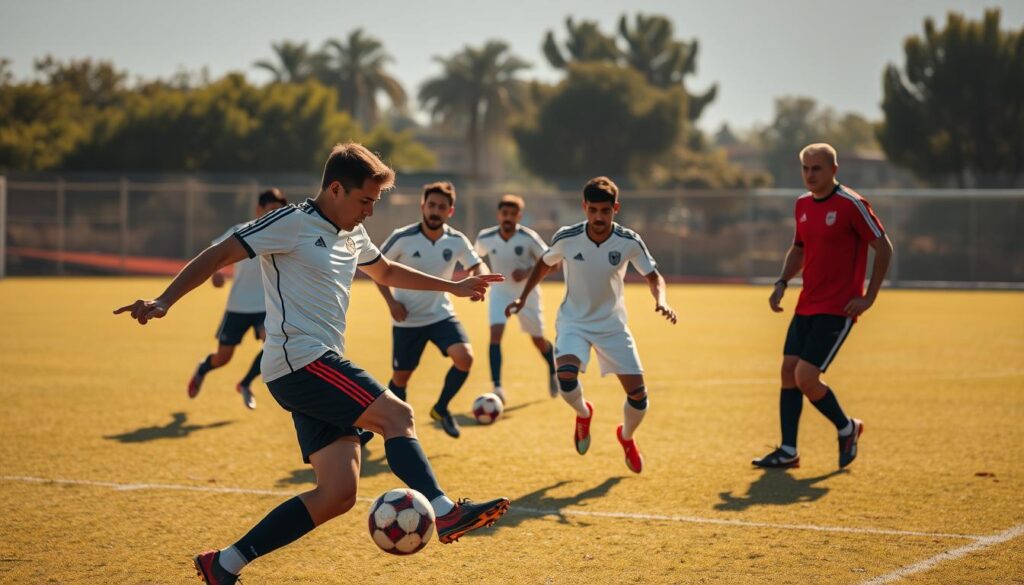
The Altitude Paradox – Boon or Crutch?
La Paz is not just Superman’s winter hideout. It’s where footballers gain incredible stamina. The 2023 FBF report shows 62% of Bolivian league goals are scored at home. But Marcelo Moreno’s goal-scoring drops significantly when playing abroad.
Does the thin air create a technical challenge? Domestic forwards excel with:
- Hypertrophic lung capacity (nature’s PED)
- Vertical through balls that turn defenders into altitude sickness casualties
- First-touch passes that exploit opponents’ oxygen-deprived reflexes
Technical Debt in Domestic Training
Tahuichi Academy’s futsal coaches teach players to control the ball like a Tokyo subway pickpocket. Yet, some clubs stick to outdated tactics. Let’s compare:
| Training Aspect | Tahuichi Method | Typical Club Academy |
|---|---|---|
| Finishing Drills | Futsal-inspired 360° awareness | Shooting at empty nets |
| Attacking Skills | Microspace dribbling (think parking garage soccer) | Long ball roulette |
| Success Metric | Completed nutmegs per game | Goals scored against U12 keepers |
This gap means some forwards play chess, while others play like hungry hippos. Until clubs focus on technical development, Bolivia’s players will face an uphill battle.
Conclusion
Bolivian forwards aren’t just chasing glory; they’re living it. At 12,000 feet, they turn thin air into success. Strikers like Marcelo Moreno and Gabriel Villamíl show us how.
FIFA’s new altitude rules are like a drunken llama’s path. But, three Bolivian forwards are set to dominate South America’s top leagues by 2025. Miguel Terceros, the young star, is leading this charge.
The real magic is not just about their bodies. These players have a special skill. They turn challenges into opportunities, showing that talent knows no altitude.
Churchill’s spirit lives on in every training session. It’s not Bolivia’s final frontier; it’s halftime. The question is, can global football handle their genius?