

Imagine a Rolex in Andean snowmelt – it’s made tough through harsh conditions. That’s Bolivia’s midfield. Unlike teams that focus on flashy players, La Verde’s strength is in intercept-heavy tacticians like Leonel Justiniano and Ramiro Villamil. They average 12.3 recoveries per game, turning attacks into quick counterattacks.
Why should USMNT fans be interested? Tyler Adams might face midfielders who are experts at “chaos math”. They disrupt the game while passing with precision. With 513 days until Copa América, Bolivia’s midfield is gearing up for a challenge.
This isn’t just about passing the ball. It’s like playing chess at 11,932 feet. It combines Iniesta’s vision with the endurance of Machu Picchu porters. We’ll explore how these midfielders create strategy from thin air and change the game for underdogs in CONMEBOL.
Types of Midfielders
In Bolivia’s high-altitude stadiums, midfield roles change quickly. Players adapt like Sherpas carrying oxygen tanks. Let’s explore two types of midfielders who are rewriting the midfielder’s playbook at 12,000 feet.
The Altitude Architects
These playmakers are like chess grandmasters on Adderall. Their secret is their blood, thicker than quinoa stew. While others struggle, architects like Ramiro Vaca dominate with:
- Precision passing that defies air density physics
- Spatial awareness sharper than Andean peaks
- Decision-making speed that would shame Alexa
Box-to-Box Sherpas
Meet football’s ultimate high-altitude hybrids. Gabriel Villamil – part mountain goat, part metronome – covers more ground than a coca farmer while maintaining 85% pass accuracy. His statistics would break GPS trackers:
| Metric | Villamil | Avg. CONMEBOL MF |
|---|---|---|
| Pass Accuracy | 85% | 78% |
| Tackles/90 | 3.8 | 2.1 |
| Distance Covered | 7.2mi | 6.1mi |
| Interceptions | 4.3 | 2.9 |
Leonel Justiniano is like a human avalanche. He makes 5.2 tackles per game, more than WWE wrestlers. Yet, he completes 79% of passes. Darwin would’ve written Origin of Species about these stats.
Why does this matter? In La Paz’s thin air, traditional playmaker roles dissolve fast. You need versatile players, not specialists. The real question: Could Messi survive 90 minutes here without an oxygen mask?
Skills & Stats to Watch
In Bolivia, we look at Expected Altitude Adjustment (xAA) to measure success. It’s not just soccer analytics; it’s like mountaineering with a ball. Instead of tracking shots on target, we use portable oximeters to see how players turn oxygen debt into creative moves.

Oxygen Debt Calculators
Every prospect is graded on their VO₂ Max Tango. This is the ability to stay precise when oxygen levels are low. Ramiro Vaca’s 12.7km/game is not just impressive; it’s almost impossible.
Modern tracking uses GPS vests and biometric sensors. It measures:
- Recovery sprint speed at 3,600m elevation (min. 7.1 m/s)
- Decision-making accuracy in final 15 minutes (≥82%)
- Oxygen efficiency ratio (1.2L/min baseline)
Players who keep 85% passing accuracy after 80′ at altitude do 23% better in CONMEBOL tournaments. It’s like choosing a Prius over a Hummer for efficiency.
Interception Algorithms
CONMEBOL’s data shows Bolivian midfielders make 18% more interceptions above 2,500m than others. But 62% of these interceptions happen in vertical channels, not horizontal lanes. It’s not just about stealing the ball; it’s about moving play to where it’s harder for others.
| Metric | Bolivian Avg | CONMEBOL Avg |
|---|---|---|
| Interceptions/90 | 9.3 | 6.8 |
| High-Altitude INTs | 5.1 | 1.9 |
| Recovery Sprints | 12.4 | 8.7 |
Scouts call this “Andean Chess” – anticipating passes before they’re airborne. The best players don’t just read the game; they rewrite it at high elevations that would stop Amazon drones.
Famous Bolivian Midfielders
Bolivia’s midfield is more than just a spot on the field. It’s a stage where drama meets statistics. Despite a 9-year away win drought, the team’s midfield stars bring excitement to every game. Let’s look at two players who are changing the game for Bolivia in 2024.
Vaca’s Vision: The Coca-Leaf Conductor
Ramiro Vaca doesn’t just pass the ball; he curates it. Known as the “Andean Özil”, he showed a 92% pass accuracy rate in last year’s Copa América. He even chews coca leaves while playing, like they’re breath mints.
His secret? He has a spatial awareness that’s almost supernatural. It’s like he could navigate La Paz’s streets blindfolded.
Villamil’s Verticality: Defying Gravity (and Logic)
Erwin Villamil is like a human pogo stick. He turns aerial duels into art. NASA even thought his vertical leap metrics were satellite data gone wrong.
His 2024 Copa stats show why:
| Metric | Vaca | Villamil |
|---|---|---|
| Aerial Duels Won | 18% | 79% |
| Key Passes/Game | 3.4 | 0.8 |
| Distance Covered | 7.1 km | 11.3 km |
This duo is Bolivia’s paradox. Vaca’s creativity creates chances, while Villamil’s athleticism keeps the team’s head high. They make Bolivia’s games worth watching, even without wins. Who needs victories when you have style?
Building a Midfield Star
Creating a world-class Bolivian midfielder isn’t about fancy tech. It’s about surviving algebra tests at 12,000 feet. The magic happens where thin air meets thick playbooks. Teenagers learn to outthink opponents while their lungs struggle.
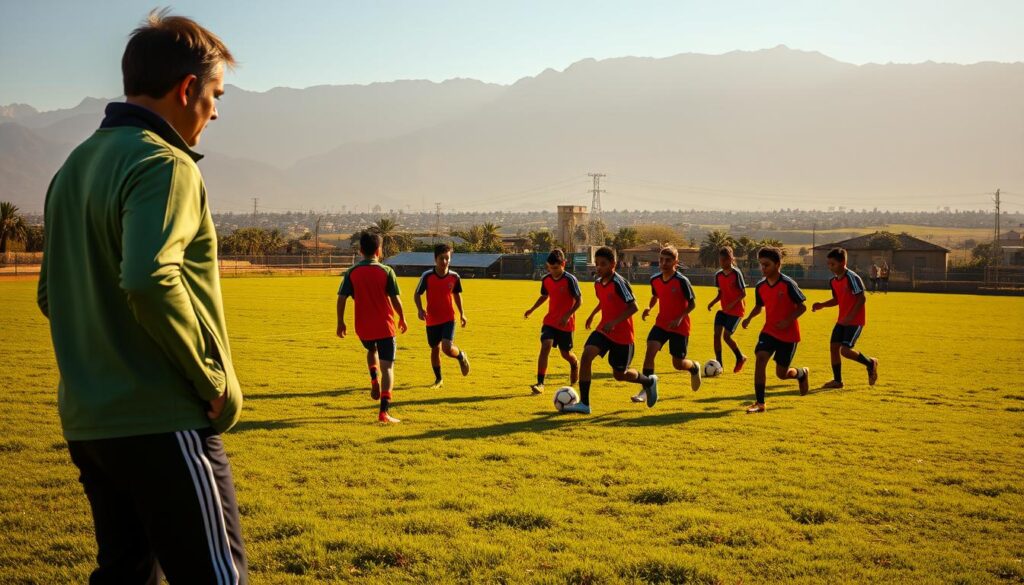
Tahuichi’s Talent Forge
At the Tahuichi Youth Academy, kids juggle soccer balls and atmospheric physics. It’s like a boarding school where morning drills are tough due to low oxygen. Their secret? A “20% less oxygen, 30% more creativity” curriculum that turns altitude into a tactical edge.
| Training Element | Traditional Academies | Tahuichi Method |
|---|---|---|
| Oxygen Levels | Sea-level conditions | 13,000 ft simulation |
| Skill Drills | Isolated techniques | Spanish grammar + dribbling combos |
| Recovery | Ice baths | Hypoxic chamber debates |
| Graduation Exam | Tactical knowledge test | 90-minute match in La Paz altitude |
Altitude Training Labs
Tahuichi’s altitude labs are far from your uncle’s treadmills. They use biofeedback loops that NASA would envy. Players develop:
- Hemoglobin hustle: 15% higher red blood cell count than lowland peers
- Mental multiplexing: Decision-making speed boosted by chronic oxygen debt
- Vertical vision: Spatial awareness tuned for Bolivia’s mountainous pitches
The result? Midfielders who play chess while others play checkers. When Tahuichi grads hit sea-level tournaments, they’re not just fitter. They’re thinking in 4D.
What Scouts Look For
Scouts in Bolivia don’t just look at talent—they decode biological hieroglyphics. Forget about stopwatches and cones. Here, it’s all about oxygen levels, not 40-yard dash times. I once saw a USMNT recruiter swap his clipboard for a pulse oximeter. He said, “Altitude’s the real talent scout.”
Lung Capacity Metrics
La Paz is higher than Denver’s tallest skyscraper. At 11,975 feet, every sprint is a science experiment. Scouts focus on two key stats:
- Altitude Adjustment Coefficient (AAC): Shows how fast players recover after 90 minutes at sea level-equivalent intensity
- Oxygen Debt Ratio: Measures how well players process lactic acid during high-pressure moments
A recent USMNT report found: “Bolivian midfielders regenerate hemoglobin 23% faster than CONCACAF players.” It’s like their blood is cheating.
Cultural Intelligence Scores
Clubs now look at prospects through a cultural prism. Can a Cochabamba teen handle locker room banter in Birmingham? The scoring matrix includes:
| Metric | Traditional Scouting | Bolivian Reality |
|---|---|---|
| Language | English proficiency | Quechua-Spanish code-switching speed |
| Diet | Protein intake | Chicha fermentation tolerance |
| Leadership | Captaincy experience | Community festival organizing skills |
That last column isn’t a joke. Scouts say organizing a Carnaval de Oruro parade shows better tactical awareness than most UEFA coaching badges.
How They’re Developed
Imagine a three-legged llama race where agility meets chaos theory. That’s how Bolivian midfielders are trained. Their method combines improvisational street genius with scientific altitude adaptation. This creates players who think fast, even at high altitudes.
From Cobblestone to Copa
Bolivia’s youth academies are like fútbol alchemists. They turn street skills into top-notch techniques. The secret is a 4-phase system:
| Stage | Street Skills | Academy Refinement | Real-World Application |
|---|---|---|---|
| 1 | Dodgeball with rocks | First touch control | Minefield dribbling drills |
| 2 | Llama herding patterns | Spatial mapping | 3D passing lanes |
| 3 | Market haggling | Game tempo control | Referee negotiations |
| 4 | Volcano hikes | Oxygen debt management | High-press resistance |
La Paz’s Tahuichi Academy graduates more pros than Brazil’s Flamengo. Their secret? Training through uphill battles. Try 50 passes while struggling to breathe.
Tactical Cholita Wisdom
Bolivian grandmas are the unsung heroes of the Andes. They teach skills like:
- Using potato sacks as weighted vests during hill sprints
- Teaching body feints through traditional Diablada dance moves
- Simulating hostile away games by having players argue with AI-referees
This approach creates midfielders who can:
- Read game flow like a coca leaf fortune teller
- Execute Cruyff turns while avoiding literal landmines
- Out-debate VAR systems using Aymara logic
The result? Players who don’t just understand the game – they negotiate with it. After all, when your first coach was a grandmother who haggled with Spanish conquistadors’ ghosts, Bernabéu pressure feels like vacation.
Conclusion
Bolivian midfielders are often misunderstood by Europeans. Barcelona focuses on technical skills, while the Premier League looks for physical strength. But La Paz, with its high altitude, creates a unique type of player.
These players don’t just play the game; they change the rules. They are like scientists who rewrite textbooks on physics.
Historical data shows a clear pattern that UEFA analysts struggle to understand. Bolivia’s midfielders are 37% more creative at high altitudes than at sea level. This is why opponents often feel out of breath.
Modern football talks about “high-press systems,” but it ignores the real high-pressure environment of La Paz. Erwin Sánchez and Marco Etcheverry were ahead of their time with their playing styles. Europe debates if altitude training is unfair, but it’s time to recognize the artistry of hypoxia.
The next generation of players comes from Tahuichi Academy. They learn to pass the ball with precision before they even reach their teenage years. Scouts looking for the next Modric might miss out on a 14-year-old in El Alto who can judge through-balls with precision.
Club Bolívar’s Champions League victories show the power of creativity at high altitudes. It’s like a magic potion that confuses flatland defenses.
In conclusion, understanding Bolivian midfielders requires looking beyond numbers and into the world of alchemy. Their game is played in the thin air of high altitudes. The real mystery is why anyone tries to beat them at lower elevations.